

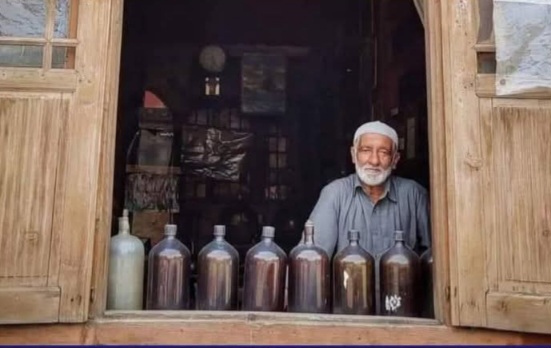
Ziraat Times Team Report
Srinagar: Tucked in a narrow bylane near the historic Khanqah-e-Moula shrine in Old Srinagar, there lies a humble, unassuming shop. Its wooden façade and modest signage betray no clue of the centuries-old heritage that quietly breathes within. Step closer, and the delicate aroma of rose water, sandalwood and musk welcomes you into a world that is fast fading – except for one man who refuses to let it go.
Meet Abdul Aziz Kozgar, Kashmir’s last remaining traditional rose water maker. A frail but determined figure in his 70s, Aziz Sahab runs the ‘Arq-i-Gulab Dukan’, a shop that has been producing natural rose water and herbal extracts for more than a century, carrying forward a legacy that dates back almost 400 years.
“We are known as Kozgars, meaning extract makers,” he says, his voice wrapped in the calmness of one who has made peace with both heritage and solitude. “This art came from Turkey to Kashmir through the routes of Central Asia, and my family has kept it alive for generations.”
Unlike the commercially bottled varieties, Kozgar’s rose water — or Arq-e-Gulab — is distilled using traditional methods from real Kashmiri roses grown in the Valley. The petals are carefully cleaned, placed in large copper vessels (deg) with water, and slowly distilled over firewood in a painstaking process that can take hours.
The result? A potent, chemical-free essence used not only in rituals and beauty regimes, but also in medicine, healing, and emotional wellness. In old Kashmir, a few drops of rose water in the eyes were believed to cure strain; a splash on the face, to restore tired spirits; a whiff, to calm the anxious heart.
Aziz’s shop also stocks other herbal extracts—Arq-e-Sandal, Arq-e-Kewra, Arq-e-Darchini (cinnamon), and even rare Arq-e-Musk—all used for their therapeutic and traditional value. Customers who still visit his shop often come with age-old prescriptions handed down by grandmothers and Hakims.
“These are not perfumes,” he clarifies. “They are shifa remedies. That is how our ancestors saw them.”
A tradition in decline
But this art is on the brink.
The younger generation, he says, is drawn to other pursuits —technology, trade, migration — and have little patience or economic incentive to continue a craft that requires such dedication for such modest returns.
“I am standing at the last wicket,” he says, half smiling. “When I’m gone, this shop might close. There’s no one after me.”