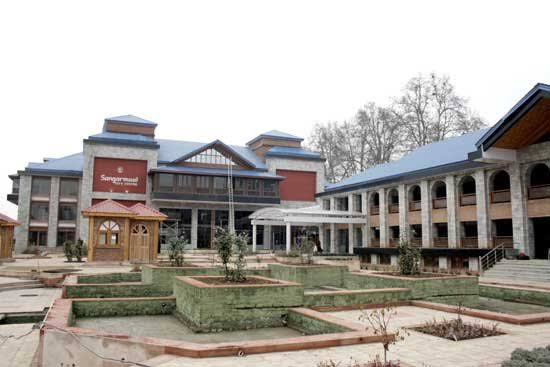
Whenever I drive from Partap Park towards Nowhatta, one sight on my right continues to puzzle me — the Sangarmal Shopping Complex. Ideally located just a few hundred meters from Srinagar’s central commercial spine, Residency Road, this building should have evolved into a bustling urban magnet. Yet, it stands curiously still, far removed from the vibrant hustle one would expect from a complex in the heart of the city.
A few years ago, a friend of mine, Shaikh Feroz, a seasoned hospitality professional, launched the Seven Seas Restaurant within Sangarmal. The setup was promising — master chefs, ambient dining, weekend buffet packages. I recall envying those well-curated dinners and the creative energy the initiative brought into the complex, albeit briefly. But it didn’t last. Today, the space feels silent. Sangarmal is rarely on the itinerary of women shoppers, who traditionally drive the retail economy and social spaces in Kashmir.
Nestled in the heart of Srinagar, the Sangarmal City Centre Complex was once envisioned as an example of modern urban development in the Kashmir Valley. Conceived to merge shopping, entertainment, and administrative activity into a single, bustling hub, Sangarmal was expected to transform the region’s commercial landscape. However, in recent years, questions have surfaced about its business viability, with many suggesting that the complex is struggling to attract and sustain commercial activity. This article examines the factors that may have contributed to the current state of Sangarmal, analyses the challenges, and explores ways to revive its relevance.
Why did such a well-positioned shopping complex fail to thrive? From conversations with several retail business owners and mall operators across Srinagar, a few insights emerged. Many pointed out that Sangarmal lacked the commercial curation and management culture essential for sustained retail success. Unlike newer malls, where brand selection, seasonal promotions, weekend events, and family-oriented activities are strategically planned, Sangarmal has largely functioned as a static property with no real attempt at evolution. Business owners described it as a place where, after the initial buzz, neither the administration nor the tenants invested in experience-building. There’s no footfall strategy, no festive calendar, and certainly no anchor stores or entertainment features that compel return visits. As one of them put it: “It looks like a mall, but it never functioned like one.”
The Sangarmal Complex was conceived by the Jammu & Kashmir Housing Board as a modern response to Srinagar’s growing urban needs. Its strategic location on MA Road, proximity to major government offices, and promise of state-of-the-art amenities made it an attractive proposition for both investors and consumers. The plan was ambitious — a blend of retail outlets, entertainment spaces, office areas, restaurants, and parking facilities, all wrapped in contemporary architecture. The hope was that Sangarmal would not only serve as a shopping destination but also as a social and administrative hub for locals and tourists alike.
When the complex first opened, there was palpable excitement. Major brands and local enterprises leased shop spaces. Food courts and cafés were expected to attract youth and professionals. The ample parking and secure environment provided a welcome alternative to the congested, chaotic traditional bazaars of Srinagar. For a brief period, Sangarmal succeeded in capturing public interest. Families visited on weekends, couples strolled through its polished corridors, and office-goers found convenience in its eateries and services. The complex, at its zenith, appeared to fulfil its original vision.
Yet, within a few years, cracks began to appear in Sangarmal’s success story. Several factors may have contributed to its faltering business fortunes. Kashmir has long been plagued by political uncertainty. Frequent shutdowns, curfews, and civil unrest have had a direct impact on commercial activity. Sangarmal, though centrally located, often had to shut down during such periods. The unpredictability of the environment discouraged both consumers and investors.
Consumer preferences were also changing. The rise of e-commerce and online shopping began to lure customers away from physical malls. In Kashmir, the convenience of online ordering, especially during times of unrest or bad weather, became an attractive alternative. Shopkeepers privately shared that, despite its central location, Sangarmal struggled with issues of access. Traffic congestion on MA Road, inadequate public transport, and waterlogging during heavy rains created further obstacles. The perception that the complex catered only to an elite clientele deterred wider footfall. Unlike successful malls in other regions, Sangarmal failed to host regular events or maintain public engagement. The absence of flagship or anchor stores further weakened its appeal. Over time, the ambience suffered, and as businesses closed, shuttered shops painted a picture of decline — creating a downward spiral of waning interest.
A combination of factors likely accounts for Sangarmal’s stagnation: design oversight, market disconnect, and planning fatigue. Commercial success in urban spaces depends not just on geography, but on experience. While Sangarmal enjoys prime accessibility, it lacks the features that make a space inviting and repeat-worthy — reliable parking, curated retail, family-friendly zones, and, above all, a sense of vibrancy. In the absence of sustained engagement, footfall dwindled, shops closed, and visitors stopped coming. A structure meant to symbolize modern downtown Srinagar faded from public memory.
Compare this with new commercial hubs emerging at City Mall Lal Chowk, Nirman Complex Hyderpora, or along the bypass — where better zoning, cleaner environments, and integrated leisure options are consciously built. These places attract not just consumers, but communities. Urban spaces thrive when they become part of the city’s emotional fabric, not just its concrete layout.
Sangarmal didn’t lose relevance entirely because of its location. It faltered due to a lack of imagination, poor continuity of vision, and a disconnect between civic infrastructure and cultural behaviour. However, it’s not too late. The Sangarmal Complex can still be revived — but not through isolated shop rentals or one-time launches. It needs reimagination as a community-centric urban space — a curated blend of retail, dining, arts and culture, workshops, and civic services. City planners and stakeholders must treat it not as a dead investment, but as a dormant asset. Think cultural festivals, heritage craft zones, food haats, children’s libraries, exhibition corners, even municipal services — all brought under one roof. Most importantly, the complex must be made inviting to women, senior citizens, and families.
If Srinagar is to grow as a city of heritage with modern aspirations, we cannot afford to let prime urban infrastructure fall into disuse. Sangarmal deserves a second life, not just as a commercial address, but as a reflection of what thoughtfully planned urban renewal can achieve in Kashmir. In a city blessed with aesthetic and cultural heritage, a space like Sangarmal deserves revival — not abandonment. A joint task force comprising urban planners, marketing strategists, retail experts, and municipal authorities must be constituted to engage directly with shop owners, tenants, and potential investors for a strategic reimagining of sustainable business.
To breathe new life into this vital urban space, we need a collaborative approach.
Dr. Fiaz Maqbool Fazili is a medico and civic writer known for his commentary on healthcare systems, ethics and urban development. He can be reached at drfiazfazili@gmail.com.


Comments are closed.