

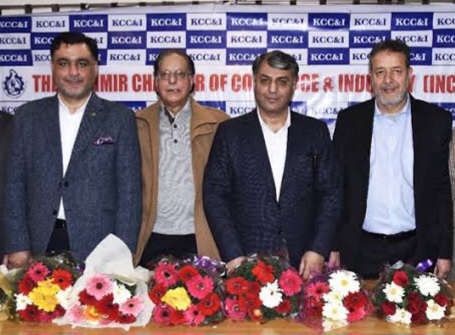
Srinagar – A high-level delegation of the Kashmir Chamber of Commerce and Industry (KCCI), led by its President Javid Ahmad Tenga and Joint Secretary General Umar Nazir Tibetbaqal, held a detailed meeting with S.C.L. Das, Secretary, Ministry of Micro, Small and Medium Enterprises (MSME), Government of India, to discuss pressing issues facing Kashmir’s MSME and handicrafts sectors.
During the meeting, President Javid Ahmad Tenga highlighted a sharp decline in handicraft exports from Jammu and Kashmir, which have dropped to ₹733 crore in the financial year 2024–25. He emphasized that this fall was deeply concerning for the region’s traditional sectors that support lakhs of livelihoods. Outlining KCCI’s ambitious but realistic goal, he said the Chamber is targeting a five-fold increase in exports — aiming for ₹4,000 crore in the next 4–5 years, in line with the Government of India’s vision of a $5 trillion economy.
To achieve this, KCCI urged the Ministry to support the participation of J&K-based handicrafts exporters in major global trade fairs, including Global Village Dubai and other key international destinations. The MSME Secretary responded positively to the request and directed the Industries & Commerce Department, J&K, to liaise with KCCI to identify priority events and facilitate participation.
The KCCI delegation also submitted a memorandum proposing the creation of sector-specific MSME clusters across Kashmir. These clusters would offer shared infrastructure and services in areas such as fruit processing, food packaging, herbal product manufacturing, and handicrafts, including copperware, papier-mâché, woodwork, carpet weaving, and Pashmina finishing. The proposal was welcomed as a sustainable approach to reviving and modernising traditional sectors.
A key concern raised by KCCI was the limited access to credit for MSMEs due to poor CIBIL scores. The delegation pointed out that these scores often reflect regional instability and structural disruptions, rather than wilful default. KCCI requested a one-time CIBIL score relaxation or amnesty for micro and small units, along with region-specific financial inclusion norms tailored to sensitive geographies like Kashmir.
On the environmental front, KCCI proposed the establishment of Common Effluent Treatment Plants (CETPs) in industrial areas and cluster-based sewage treatment plants (STPs) in key tourist destinations including Srinagar, Gulmarg, Pahalgam, Sonamarg, and Dal Lake. The Chamber suggested that such infrastructure be funded through MSME schemes to support eco-friendly development. The Secretary described the idea as a “good initiative” for promoting sustainable tourism in the region.
Another notable suggestion from KCCI was the creation of a common laundry and dry-cleaning facility to serve the region’s hospitality sector. The Secretary informed the delegation that a ₹10 crore provision already exists under MSME schemes for such infrastructure and assured support for its rollout.
The delegation further highlighted the need for:
-
Solarisation of industrial units to offset high energy costs,
-
Flatted factory complexes to support IT and service sectors,
-
Revival packages for stressed and closed MSMEs, and
-
Enhanced support for the startup ecosystem, including incubation centres and funding assistance.