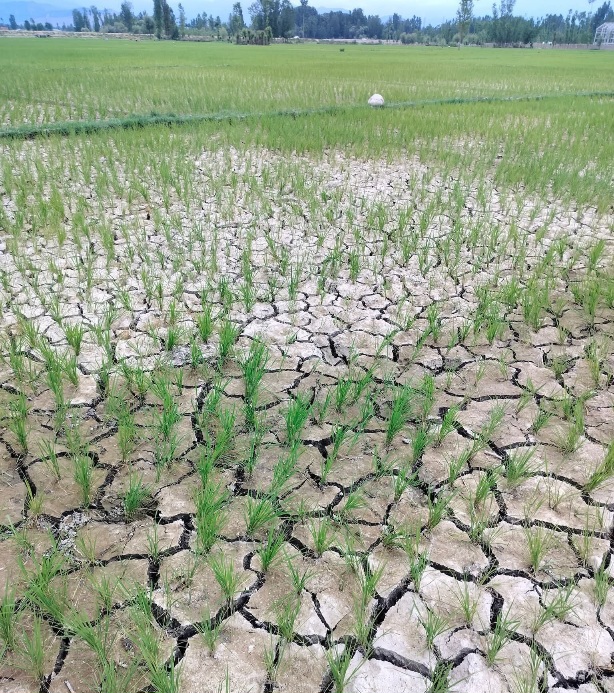
Srinagar: Large swathes of Kashmir Valley, especially in north and south Kashmir, are grappling with one of the worst irrigation water shortages in recent memory, putting this year’s paddy cultivation under severe stress and triggering alarm among farmers and agricultural planners.
In several areas of Baramulla, Anantnag, Pulwama, Bandipora, Kulgam and Shopian, farmers report that irrigation canals have either dried up or are running with significantly reduced flow, leaving vast stretches of paddy fields parched during what should be the peak transplantation season.
“This is the first time in decades that water is not available in late June,” said Ghulam Hassan Dar, a farmer in Anantnag’s Bijbehara area. “We are staring at crop failure unless urgent measures are taken.”
Climate change and early glacier melt to blame
Experts attribute the crisis primarily to climate change, with the unseasonal heatwave in April and May 2025 triggering premature melting of glaciers in the upper reaches. As a result, water that would traditionally be released gradually through the summer months has already flowed downstream early, leaving little for irrigation when it is most needed.
According to data from the Irrigation and Flood Control Department, the water level in major canals and streams like Lidder, Ferozpora, Veshaw, Romshi, Madhumati and other streams in Anantnag, Kulgam, Handwara and Kupwara is at record lows for this time of the year.
“Glacier-fed streams are drying weeks ahead of schedule. This is a clear symptom of a changing climate, where snowmelt timing and volumes are no longer predictable,” said Dr. Showkat Nazir, a hydrologist.
Encroachment and poor maintenance of canals worsen the crisis
In addition to climatic factors, the crisis has been compounded by widespread encroachments and neglect of irrigation infrastructure. In many villages, traditional irrigation canals (kulhs and zams) have been encroached upon, silted, or diverted for construction and horticultural use.
Farmers in Tral, Sopore and Kulgam blame local authorities for failing to desilt canals and crack down on illegal diversions. “Water that should flow to our rice fields is being siphoned off upstream for commercial orchards and new constructions,” said Manzoor Ahmad Wani, a grower from Handwara.
Paddy cultivation under threat
The cascading impact is now threatening Kashmir’s primary food crop — paddy. Agriculture officers say that in some districts, only 70% –80% of the expected paddy transplantation has been completed, as farmers wait in vain for irrigation releases.
The crisis could also impact food security and livelihoods, as thousands of families depend on paddy farming for both consumption and income.
Government response and urgent measures needed
While the Jammu & Kashmir Agriculture and Irrigation Departments have acknowledged the problem, field-level interventions have so far been slow.
Officials say water rationing schedules are being considered, and mobile water tankers may be deployed in worst-hit areas. Long-term measures, including catchment restoration, canal de-siltation, and promotion of climate-resilient agriculture, are being discussed.
Call for policy shift
Environmentalists and farmers’ groups are calling for a state-level irrigation resilience plan and a comprehensive audit of Kashmir’s traditional water systems.
“We are seeing the collapse of age-old water management wisdom,” said Advocate Bashir Ahmad, an expert on water rights. “This is no longer just a weather issue. It’s an administrative, ecological and policy failure.”
Unless urgent action is taken, the 2025 paddy season could mark a turning point in Kashmir’s agrarian economy — one where climate change and mismanagement combine to erode the Valley’s centuries-old farming traditions.


Comments are closed.