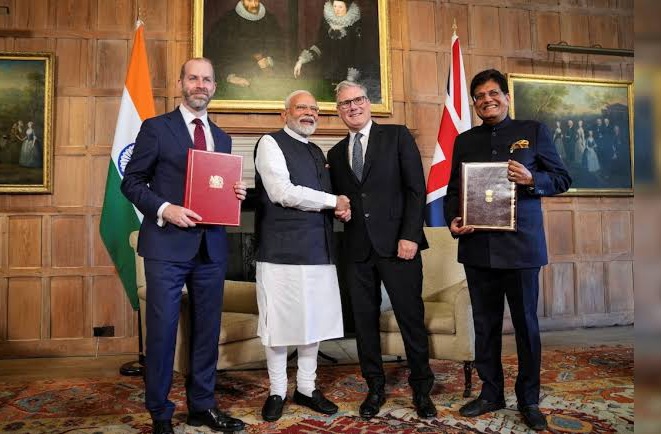
Srinagar: The Kashmir Chamber of Commerce & Industry (KCCI) has welcomed the recently concluded India–UK Free Trade Agreement (FTA) as a forward-looking, strategic step that is expected to strengthen bilateral economic relations, widen market access for Indian products, and enhance the global competitiveness of Jammu and Kashmir’s traditional industries.
In a formal statement issued today, the KCCI President Javed Ahmed Tenga expressed particular appreciation for the Government of India’s decision to exclude apples from the list of tariff concessions under the FTA, calling it a “sensitive and informed move” that acknowledges the unique vulnerabilities of Kashmir’s horticulture sector. The Chamber noted that apple cultivation supports the livelihoods of over three million people in Jammu and Kashmir and remains the backbone of the region’s rural economy.
“Any abrupt exposure to tariff-free competition, especially from countries where apples are heavily subsidised, could have proven devastating for our growers,” said Faiz Ahmad Bakshi, Secretary General of KCCI. “The government’s decision to retain import duties on apples reflects a clear understanding of ground realities and long-term economic sustainability.”
KCCI said it had directly flagged this concern during a recent interaction with Union Commerce and Industry Minister Piyush Goyal during his visit to Kashmir. The Chamber had urged that Kashmir’s horticulture produce be treated as sensitive in international trade agreements, and today’s outcome demonstrates responsiveness to that appeal.
Boost for Pashmina, Saffron and Willow Exporters
While praising the apple exemption, KCCI also welcomed the inclusion of traditional Kashmiri products such as pashmina, saffron, and Kashmiri willow in the tariff concession list under the FTA. These changes are expected to ease access to the UK market and create new export opportunities for artisans, growers, and sports goods manufacturers across the Valley.
“This agreement opens fresh avenues for our time-honoured industries,” the Chamber noted. “The UK has always been an important destination for Kashmiri crafts, and improved access will go a long way in empowering rural artisans, promoting women-led economic participation, and reviving traditional sectors.”
KCCI highlighted that handicrafts and handlooms remain Kashmir’s most important non-agricultural employment sectors, and increased demand abroad would help stabilise incomes and promote the preservation of artisanal heritage.
While broadly supporting trade liberalisation, the Chamber reiterated its appeal to the Government of India to continue treating horticulture as a sensitive sector in all upcoming trade negotiations. It stressed that any relaxation in tariff protection must be preceded by robust domestic reforms, infrastructure upgrades, and productivity improvements to ensure that local producers are not left vulnerable.
“The interests of our fruit growers must be safeguarded until systemic reforms—such as cold chain infrastructure, grading facilities, and access to credit—are fully implemented,” the Chamber stated.
KCCI reaffirmed its commitment to work in close coordination with the Ministry of Commerce and Industry, the Government of Jammu and Kashmir, and other relevant agencies to promote the interests of Kashmir’s traditional sectors globally. The Chamber said that with a balanced, inclusive and region-sensitive approach, the India–UK FTA could prove transformative for the export ecosystem of Jammu and Kashmir.
“We see this agreement not just as a trade deal, but as an opportunity to amplify the voices of our artisans, empower our rural economy, and strengthen Kashmir’s place in global markets,” Mr Tenga added.