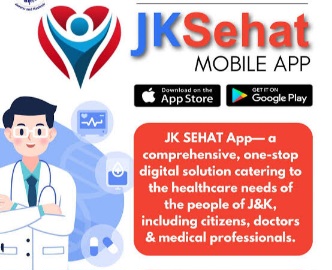
Srinagar – As the Jammu and Kashmir government pushes forward with the digitalisation of healthcare services through the JK Sehat mobile application, concerns are growing among sections of the population—particularly those without smartphones or digital literacy. While the app promises streamlined access to medical care, many fear that it may eventually replace traditional hospital registration counters, leaving digitally excluded individuals behind.
Over the past few months, thousands of citizens across J&K have downloaded the JK Sehat App to book appointments, access health records, and receive medical advice. However, patients from rural, remote, and economically weaker backgrounds worry about losing access to in-person registration services if the system transitions entirely online.
“We’ve heard rumours that even hospital tickets will only be available through the app,” said Ghulam Ahmad, a resident of Anantnag. “Many in my village don’t own smartphones. If counters are closed, how will people like us get treatment?”
The anxiety is particularly acute among senior citizens and those who are not comfortable using digital devices. “My parents can’t operate smartphones, and they rely on me or someone else to accompany them to the hospital,” said Ishfaq Wani of Baramulla. “Digitising healthcare is good, but it must not come at the cost of accessibility.”
Similar concerns are echoed in areas with poor internet connectivity. “Sometimes we go for days without stable network coverage,” said a resident of Shopian. “How are we supposed to access healthcare through an app under these conditions?”
Health Department responds
In response to the concerns, Director of Health Services Kashmir (DHSK), Dr Jahangir Bakshi, clarified that there are no plans to discontinue physical hospital ticket counters.
“Traditional registration desks will continue to operate,” he told KNO. “The JK Sehat App is an additional option, not a replacement. Our approach is about digital inclusion, not exclusion. The goal is to provide multiple access points so no citizen is left out.”
Dr Bakshi emphasised that the app aims to enhance convenience—allowing users to book appointments, view test reports, and receive notifications about healthcare services—while ensuring that offline services remain intact.
About the JK Sehat App
The JK Sehat (e-SeHAT) mobile application was officially launched by Chief Minister Omar Abdullah in April this year as part of a broader effort to modernise healthcare delivery across Jammu and Kashmir.
The app features:
Teleconsultation and tele-diagnosis services, emergency care access and real-time updates on hospital services, doctor availability and appointment scheduling, health monitoring tools, including AI-powered symptom checkers and medication reminders, multilingual support for broader accessibility and integration with wearable devices for real-time vitals tracking
Additionally, the app supports health education, offering CPR and Basic Life Support (BLS) modules, as well as access to medical education resources for students—including details on academic programs, hostel accommodation, and library facilities.
While the digitisation of healthcare promises significant benefits—including reduced waiting times, better patient tracking, and enhanced administrative efficiency—stakeholders and experts alike agree that the digital divide must be addressed.
“Digital healthcare should be an enabler, not a barrier,” said a healthcare policy analyst. “The success of platforms like JK Sehat will depend on how well the government ensures inclusivity—through digital literacy programs, multilingual interfaces, offline alternatives, and community outreach.”