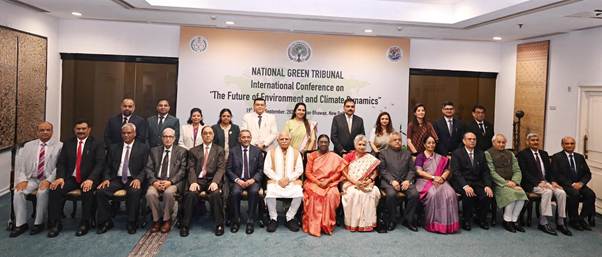
President Murmu stresses community-based climate adaptation; deliberations focus on climate justice, institutional accountability and transboundary cooperation
NEW DELHI, SEPTEMBER 20: The National Green Tribunal’s (NGT) two-day international conference on ‘The Future of Environment and Climate Dynamics’ concluded in New Delhi on Sunday with a call for translating environmental commitments into effective action, strengthening institutions and promoting sustained international cooperation for a sustainable, resilient and equitable future.
President of India Droupadi Murmu addressed the valedictory session, where she highlighted the importance of strengthening climate resilience through people-centric and community-based adaptation approaches rooted in traditional knowledge.
The conference brought together jurists, policymakers, scientists, academicians, environmental experts and other stakeholders from 17 countries, along with representatives of the United Nations Environment Programme (UNEP) and the Asian Development Bank (ADB).
President stresses community-based climate resilience
In her keynote address, President Murmu lauded the NGT’s role in strengthening environmental governance and emphasised the need for climate adaptation approaches that place communities and people at the centre, while drawing on traditional knowledge.
The valedictory session was attended by Union Minister for Housing and Urban Affairs and Power Manohar Lal, Supreme Court Judge Justice B.V. Nagarathna, NGT Chairperson Justice Prakash Shrivastava and Solicitor General of India Tushar Mehta.
India highlights non-fossil energy capacity and sustainable development
Union Minister Manohar Lal highlighted India’s efforts to balance rapid development with environmental sustainability, stating that non-fossil sources account for nearly 55 per cent of the country’s installed power generation capacity.
He said India had achieved its target of 50 per cent non-fossil installed capacity five years ahead of schedule.
The minister also highlighted initiatives related to sustainable urban development, water security, public transport, green mobility and electric vehicles. He stressed the importance of collective action to address climate change.
Justice Nagarathna calls for accountable environmental governance
Justice B.V. Nagarathna said environmental governance must balance development and conservation, present needs and the interests of future generations, while recognising the differentiated impacts of environmental challenges on communities and generations.
She highlighted the Supreme Court’s shift towards an ecocentric approach and stressed the importance of effective institutions, enforcement, transparency, accountability and access to justice.
According to her, interconnected challenges such as climate change, biodiversity loss, pollution and water scarcity require cooperation across jurisdictions, knowledge-sharing and equitable responsibility among nations.
NGT chairperson calls for laws and institutions capable of delivering action
NGT Chairperson Justice Prakash Shrivastava said the two-day discussions had underscored the need to move beyond identifying environmental challenges and focus on developing laws, institutions and partnerships capable of responding effectively.
He emphasised that climate action must be inclusive and equitable, particularly in addressing the concerns of vulnerable communities and future generations.
Justice Shrivastava also called for environmental law to remain responsive and forward-looking by incorporating technology, innovation, sustainable finance and just transition principles.
Solicitor General stresses integration of law, science and governance
Solicitor General Tushar Mehta said environmental challenges required the combined expertise of law, governance, science, economics and society.
He emphasised the need to balance biodiversity protection, climate action and development through scientific assessment, innovation and sustainable development.
Mehta said environmental protection should be viewed as a condition for enduring human progress, requiring stronger institutions, effective implementation and responsible governance.
NGT souvenir ‘Harit Nyayam’ released
During the valedictory session, Manohar Lal released the NGT’s souvenir, ‘Harit Nyayam’, and presented its first copy to President Murmu.
The souvenir documents the establishment, growth and achievements of the National Green Tribunal. According to the release, it is intended to serve as a repository of ideas and perspectives for policymakers, the legal fraternity and citizens.
Conference focuses on environmental challenges and forest protection
The second day of the conference featured two technical sessions.
The session on ‘Planetary Environmental Challenges and Cooperation’ examined interconnected environmental and climate challenges, shared natural resources, competing national interests, transboundary cooperation and regional and international best practices.
The session on ‘Forests for the Future: A Dialogue on Forest Protection & Restoration’ focused on forest governance, sustainable forest management, community participation, biodiversity conservation and emerging threats to forests. It also addressed legal and institutional mechanisms and the use of technology and scientific and satellite-based monitoring.
Discussions included a shared vision for forest protection and restoration, priority actions, regional cooperation, institutional partnerships and measurable goals.
The conference, inaugurated by Prime Minister Narendra Modi on September 19, provided a platform for dialogue and knowledge exchange on judicial, scientific, policy and institutional practices related to environmental and climate challenges.
The deliberations brought together perspectives from different jurisdictions and highlighted the need for stronger environmental governance, climate justice, institutional cooperation, knowledge-sharing and practical approaches to addressing transboundary environmental concerns.
The conference concluded with a shared emphasis on converting environmental principles and commitments into effective action, supported by stronger institutions and sustained international cooperation for a sustainable, resilient and equitable future.