New Delhi, September 19: The Agro Chem Federation of India (ACFI) has called for a dedicated ₹5,000–7,500 crore support programme for upstream agrochemical manufacturing, along with a seven-to-eight-year policy framework, to strengthen domestic production of agrochemical technicals and intermediates and improve the competitiveness of India’s crop protection industry.
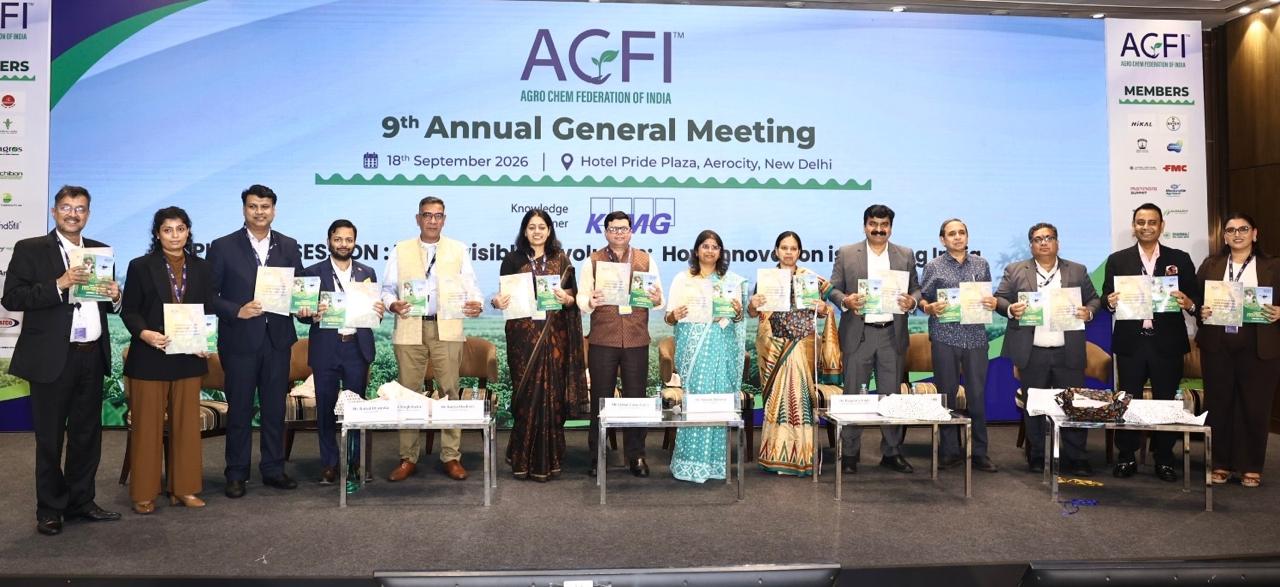
The proposal is part of a knowledge paper, “Redefining Indian Crop Protection through Innovation: From Scale to Science”, released by ACFI and consultancy firm KPMG.
The report said policy support should focus on addressing specific ecosystem and cost disadvantages affecting Indian manufacturers rather than creating permanent protection or dependence on subsidies.
It proposed two to three years for plant commissioning followed by sustained production support, with graded investment thresholds covering both large companies and MSMEs and greenfield as well as brownfield expansion.
Among the key measures proposed are PLI-style incentives of 5–8% on incremental sales, 30–40% subsidies on industrial electricity and effluent-treatment costs, and capital grants for specialised research and development.
The report said such measures could help address the operating-cost advantages enjoyed by manufacturers in China and encourage backward integration into strategically important intermediates.
Focus on manufacturing and innovation
ACFI said India has established itself as a globally relevant manufacturing base in agrochemicals, with strengths in process chemistry, formulations, technical manufacturing and regulatory execution.
However, the report said future growth would require India to build stronger capabilities in product development, biologicals, advanced formulations, regulatory science and digital agriculture rather than relying solely on additional manufacturing capacity.
ACFI Chairman Rahul Dhanuka said the focus should be on meeting farmers’ needs through innovation, an enabling regulatory framework, stronger domestic capabilities and resilient supply chains.
He also highlighted digitalisation and sustainable agriculture as important areas for the sector.
The report recommended specialised agrochemical manufacturing parks with shared utilities, cluster-based environmental infrastructure, long-term financing and selective backward integration in strategically important intermediates.
It also called for strengthening pilot-scale facilities, field-validation networks, Good Laboratory Practice (GLP) laboratories, residue-testing infrastructure and formulation-development platforms to bridge the gap between research and commercial deployment.
Single-window regulatory framework sought
The report proposed a single-window regulatory framework through a unified digital platform covering Centre and state-level approvals.
It called for transparent and time-bound approval processes and clearer regulatory pathways for biological crop-protection products.
ACFI and KPMG identified biological crop protection as a significant opportunity for India, citing the country’s biodiversity, agricultural base, fermentation capabilities and scientific talent.
The report, however, said commercialisation of biological products would depend on factors including batch consistency, formulation stability, scalable manufacturing, multi-location field validation and farmer adoption.
It said India’s future competitiveness would increasingly depend on its ability to develop, register, manufacture and commercialise differentiated crop-protection solutions for global markets.
Experts discuss next phase of agricultural innovation
The recommendations were discussed alongside a panel session titled “The Invisible Revolution: How Innovation is Feeding India”, organised by ACFI following its annual general meeting.
Dr Vishal Chaudhary, Scientist to the Government of India, said India’s manufacturing position in agrochemicals needed to be complemented by greater focus on research, innovation and technology development, supported by stronger public-private partnerships and engagement among research institutions, academia and industry.
Dr Sweety Behera, Director, FSSAI, said scientific advancement in agriculture needed to give equal importance to sustainability and consumer safety, with regulatory decisions based on scientific evidence, risk-based approaches and effective surveillance.
Dr Kavya Dashora, Professor, Indian Institute of Technology Delhi, highlighted the potential of nanotechnology for targeted delivery, controlled release and reduced input use, while pointing to the need for stronger data, tracking mechanisms and “safe-by-design” approaches.
Pushplata Singh, Director, TERI, said biotechnology and nanotechnology could contribute to more sustainable and climate-resilient agriculture, including through biogenic approaches to nanopesticides.
Dr Rajvir Rathi, Director- Agricultural Affairs, Bayer CropScience, highlighted technology licensing and access frameworks as a means of improving the availability and affordability of proven agricultural technologies.
Srinivasa Karavadi, Founder & CEO, KshetragnaFarm Solutions, said crop protection, biologicals, crop nutrition, seeds and digital technologies needed to be integrated rather than developed in isolation.
Gopinath Koneti, Partner and Senior Advisor, KPMG India, stressed that agricultural innovation ultimately needed to demonstrate economic viability and measurable benefits for farmers.
Prabhudutta, Deputy Editor, Hindu BusinessLine, said the industry needed to anticipate changing consumer preferences and farming practices while ensuring product reliability, responsible development and farmer trust.
Dr Kalyan Goswami, Director General, ACFI, said biotechnology, crop protection, biologicals, nanotechnology, digital technologies, improved seeds and crop nutrition needed to converge to create solutions that were scientifically sound, economically viable and relevant to farmers.
He said ACFI would continue bringing together industry, academia, government and the scientific community to support the movement of agricultural innovations from research to field-level application.


Crazy Traps, Hilarious Fails – Play Ajian Steal An Egg! https://stealanegg.pythonanywhere.com/