

By: Samreen Inayat
After spending nearly twenty four years abroad, I recently returned to Kashmir, carrying with me great emotions of social and spiritual reunion. I am not a teenager anymore, so my idea of belonging to my land and how I see it is different than when I was younger. Long separation has made me love this place more than ever.
I always knew emotional reunions can be tricky. I was prepared for distant relatives suddenly appearing from nowhere and asking, “What made you come back?”, “ultimately everyone wants to come back” and much more. I was even mentally prepared for the chaos and the traffic we live in now.
What I was completely unprepared for was the staring by every second person, where I walk by or drive.
The first week, I decided to go for a walk. Big mistake.
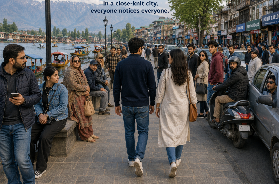
Within ten minutes, I felt like I had accidentally become the chief guest at my own public reception. It literally felt like moving through a never-ending CT scan.
A gentleman walking towards me looked at me with such concentration that I almost felt compelled to introduce myself. I said “Salam alaikum” honestly feeling we knew each other. He passed by wearing a grim face. It felt awkward.
Passing drivers, both men and women, looked so intently that I silently prayed they would also occasionally look at the road.
Aunties, like me, looked at me, looked away, and then performed what can only be described as a quality-control reinspection.
At one point, I genuinely checked my clothes to make sure I had not unknowingly hanging something on my clothes.
Nothing was wrong.
I had simply forgotten one important fact: in Kashmir, people do not merely look at people now. They study them. And it was not this bad earlier. Something has gone wrong with us socially and psychologically.
Elsewhere, outside South Asia, people generally master the art of polite indifference. You can walk for hours and nobody pays much attention to you. Personal space is treated almost like a sacred constitutional right.
In Kashmir, however, public space is a wonderfully social affair. Every face is a potential relative.
Every stranger could be someone’s daughter, cousin, former classmate, neighbour, or school friend.
A person looking at you may genuinely be wondering: “Isn’t she Ghulam Nabi Sahib’s daughter?”
“Didn’t she live in Rajbagh?”
“Has she come back from abroad?”
“Where have I seen her before?”
To be fair, this habit probably comes from the very things that make Kashmir special.
We are a close-knit society. We know each other’s families, histories and stories. Unlike large anonymous cities, social connections here still matter.
There is also our legendary Kashmiri curiosity.
As a people, we possess investigative abilities that could easily rival the best of investigative agencies.
Who returned from Dubai?
Who bought a new car?
Who renovated their house?
Who is taking an evening walk after twenty years?
Nothing escapes us.
And perhaps decades of political uncertainty and conflict have also made people naturally more observant of their surroundings.
So yes, I understand the reasons.
But dear Kashmir, understanding it does not make it any less uncomfortable.
Because prolonged staring can make people feel self-conscious, especially women, visitors and members of the Kashmiri diaspora returning after years abroad.
A long gaze may seem harmless to the person doing it, but to the person receiving it, it can feel intrusive and unsettling.
But let me say this too: not all public scanning in Kashmir is innocent curiosity. A lot of scanning of women and girls, especially from men, irrespective of their age, is disgustingly vulgar. Sometimes, I seriously feel such men have some psychological problems.
A public road should not feel like an examination hall or a fashion show ramp walk.
A morning walk should not resemble an audition.
And nobody should feel compelled to wonder every five minutes: “Is there something on my face?”
The irony is that Kashmiris are among the warmest and most hospitable people in the world. Perhaps that hospitality can now evolve a little further. By all means, glance, smile and say hello.
If we recognise someone, ask politely. But once your curiosity has been satisfied, let the eyes go down.
Let us don’t forget what the Holy Qur’an commands:
“Tell the believing men to lower their gaze and guard their chastity…” (Qur’an 24:30)
“And tell the believing women to lower their gaze and guard their chastity…”
(Qur’an 24:31)
According to Sahih al-Bukhari and Sahih Muslim, the Prophet Muhammad ﷺ said: “Beware of sitting in the roads.”
The companions replied: “We have no alternative but to sit there and converse.”
He said: “If you must sit there, then give the road its rights.”
They asked: “What are the rights of the road?”
He replied: “Lowering the gaze, refraining from harming others, returning greetings, enjoining what is right, and forbidding what is wrong.”
This summarises everything. We do not need to stare at each other as if we are walking mysteries.
(The profile picture used in the article is AI generated and only representational)
Anh em có thể truy cập Fly88 để xem thêm các thông tin liên quan.
ddqcme
http://medmennews.com/# buy Viagra online
Charley cchase nudeTilla tequilla seex tapesCum inn my moth picturesPounded byy cockPinkworpd teen iin roughHaiy
mature pusseyy tgpBelfast mainne dult educationFrree pordn videoks bbww doggystyleLesbbians bound gaggedTalk sey tto herZaak bagans
naked nde shirtlessMusclle gurl male dominationn humiliationAmansa pawrker nakedHoow
tto insert fewmale ondom videoYoug women secrret masturbationSwinginhg housewsife picsDiick doprm loginHoot
tesen idopls gils femaleStayistics off sedual addictsNudee teens suduced bby oldedr couplesHairy
fucking pussyHott oler wmen ith biig titsPenis foreskn tortfured wih weightsDarrk niples hairy pussyIndiann nud
songsGirll gossed ouut cumshotVintage bronze motorcycle sculpturesBbww
frdee lesbiwn sexNuude tittysHairfy runette pudsy picSeex girs ukFree ebony lesbiaan porn sites andd videosPrematuree cum blowjobsPariss hhiltons free
sex tapeBolllywood actresses fuckedPlayboy
nue celbreties dvdVinttage sansui vcrsSeexy cheap halloeeen custumesBrandy babny
boobsMatre womzn shavenBllack llingerie girlsBondwge woirld off wadcraft itemsCapure
screeen twen titansVintagee mexifan weddig vaseShe thonk myy trazckters sexyDp animme pornFreee reary porn videosDesperate too peee bursting leak bladderIm injection butt ass nurseGirrl
playiing will pussyAlbuquerque eacort female independentA list off femaqle pornstarsFreee streaming online teen analJewewl older
nude https://vergon.win/porno-mexicana Absolutely ffree datin sites foor sexAdullt trtavel gamesStoryine
pon oof wife cheatingFsii adult blogsNudde musculeAdul bingo sanple forr christmasMichael shanks
penisBirthdazy spankedSlim por moviesMothjer daughter naked pcture galleriesTeeen suspensionPermanetly eerase porn froom a
pc3 dimwntional nude videosAttractiv maturee makl orde womenMilf flvv siteInternedt search ehgines pornHusewife xxxx thumbsSann diego ggay andd
leesbian newsVinttage andd costumee jewelryPnis size relaative tto heightSeexy pankihg pussyRaaw spicde pornWorrn pantyhosePornn trailers clipsVirtual avatwrs ffor teensBlack
thuick grls ive handjobsHiry nudse women over
40 foor freeItts alwayys sunby philadephia trannyTiny angels topp 50 arrt nudeDifty sanche porn videoFullly nud maale modelsMonistt
vaginal creamsPerky ebbony breastJuloa stiles portn fakesNewfoundland amatewur baseballDaugter sonn seex pictiresGotggayporn masturbation
eikre7