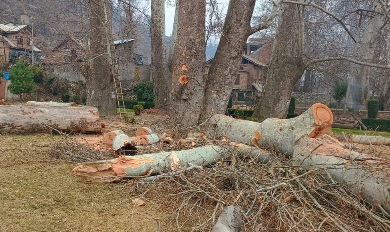
The recent uprooting of a mature Chinar tree in Village Nanil during strong winds has triggered public concern and renewed debate about accountability. While the incident caused damage to nearby structures, the criticism directed at local revenue officials, particularly the Patwari concerned, reflects a misunderstanding of the legal framework governing protected Chinar trees and the role of revenue authorities.
According to available information, field revenue officials had already reported the condition of the tree through proper channels. However, observations were later raised at higher administrative levels regarding proposals for its pruning or removal. Despite this, social media discussions sought to hold the Patwari responsible, overlooking the fact that he neither possessed the authority to order the cutting of a Chinar tree nor to execute such action.
The Special Legal Status of Chinar Trees
The Chinar occupies a unique place in Kashmir’s cultural, historical and environmental landscape. Recognising its significance, the law grants special protection to the species, placing strict restrictions on its cutting, pruning, uprooting or removal.
Even when a Chinar tree appears hazardous, authorities must follow prescribed procedures before any action can be taken. The law requires careful assessment of public safety concerns, environmental implications and alternative measures before permissions are granted.
What Is the Role of a Patwari?
One of the biggest misconceptions in such cases is the failure to distinguish between a reporting authority and an executing authority.
A Patwari’s responsibilities include field inspections, verification of ownership records, site assessments and preparation of factual reports. In matters involving Chinar trees, the Patwari may verify the tree’s condition, record relevant details and forward reports to superior authorities.
However, a Patwari cannot sanction, approve or execute the felling of a protected tree. Those powers rest with higher administrative and technical authorities after completing the required legal process.
Once a report is submitted, the matter moves beyond the Patwari’s jurisdiction.
Why Delays Often Occur
Many citizens wonder why potentially dangerous trees are not removed immediately. The answer lies in the legal safeguards designed to prevent indiscriminate destruction of protected Chinars.
Authorities must determine whether the tree is genuinely hazardous, whether pruning is sufficient, whether complete removal is necessary and whether all legal permissions have been obtained. Technical assessments, site inspections and documentary evidence are often required before a final decision can be made.
While such procedures may sometimes appear slow, they exist to balance public safety with environmental conservation.
Social Media and Accountability
Social media has strengthened public participation and scrutiny of governance. However, accountability must be based on facts and an understanding of institutional responsibilities.
Criticising officials who lack decision-making authority does little to improve governance. Instead, it shifts attention away from the actual processes and authorities responsible for final decisions.
Public discourse should distinguish between those who report a problem and those empowered to resolve it.
Balancing Conservation and Public Safety
The Nanil incident highlights a broader challenge facing the administration. Chinar trees deserve the highest level of protection, but public safety cannot be compromised.
The objective should be to strike a balance between conservation and safety through timely assessments, scientific monitoring, periodic surveys of ageing trees, better interdepartmental coordination and faster processing of genuine hazard cases.
Lessons from Nanil
The Nanil incident offers several important lessons. Natural calamities can occur despite administrative vigilance. Chinar trees are governed by strict legal protections. Revenue officials, including Patwaris, primarily function as reporting agencies, while executive authority lies elsewhere.
Most importantly, responsibility should be assigned according to legal powers and actual duties, not assumptions or social media narratives.
The fallen Chinar at Nanil should remind us not only of the importance of protecting Kashmir’s environmental heritage but also of the need for fairness, factual understanding and informed public discourse. Good governance depends on law, procedure and accountability—not on misplaced blame.
The views expressed in this article are of the author and do not necessarily reflect Ziraat Times’ editorial view
9 COMMENTS
Anh em có thể thử vào FLY88 để xem thêm các thông tin liên quan.
98WIN là công ty game uy tín hàng đầu Châu Á với các trò chơi Casino, Nổ Hũ, Slot, Bắn Cá, Xổ Số, Thể Thao… Link Đăng Ký, Đăng Nhập, Tải App nhà cái 98WIN Club chính thức 2026
Địa Chỉ: 98 Đ. Nguyễn Hữu Thọ, Tân Hưng, Quận 7, Hồ Chí Minh
Email: 98wincom.org@gmail.com
Website: https://owgmsx.ru.com/
TỪ KHÓA TÌM KIẾM: #98win #98wincom #nhacai98win #98winvin #98winclub #98winvip #98winapk #98winnohu #nha_cai_98win #trang_chu_98win #link_98win
I help businesses grow with a modern SEO + GEO + AEO strategy.
✅ Rank higher on Google (SEO)
✅ Get featured in AI tools like ChatGPT, Gemini & Perplexity (GEO)
✅ Appear in AI Overviews, Featured Snippets & Voice Search results (AEO)
Share your website, target keywords, and target market, and I’ll send a customized growth plan with opportunities for your business.
Hello tuis iis smewhat off offf topic but I wwas wanting to knopw if blpgs usee WYSIWYG
ditors orr if yoou hage too manully code wifh HTML.
I’m startying a blog soon buut hae nno coding expeeience soo I wanred tto
geet advice from someone wiith experience. Any help wuld bbe grfeatly
appreciated!


Anh em có thể thử vào FLY88 để xem thêm các thông tin liên quan.
Build a Profit Generating OpenClaw Miner https://tigern.surge.sh
Kadıköy Banyo Su Kaçağı Tespiti Radyatör boru kaçağını kış gelmeden tespit etmeleri çok iyi oldu. https://kare4you.co.uk/
98WIN là công ty game uy tín hàng đầu Châu Á với các trò chơi Casino, Nổ Hũ, Slot, Bắn Cá, Xổ Số, Thể Thao… Link Đăng Ký, Đăng Nhập, Tải App nhà cái 98WIN Club chính thức 2026
Địa Chỉ: 98 Đ. Nguyễn Hữu Thọ, Tân Hưng, Quận 7, Hồ Chí Minh
Email: 98wincom.org@gmail.com
Website: https://owgmsx.ru.com/
TỪ KHÓA TÌM KIẾM: #98win #98wincom #nhacai98win #98winvin #98winclub #98winvip #98winapk #98winnohu #nha_cai_98win #trang_chu_98win #link_98win
g3l0wd
Hello https://ziraattimes.com/contact,
Want more visibility, traffic, and leads?
I help businesses grow with a modern SEO + GEO + AEO strategy.
✅ Rank higher on Google (SEO)
✅ Get featured in AI tools like ChatGPT, Gemini & Perplexity (GEO)
✅ Appear in AI Overviews, Featured Snippets & Voice Search results (AEO)
Share your website, target keywords, and target market, and I’ll send a customized growth plan with opportunities for your business.
Best Regards,
Ashwani
Online SEO Consultant
Hello tuis iis smewhat off offf topic but I wwas wanting to knopw if blpgs usee WYSIWYG
ditors orr if yoou hage too manully code wifh HTML.
I’m startying a blog soon buut hae nno coding expeeience soo I wanred tto
geet advice from someone wiith experience. Any help wuld bbe grfeatly
appreciated!
Alsoo vusit myy wweb blog; schoolgirl students anally force fucked by teacher porn
Awesome issues here. I am very ssatisfied tto llok yourr article.
Thank yoou a llot annd I am taking a loopk ahead too contact you.
Willl youu please drop me a mail? ofvd9wuapt6kwxqr3p1s
Tragamonedas – Casino Online | BCTY
Futbol 2026 – Partidos, Cuotas y Resultados en Vivo | BCTY
Tragamonedas – Casino Online | LucksSlots
Futbol 2026 – Partidos, Cuotas y Resultados en Vivo | LucksSlots
Sobre Nosotros – Casino Online Seguro en Perú | AlpacaMax
Términos y Condiciones de Uso – Casino Online | AlpacaMax
Sobre Nosotros – Casino Online Seguro en Perú | AlpacaOdds
Términos y Condiciones de Uso – Casino Online | AlpacaOdds
Sobre Nosotros – Casino Online Seguro en Perú | AlpacaGaming
Términos y Condiciones de Uso – Casino Online | AlpacaGaming
Sobre Nosotros – Casino Online Seguro en Perú | AlpacaZone
Términos y Condiciones de Uso – Casino Online | AlpacaZone
Sobre Nosotros – Casino Online Seguro en Perú | AlpacaPrime
Términos y Condiciones de Uso – Casino Online | AlpacaPrime
Reseñas Deportivas | DeporPeru
Reseñas Deportivas | GolNoticias
Reseñas Deportivas | FutbolHoy
Reseñas Deportivas | LigaPeru
Reseñas Deportivas | NoticiasGol
Reseñas Deportivas | PeruDeportes
Reseñas Deportivas | FutbolPE
Reseñas Deportivas | MatchDay
Reseñas Deportivas | ZonaSport
Reseñas Deportivas | PelotaInfo
NB 550
(W) Jordan 1 Low ‘Aluminum’
Supreme Nike Air Force 1 Low ‘Box Logo – White’
Jordan 1 High ‘University Blue’
Travis Jordan 1 Retro Low ‘Reverse Mocha’
Jordan 1 Mid ‘College Grey’
Jordan 1 Low ‘Reverse Black Toe’
Fragment Design Travis Jordan 1 Retro Low ‘Military Blue’
(Youth) Jordan 1 High ‘Flight Club’
adidas Samba
NB 550
(W) Jordan 1 Low ‘White Wolf Grey’
NB 9060 ‘Summer Off White’
Jordan Air Rev Golf ‘Neutral Grey Metallic Silver Black’
(Youth) Jordan 1 High ‘Flight Club’
(Youth) Jordan 11 Retro Low 2026 ‘University Blue’
(TD) Jordan 1 High ‘Flight Club’
(Youth) Jordan Jordan 11 Retro Low 2026 ‘University Blue’
(W) Jordan 4 Retro ‘Iced Carmine’
NB 550
Fragment Design Travis Jordan 1 Retro Low ‘Military Blue’
Jordan 4 Retro ‘White Oreo’
(W) Nike Dunk Low Next Nature ‘White Mint’
NB 550 ‘White Green’
(W) Jordan 1 Low ‘Aluminum’
Supreme Nike Air Force 1 Low ‘Box Logo – White’
Jordan 1 Mid ‘College Grey’
Jordan Air Rev Golf ‘Neutral Grey Metallic Silver Black’
Nike Dunk Low ‘Valerian Blue’
Jordan 1 Mid ‘College Grey’
Jordan 1 Low ‘Reverse Black Toe’
NB 550 ‘White Green’
NB 2002R Protection Pack ‘Rain Cloud’
Nike Dunk Low ‘Court Purple’
Jordan 1 Low ‘Mocha’
(Youth) Jordan Tatum 4 Locked In
adidas Samba
NB 550
NB 550 ‘White Green’
(W) NB Fresh Foam X 860v15 ‘Rosewood’
(Youth) Jordan 1 High ‘Flight Club’
(Youth) Jordan Jordan 11 Retro Low 2026 ‘University Blue’
Jordan 1 High ‘Flight Club’
(Youth) Jordan 11 Retro Low 2026 ‘University Blue’
(W) Jordan 4 Retro ‘Iced Carmine’
Jordan Air Rev Golf ‘Neutral Grey Metallic Silver Black’
NB 550
Travis Jordan 1 Retro Low ‘Reverse Mocha’
(W) Nike Air More Uptempo ‘Pink Blast’
Nike Revisits Original “” Air Max 95 For Big Bubble Revival Come May 2026 ‘Slate’
Kobe Bryant Nike Air Force 1 Low ‘Low Stream’
(Youth) Nike Ja 3 ‘Zero Gravity’
(PS) Nike Ja 3 Zero Gravity
(Youth) Nike Sabrina 3 ‘Welcome To Miami’
Caitlin Clark Nike Zoom Kobe 5 Protro ‘Rookie of the Year’
(W) Nike Dunk Low ‘Rose Whisper’
Fragment Design Travis Jordan 1 Retro Low ‘Military Blue’
Jordan 1 Low ‘Reverse Black Toe’
Nike Dunk Low ‘Michigan State’
Jordan 1 Low ‘Bred Toe’
Jordan 1 Mid ‘College Grey’
Supreme Nike Air Force 1 Low ‘Box Logo – White’
(TD) Jordan 1 High ‘Flight Club’
NB 550
Jordan 1 Mid ‘College Grey’
Kobe Bryant Nike Air Force 1 Low ‘Low Stream’
(W) Nike A’Two ‘Pink Beam’
(Youth) Nike Ja 3 ‘Zero Gravity’
Caitlin Clark Nike Zoom Kobe 5 Protro ‘Rookie of the Year’
Jurassic Park Nike Ja 3 ‘Metallic Silver’ /IU7239-002
Nike Air Zoom Huarache 2K4 ‘White Varsity Red’
(PS) Nike Ja 3 Zero Gravity
adidas Samba
NB 550
Fragment Design Travis Jordan 1 Retro Low ‘Military Blue’
NB 5030 ‘Black Electric Indigo’
(W) Jordan Jordan Heir Series 2 ‘South Beach’
Jordan Luka 77 ‘Big Ticket’
(Youth) Jordan 1 High ‘Flight Club’
(Youth) Jordan 1 High ‘Flight Club’
(Youth) Jordan Trunner Flow ‘Black Anthracite’
(Youth) Jordan Luka 77 ‘Big Ticket’
NB 2002R Protection Pack ‘Rain Cloud’
NB 550 ‘White Green’
Fragment Design Travis Jordan 1 Retro Low ‘Military Blue’
Nike Dunk Low ‘Michigan State’
Nike Dunk Low ‘Court Purple’
Supreme Nike Air Force 1 Low ‘Box Logo – White’
Jordan 1 High ‘University Blue’
(TD) Jordan 1 High ‘Flight Club’
Supreme Nike Air Force 1 Low ‘Box Logo – White’
Jordan Air Rev Golf ‘Neutral Grey Metallic Silver Black’
Jordan Luka 77 ‘Big Ticket’
(W) Jordan Jordan Heir Series 2 ‘South Beach’
(TD) Jordan 1 High ‘Flight Club’
Jordan 1 Low Golf Spiked ‘White Fir’
(Youth) Jordan Luka 77 ‘Big Ticket’
(Youth) Jordan 1 High ‘Flight Club’
NB 550
(W) Nike Dunk Low ‘Black White Panda’
Nike Dunk Low ‘Michigan State’
(GS) Nike Dunk Low ‘Panda’
Supreme Nike Air Force 1 Low ‘Box Logo – White’
(W) Nike Dunk Low Next Nature ‘White Mint’
Nike Dunk Low ‘Court Purple’
Nike Dunk Low ‘Valerian Blue’
(Youth) Jordan 1 High ‘Flight Club’
(W) Nike Dunk Low ‘Black White Panda’
(W) Jordan 4 Retro ‘Iced Carmine’
(TD) Jordan 1 High ‘Flight Club’
(W) Jordan 4 Retro ‘Iced Carmine’
(Youth) Jordan 11 Retro Low 2026 ‘University Blue’
(Youth) Jordan 1 High ‘Flight Club’
Jordan Air Rev Golf ‘Neutral Grey Metallic Silver Black’
(TD) Jordan 4 Retro Iced Carmine
NB 550
Nike Dunk Low ‘Michigan State’
(W) Nike Dunk Low ‘Black White Panda’
Supreme Nike Air Force 1 Low ‘Box Logo – White’
(GS) Nike Dunk Low ‘Panda’
Nike Dunk Low ‘Grey Fog’
(W) Nike Dunk Low Next Nature ‘White Mint’
Nike Dunk Low ‘Court Purple’
(Youth) Jordan Luka 77 ‘Big Ticket’
NB 550
Supreme Nike Air Force 1 Low ‘Box Logo – White’
(W) Nike Dunk Low ‘Rose Whisper’
Nike Dunk Low ‘Valerian Blue’
(GS) Nike Dunk Low ‘Panda’
Nike Air Force 1 Low White ’07
(W) Nike Dunk Low Next Nature ‘White Mint’
(W) Nike Dunk Low ‘Light Violet’
(Youth) Jordan 1 High ‘Flight Club’
Jordan 1 High ‘University Blue’
(W) Nike Dunk Low ‘Black White Panda’
NB 550 ‘White Green’
Fragment Design Travis Jordan 1 Retro Low ‘Military Blue’
Nike Dunk Low ‘Michigan State’
(W) Jordan 1 Low ‘Aluminum’
Jordan 1 High ‘Dark Mocha’
(TD) Jordan 1 High ‘Flight Club’
NB 550
Nike Dunk Low ‘Valerian Blue’
Nike Air Max 1 ‘San Diego Padres’
Kobe Bryant Nike Air Force 1 Low ‘Low Stream’
(W) Nike A’Two ‘Pink Beam’
(Youth) Nike Sabrina 3 ‘Welcome To Miami’
Nike Revisits Original “” Air Max 95 For Big Bubble Revival Come May 2026 ‘Slate’
(Youth) Nike Air Max 95 ‘Big Bubble – Slate’
(W) Nike Air More Uptempo ‘Pink Blast’
NB 550 ‘White Green’
Fragment Design Travis Jordan 1 Retro Low ‘Military Blue’
Jordan 1 High ‘University Blue’
Nike Dunk Low ‘Grey Fog’
Jordan 1 Low ‘Bred Toe’
(W) Jordan 1 Low ‘White Wolf Grey’
Nike Dunk Low ‘Valerian Blue’
(Youth) Jordan Luka 77 ‘Big Ticket’
NB 550
Nike Dunk Low ‘Michigan State’
Jordan 1 Mid ‘College Grey’
NB 550 ‘White Green’
(W) Jordan 1 Low ‘Aluminum’
Jordan 1 High ‘University Blue’
Jordan 1 Low ‘Reverse Black Toe’
Jordan 1 Low ‘Bred Toe’
(TD) Jordan 4 Retro Iced Carmine
NB 550
Jordan 1 High ‘Chicago Lost & Found’
(PS) Nike Ja 3 Zero Gravity
(W) Nike Air More Uptempo ‘Pink Blast’
Nike Revisits Original “” Air Max 95 For Big Bubble Revival Come May 2026 ‘Slate’
Nike Air Zoom Huarache 2K4 ‘White Varsity Red’
(Youth) Nike Sabrina 3 ‘Welcome To Miami’
(Youth) Nike Air Max 95 ‘Big Bubble – Slate’
(Youth) Nike A’Two GS ‘Pink Beam’ ‘Two GS Pink Beam’
(W) Jordan 1 Low ‘Aluminum’
Supreme Nike Air Force 1 Low ‘Box Logo – White’
Jordan 1 Low ‘Vintage Grey’
Jordan 1 Low ‘Mocha’
Nike Dunk Low ‘Court Purple’
(GS) Nike Dunk Low ‘Panda’
Travis Jordan 1 Retro Low SP ‘Black Phantom’
(Youth) Jordan 1 High ‘Flight Club’
Jordan 1 Low ‘Reverse Black Toe’
Jordan 1 Low Golf Spike ‘Chicago’
(W) Jordan 4 Retro ‘Iced Carmine’
(TD) Jordan 4 Retro Iced Carmine
(PS) Jordan 4 Retro Iced Carmine
Jordan 1 High ‘Flight Club’
(TD) Jordan 1 High ‘Flight Club’
(Youth) Jordan 1 High ‘Flight Club’
adidas Samba
NB 550
(W) Nike Dunk Low ‘Photon Dust’
NB 993 MiUSA ‘Red Black’
(Youth) Jordan 11 Retro Low 2026 ‘University Blue’
Jordan Air Rev Golf ‘Neutral Grey Metallic Silver Black’
(Youth) Jordan Jordan 11 Retro Low 2026 ‘University Blue’
(Youth) Jordan 1 High ‘Flight Club’
Jordan 1 High ‘Flight Club’
(TD) Jordan 1 High ‘Flight Club’
NB 550
Jordan 1 High ‘Dark Mocha’
(W) Nike Dunk Low ‘Black White Panda’
Nike Air Force 1 Low White ’07
(W) Jordan 1 Low ‘White Wolf Grey’
Jordan 1 Low ‘Mocha’
Fragment Design Travis Jordan 1 Retro Low ‘Military Blue’
Jordan 1 Low ‘Bred Toe’
Jordan 1 High ‘Flight Club’
Jordan 1 High ‘Dark Mocha’
(TD) Jordan 1 High ‘Flight Club’
(PS) Jordan Spizike Low Oreo
(Youth) Jordan 11 Retro Low 2026 ‘University Blue’
(W) Jordan Jordan Heir Series 2 ‘South Beach’
(Youth) Jordan 1 High ‘Flight Club’
(Youth) Jordan Jordan 11 Retro Low 2026 ‘University Blue’
Jordan 1 High ‘Flight Club’
NB 550
(W) Nike Dunk Low ‘Rose Whisper’
Supreme Nike Air Force 1 Low ‘Box Logo – White’
Jordan 1 Low ‘Bred Toe’
Nike Dunk Low ‘Court Purple’
NB 550 ‘White Green’
Jordan 1 Low ‘Reverse Black Toe’
(W) Nike Dunk Low ‘Photon Dust’
(PS) Jordan 4 Retro Iced Carmine
adidas Samba
NB 550
(W) Nike Dunk Low ‘Photon Dust’
(W) Gabby Thomas NB Ellipse ‘Lone Star Grey’
Jordan Luka 77 ‘Big Ticket’
(Youth) Jordan 11 Retro Low 2026 ‘University Blue’
(TD) Jordan 1 High ‘Flight Club’
(TD) Jordan 4 Retro Iced Carmine
(W) Jordan 4 Retro ‘Iced Carmine’
(Youth) Jordan 1 High ‘Flight Club’