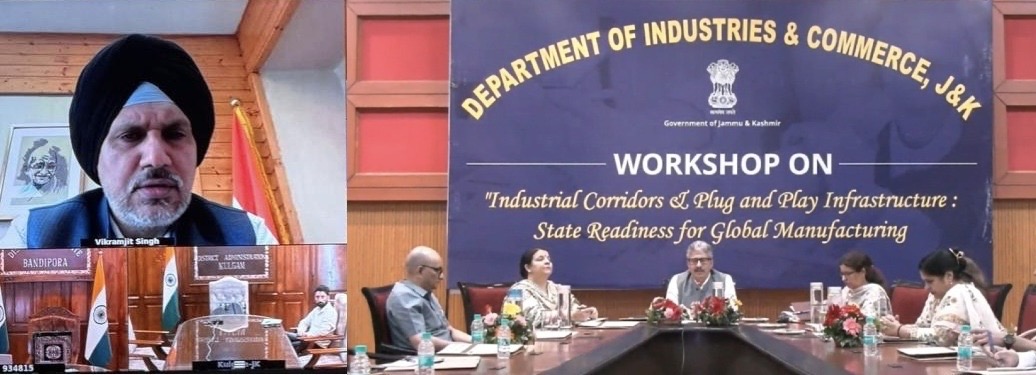
Jammu, June 8: The Jammu & Kashmir government on Monday held a Union Territory-level consultative workshop on industrial corridors and plug-and-play infrastructure, bringing together government officials, industry representatives and business leaders to discuss the region’s preparedness for integration into global manufacturing value chains.
The workshop, organised by the Department of Industries & Commerce at the Convention Centre in Jammu, was themed “Industrial Corridors & Plug-and-Play Infrastructure: State Readiness for Global Manufacturing.”
The exercise forms part of a nationwide consultation process initiated by the Department for Promotion of Industry and Internal Trade under the Ministry of Commerce and Industry in preparation for a National Departmental Summit scheduled to be held in July 2026.
The initiative has emerged from the Centre–State consultative framework developed following the 5th National Conference of Chief Secretaries and aims to strengthen India’s manufacturing competitiveness through coordinated efforts in industrial infrastructure development, logistics integration, investment facilitation, industrial corridors, plug-and-play ecosystems, skill development and policy reforms.
The workshop began with a welcome address by Arun Kumar Manhas, Director, Industries & Commerce, Jammu.
Addressing the gathering, Commissioner Secretary Industries & Commerce Vikramjit Singh stressed the need to leverage the evolving geopolitical landscape in India’s favour and highlighted the significance of the consultative process.
He said the exercise provided Jammu & Kashmir with an important opportunity to showcase its industrial strengths, identify critical infrastructure gaps and place region-specific challenges before the national policy-making framework.
According to Singh, the Union Territory possesses considerable untapped potential for manufacturing-led growth and should effectively utilise such platforms to attract targeted investments and seek policy support from the Centre.
The workshop featured two thematic sessions facilitated by the team fromInvest India, followed by an extensive open-house discussion involving stakeholders from different sectors.
Deliberations were structured around four key pillars identified by DPIIT: land and industrial infrastructure assets, connectivity and gateway infrastructure, skills and innovation ecosystem, and policy, institutions and regulations.
Participants discussed measures required to strengthen industrial competitiveness, improve infrastructure readiness and enhance the ease of doing business in Jammu & Kashmir.
The open-house session allowed stakeholders to share practical insights, highlight sector-specific concerns and suggest reforms aimed at accelerating industrial development across the Union Territory. Officials said the interaction ensured that views from different regions and sectors were adequately reflected in the consultation process.
The workshop is part of the government’s broader efforts to assess the preparedness of States and Union Territories for integration into global manufacturing value chains in line with the vision of Viksit Bharat 2047.
Officials said Jammu & Kashmir has been actively engaging stakeholders through a series of consultations under the nationwide exercise. The recommendations and feedback emerging from these discussions will be consolidated and submitted to DPIIT for consideration during policy deliberations at the forthcoming National Summit.
Among those who participated in the workshop were Manik Batra, Chairman of the ASSOCHAM J&K Council; Parveen Pargal, Member of the National Executive of Laghu Udyog Bharti; Harvinder Singh; Rakesh Sharma; and Rakesh Bhat, along with prominent industrialists, representatives of various government departments, district officials and senior officers of the Industries and Commerce Department.
Officials said the consultations are expected to help shape future industrial policy recommendations while ensuring that Jammu & Kashmir’s infrastructure requirements, investment priorities and long-term growth aspirations are reflected in national manufacturing and industrial development strategies.
Hi, 11bet hiện là sân chơi ổn định với tốc độ ổn định.
Kho game nhiều lựa chọn từ bắn cá, khuyến mãi hấp dẫn. Tôi đang chơi ok,
mọi người đang tìm nhà cái thì nên thử nhé!


https://shorturl.fm/mkHAi
https://shorturl.fm/2idzs
Hi, 11bet hiện là sân chơi ổn định với tốc độ ổn định.
Kho game nhiều lựa chọn từ bắn cá, khuyến mãi hấp dẫn. Tôi đang chơi ok,
mọi người đang tìm nhà cái thì nên thử nhé!
Link chính thức http://11bet.club/