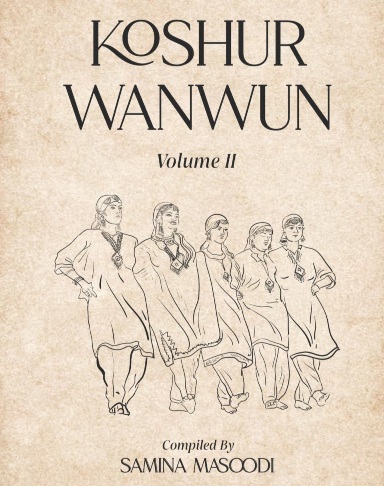
SRINAGAR, Dec 5: With the recent release of Koshur Wanwun Vol. II, US-based Kashmiri cultural archivist Samina Masoodi has made a landmark contribution to the preservation of Kashmiri heritage — expanding and enriching a growing repository of traditional wanwun songs that mark life’s celebrations in Kashmir.
A follow-up to her earlier Koshur Wanwun compilation (Volume I), Volume II collects over 500 new “wanwun huers” (couplets), many of which come from an oral inheritance passed down through generations, notably those recited by 87-year-old elder and retired teacher Misra Begum from Sopore, Baramulla. The songs were entrusted to Masoodi by Misra Begum’s granddaughter Dr. Mahnoor Khan, who played a central role in ensuring accurate transcription, pronunciation checks, and preservation of the lyrical heritage.
Safeguarding a rich folk tradition
Wanwun — literally “chorus” in Kashmiri — is an ancient and distinct form of folk singing performed mainly by women during weddings and auspicious ceremonies. The tradition involves two groups singing alternate couplets, often rich in metaphor, alliteration, and poetic imagery, weaving blessings, wisdom, and cultural values into melodic verse.
Traditionally, wanwun accompanied each stage of a Kashmiri wedding: from pre-wedding ceremonies such as henna (Maenzeraat), house-preparation rituals, through to the nikah, reception, bride’s departure to groom’s home, and post-wedding rituals including first meals and family gatherings. Volume II preserves songs associated with all these events, as well as others from engagement, naming ceremonies, and social gatherings — even including rare wanwun for events like first haircut (Zaare Kaasne) or baby’s circumcision (Khatanhaal).
Building on earlier work — a growing archive
Masoodi’s cultural preservation work is not new. Her first book, Manzeraath (2017), followed by Kasher Khander Baeth (2018), and the original Koshur Wanwun (2020), laid the groundwork. These efforts compiled lyrics of many traditional songs, making them accessible in Roman script with translations or explanatory glossaries — ensuring that even diaspora Kashmiris or younger generations can engage with their musical heritage. (kashmirisongs.com)
With Volume II, the collection expands significantly — doubling the repository, improving accessibility, and adding glossaries and English translations of hard-to-understand Kashmiri terms. The book also includes an electronic version, making it easier to read on tablets or mobile devices — a boon for Kashmiris living outside the valley or abroad.
Collaboration, community memory & cultural revival
Masoodi acknowledges the crucial role of contributors beyond herself. The compilation owes gratitude to many: besides Misra Begum and Dr. Mahnoor Khan, people like editors, proof-readers, local folk artists and community members who recalled, recited and corrected countless lines of song. This collaborative approach highlights the communal ownership of intangible heritage and the shared responsibility of preserving it for future generations.
Cultural scholars and folk-music enthusiasts see this as a timely intervention. As social changes — migration, modern lifestyles, media influences — erode traditional practices, works like Koshur Wanwun offer a committed attempt to archive and revive fading cultural expressions before they vanish.
By preserving wanwun, Masoodi is doing more than archiving songs: she is preserving identity. For many Kashmiris inside and outside the valley, wanwun evokes memories of weddings, communal gatherings, and ancestral homes. The songs carry centuries of oral history — family traditions, moral values, regional dialects, and cultural norms. The new volume ensures that these fragments of memory are not lost to time.


Comments are closed.