Srinagar: The Geological Survey of India (GSI) has officially declared Guryul Ravines, Khonmoh, Srinagar—also known as the Permian-Triassic Fossil Park—as a National Geo-Heritage Site of International Importance, marking a historic milestone in India’s geological conservation efforts. With this declaration, Guryul Ravines becomes one of 35 national geo-heritage sites across the country.
The announcement was made by Mr. Asit Saha, Director General, GSI, during an online event coinciding with the 4th UNESCO International Geo-Diversity Day and the 9th International Geo-Ethics Day 2025. Alongside Guryul Ravines, three additional sites—Mandak Pal, Bursoo, and Pastun (Tral)—were also recognized as Geo-Heritage Sites of International Importance.
During the ceremony, Mr. Saha emphasized the need for environmental conservation, balanced development, and ethical geological practices, warning against the risks of unplanned expansion and tourism. He urged geoscientists to promote sustainability and preserve biodiversity through responsible action.
The event featured presentations by a UNESCO representative, EPG Convenor Faiz Bakshi, Dy. DG GSI Dr. P.S. Mishra, and Prof. Ghulam Jeelani, Head of Earth Sciences, University of Kashmir. Prof. (Dr.) G.M. Bhat, a noted geoscientist and former Head of Geology at Jammu University, delivered a detailed presentation on new geological findings in the area. He was felicitated for his lifetime contribution to geoscience research.
EPG Convenor Faiz Bakshi lauded GSI’s decision and highlighted the group’s decade-long advocacy for the site’s protection. He raised concerns about encroachments and industrial expansion near the fossil park, warning that continued construction could irreparably harm the globally significant site. “With this declaration, the protection rules have completely changed, and authorities must ensure strict compliance,” he stated.
The Deputy Director General, GSI, Dr. P.S. Mishra, honored the Environmental Policy Group for its role in securing the recognition and promoting conservation awareness.
Guryul Ravines is of immense global scientific importance as it contains fossil evidence of the mass extinction event that occurred 252 million years ago, often termed “The Great Dying.” It also holds traces believed to represent the world’s first recorded tsunami. The site has attracted researchers from over 30 international universities since the 19th century, with early documentation by H. Falconer (1838) and Henry Godwin-Austen (1866).
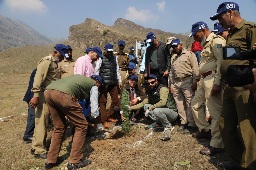
The event concluded with a plantation drive at the fossil park, symbolizing renewed commitment to conservation.


Comments are closed.