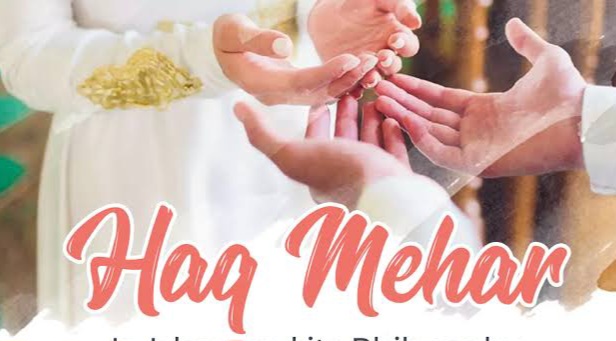
In the sprawling orchards and farmlands of Kashmir and other parts of India, there lies buried a quiet injustice. Muslim women —wives — are often given land by their husbands as Haq Mehar (dower) at the time of marriage, mentioned either in the Nikanama or supported by sworn affidavits. Yet, when the husband dies, this solemn religious and contractual promise frequently disappears. Sons, daughters, and other heirs often refuse to recognize this gift as legitimate. Revenue officials, citing technicalities, routinely hesitate to mutate such lands in the woman’s name. The result is not just a legal crisis but a moral one—the erosion of a woman’s right to her lawful dower and the denial of the dignity that land ownership offers.
Haq Mehar, under Muslim personal law, is a mandatory gift—whether in cash, kind, or property—that the husband must promise and pay to the wife, either immediately or on a deferred basis. It is not a dowry. Rather, it is an enforceable right of the wife. Courts, including the Supreme Court, have repeatedly ruled that Mehar is a debt upon the husband, payable even after his death from his estate. Islamic jurisprudence permits Mehar to be paid in land, gold, cash, or any other asset. If deferred, it becomes a liability upon death and takes precedence over distribution of the estate among heirs. Thus, Mehar is not charity—it is binding. But the question remains: how does this hold up under modern Indian revenue laws, especially when Mehar is in the form of land?
Many husbands gift land as Mehar, detailing khasra numbers, village names, and acreage either in the Nikanama or in an affidavit. In some cases, these are formal gift deeds. But in the absence of a registered gift deed, the problems begin. A Nikanama, legally admissible under the Indian Evidence Act, often contains clauses about Mehar and may specify land details. Despite this, revenue officials—particularly at the tehsil and patwari levels—rarely accept Nikanamas as sufficient for mutation.
Some men issue affidavits during their lifetime, reaffirming the land gifted to their wives as Mehar. While such affidavits support the claim—especially when uncontested and notarized—mutation authorities still hesitate without a registered deed or legal relinquishment from heirs. This brings us to a critical issue: can mutation be carried out based solely on the Nikanama and affidavit?
Under the Land Revenue Acts of many Indian states, including Jammu & Kashmir, mutations can be executed through inheritance, sale, gift, or court decree. For land given as Mehar, gift mutation (Hibbanama) is relevant. The challenge lies in whether a Nikanama or affidavit suffices to prove the gift.
Courts across India have supported the woman’s right to claim land given as Mehar, even without a formal gift deed. The Karnataka High Court, in Amina Bi vs. Revenue Authorities (2014), ruled that if land is clearly mentioned as Mehar in the Nikanama and possession has been transferred, mutation cannot be denied solely due to the absence of a gift deed. The Jammu & Kashmir High Court, in Fatima vs. State (2010), emphasized that mutation is a fiscal entry and does not confer ownership. It ruled that if the Mehar entry is backed by marital documents and possession is with the widow, she must be considered in constructive ownership. The Supreme Court, in Abdul Kadir vs. Salima (1886), affirmed that Mehar is enforceable as a civil debt—meaning a woman has a rightful claim even without a registered deed.
Disputes usually arise after the husband’s death, when the widow seeks to mutate the land mentioned as Mehar. At this point, her own children or in-laws may contest her claim. Revenue officers commonly respond with procedural barriers: mutation cannot be done without relinquishment deeds, no registered gift deed exists, or court orders are required. These procedural hurdles often become tools of harassment. The widow is forced into lengthy litigation, bearing legal costs and social pressure.
Revenue officials cite several concerns. First, land is immovable property, and transfers above ₹100 require registration under Indian law. Second, there is fear of future litigation; if a mutation is carried out and later challenged, the official may be held responsible. Third, there is a lack of clear guidelines in revenue manuals for Mehar-based mutations. Finally, if the woman is not in physical possession of the land, her claim is treated with suspicion.
In villages like Anantnag, Baramulla, or Muzaffarnagar, it is common for Nikanamas to mention 2–5 kanals of land as Mehar. The woman may live on that land for years, but when she applies for mutation, she faces resistance from heirs and revenue staff. Often, she is pressured to relinquish her claim in exchange for “maintenance.” Revenue clerks delay or dismiss her application, suggesting civil court recourse. Access to legal aid is difficult, and social stigma deters prolonged legal battles. What was meant to be a symbol of dignity becomes a source of humiliation.
To address this injustice, administrative and legal reforms are necessary. First, the government should recognize the Nikanama and affidavit as valid proof for mutation, provided land details are clear, there are no immediate objections, and possession is established. A circular should be issued by the revenue department allowing such mutations. Second, a simplified, one-time mutation category titled “Mutation based on Dower/Mehar in Muslim Personal Law” should be introduced. This could be processed using the Nikanama, an affidavit from the husband (if alive), possession proof, and optionally, a no-objection certificate from heirs.
Third, awareness campaigns should be launched to educate Muslim families. Imams, qazis, and marriage counselors should encourage proper documentation and registration of land as gift deeds at the time of marriage. Fourth, women-centric revenue counseling cells should be established at the tehsil level to assist widows in mutation applications, affidavit drafting, and mediating with family members.
Fifth, judicial precedents should inform revenue practices. Revenue officials must understand that mutation is not ownership—it merely records possession or transfer. Disputes should be settled in court, not pre-emptively by revenue authorities denying claims.
When the State denies Mehar-based land transfers, it undermines Muslim personal law and strips women of economic independence. In rural India, land is not just property—it is identity, legacy, and security. Every time a widow is denied her Mehar land, her faith-based dignity is reduced to a bureaucratic absurdity. Her marriage contract loses meaning in the face of a system she neither understands nor controls.
The law is clear. Faith is clear. The failure lies in execution. The case of Mehar land is not merely a revenue technicality—it is a civil rights issue for Muslim women. Revenue departments, especially in regions like Jammu & Kashmir, must develop streamlined, gender-sensitive mechanisms to honour Mehar-based land transfers. Let Haq Mehar not remain a forgotten promise. Let it be the foundation of a woman’s rightful share in the land she was solemnly promised—not as a gift, but as a right.