By: TAZEEMUL HAQ
Jammu & Kashmir has expanded apple production but failed to build comparable processing capacity. The challenge now is to retain more of the value its orchards generate.
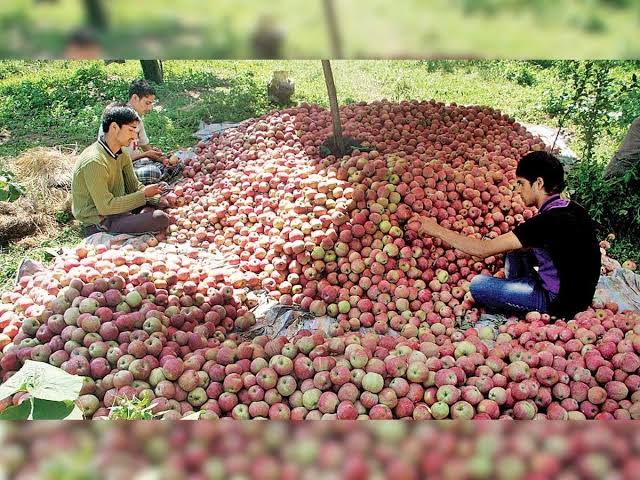
Jammu & Kashmir has recorded significant progress in apple production, supported by high-density plantations, improved planting material and production subsidies. Yet this success has exposed a fundamental weakness: the region has expanded its capacity to grow apples without building a comparable capacity to process them.
J&K produced around 21.4 lakh tonnes of apples in 2023, but only 2–3 per cent of the crop is processed locally, according to NITI Aayog’s 2026 Roadmap for Horticulture Development in the Union Territory of Jammu and Kashmir. The central question is no longer simply how to produce more apples, but how to ensure that a greater share of the value they generate remains within the region.
This is not a new problem. A study of the 2011–12 apple economy estimated that 3.22 lakh tonnes of surplus Grade-C apples were available for processing, while only around 30,000 tonnes of Grade-C and culled apples were being converted into apple concentrate (Bhat et al., 2019). More than a decade later, the processing gap persists.
The problem exposes the limitations of a production-centred agricultural policy. Subsidising orchards and increasing yields are relatively straightforward interventions, with measurable results. Industrial value addition is more demanding. It requires processing plants, reliable electricity, efficient logistics, quality standards, assured procurement, cold chains, skilled workers, market development and investment capable of surviving seasonal fluctuations.
The farmer’s position in the value chain also matters. Research on Kashmir’s apple marketing system has highlighted how market channels, infrastructure and access to information influence growers’ share of the consumer price (Rashid et al., 2024). Increasing production without improving the systems through which apples are aggregated, stored, processed and marketed may therefore leave the distribution of economic returns largely unchanged.
NITI Aayog estimates that around 15–20 per cent of apple production is culled, while only a small fraction of culled fruit is processed into concentrate. The report also estimates that about 60 per cent of apples are marketed outside the Union Territory. This represents not merely a processing deficit but a missed opportunity to create local enterprises, skilled employment and additional income for growers.
The imbalance becomes more significant when viewed alongside J&K’s food security challenges. Estimates cited in recent reporting put food-grain production in Kashmir at around 4.5 lakh tonnes against an annual requirement of 13.4 lakh tonnes, leaving a substantial deficit met through supplies from Punjab, Haryana and other states.
The contrast is striking: Kashmir produces a high-value fruit extensively marketed outside the region, yet remains dependent on external supplies for a significant share of its staple food requirements. While horticulture is an important source of income, its expansion must be considered alongside the need to protect agricultural diversity and strengthen local food security.
The distinction between production and value capture is crucial. Apples sold as fresh fruit generate income, but processing them into juice, concentrate, pectin, cider and other food products can support a wider industrial ecosystem. Branding, packaging and market development can add further value. The objective should be to locate more of these activities within J&K rather than exporting raw produce and purchasing higher-value products from elsewhere.
NITI Aayog’s 2047 roadmap recognises several of these requirements, proposing processing facilities, small-scale minimal-processing units, branding, geographical indication promotion, private-sector participation and a proposed Horticulture Development Fund. The challenge now is implementation. Policy announcements must translate into viable enterprises, reliable procurement arrangements and markets for processed products.
Success should also be measured differently. Alongside production volumes, J&K should track the share of apples processed locally, value added per tonne, growers’ share of the final consumer price, processing capacity utilisation, post-harvest losses, horticultural employment and the growth of producer-owned enterprises.
An orchard cannot be the endpoint of an agricultural strategy. Every additional tonne of apples should raise a second question: where will the additional value be created?
Kashmir does not necessarily need to produce more apples to strengthen its apple economy. It needs to process, brand and industrialise a greater share of what it already grows. Until that happens, the region’s celebrated horticultural success will remain constrained by a missing industry.
The author is a Climate Reality Leader and a master’s student in the Department of Economics, Islamic University of Science and Technology (IUST). He can be reached at tuhaq220@gmail.com.