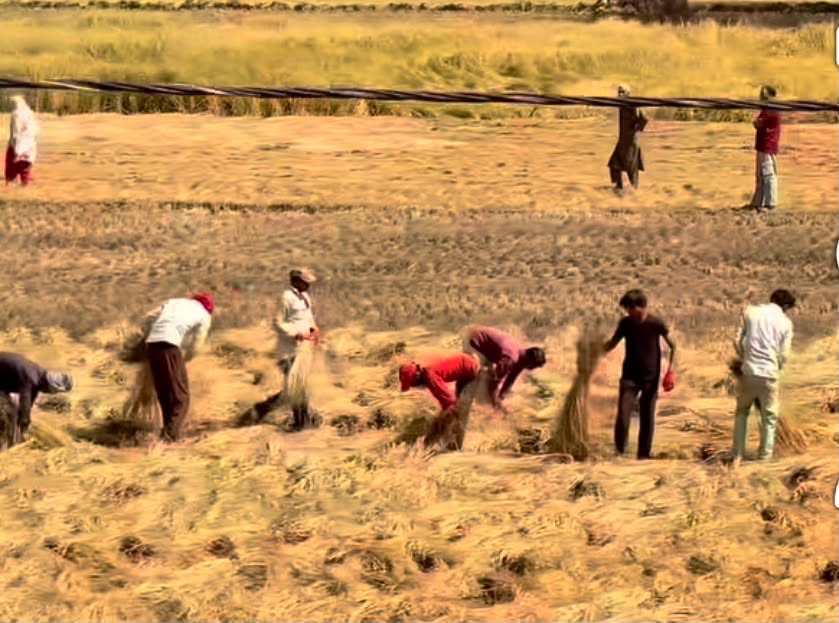
I went home to my village this week, and honestly, I haven’t been able to get over what I saw all around.
It is harvest season in Kashmir. The orchards are sagging under the weight of apples, the paddy’s gone gold and ready for cutting. And, guess what! Almost none of the hands doing that work are local Kashmiri. Labourers from other states in many cases are the ones up the ladders plucking apples, packing crates, bent over the rice fields from sunrise to sunset. Meanwhile, down at the village shop, a bunch of educated Kashmiri boys are sitting around on their phones, going on about how there is no work to be found.
I don’t say having people from outside working here is not desirable. Most of the economic systems work like that – after all thousands of Kashmiris also work outside the state. Outside workers have improved our work culture. My point is different.
I am an economics student, so I could sit here and call this a “structural distortion” or whatever term fits the textbook. But standing at the edge of that field, it didn’t feel academic at all. It just felt sad.
My grandfather’s generation did it all themselves – ploughed their own land, pruned their own trees and helped build their own houses. They carved walnut wood, wove pashmina and carpets, made papier-mâché pieces people around the world still buy. Every household had some skill, some craft and nobody thought twice about it. It wasn’t “labour” in the way we say it now, like it is something beneath us. It was just life. It was ours.
So what happened? Honestly – populist politics happened. For the last forty-odd years, every party figured out the same trick: dangle a government job, or some short-term scheme, and you’ve got yourself a vote bank. Election after election, that is the promise. And slowly, an entire generation stopped looking at their land or their workshop and started looking only toward a government seat.
And look where that has got us. A boy finishes college and then the real waiting begins – for a vacancy, then the notification, then the exam, then the result, then probably a court case holding the whole thing up for another two years. I know men well into their forties still waiting on some low-paid post that won’t even cover their monthly expenses properly. They gave away their best years to that wait. And while they waited, somebody else was plumbing their houses, painting their shops, building buildings, picking the apples off their family trees and now even the very technical job of trimming their orchards.
Try hiring domestic help here. In a region of almost nine million people, it is genuinely difficult. We haven’t run out of people – we’ve run out of people willing to do the work, because somewhere along the way we were taught that anything outside a government job is somehow lesser.
I am not blaming the youth here, to be clear. I am the youth. If you grow up being told the only respectable life is a government chair, of course that is what you chase. The real fault lies with whoever built that trap in the first place and kept cashing in on it.
And the cost of it all – a massive chunk of the J&K budget just goes into salaries and establishment expenses, year after year. Imagine if even some of that had gone into building our public infrastructure, mainly a decent healthcare system, instead. Jobs created only where they are actually needed, and the rest of that money put into things that actually grow an economy. Our apples could be sold as juice and jam under our own brands instead of shipped out raw in wooden crates. Our handicrafts could still be leading export markets instead of dying out in workshops where the old karigars have no one left to teach.
Because that is what is really happening — the artisans are getting old, there is no one picking up the craft after them, and once that last master is gone, it is gone. You don’t get it back.
I am not writing this because I don’t love my people. I am writing it because I do, and I don’t want to keep watching them wait around for a future that was never really coming. Political parties need to stop treating government jobs as a vote-winning gimmick. And we need to be honest with ourselves too – no work is small. Plucking an apple or carving a piece of wood or painting a house doesn’t make your hands any less worthy.
Our grandparents made this valley what it is with their own two hands. I would like to believe we still can.
Next time, I don’t want our youth to just watch from the edge of these orchards. I want to them, all of us, to be right there.