SKUAST-K hosts Sustainable Mountain Development Summit and Agriculture Science Congress; Shalimar Declaration expected
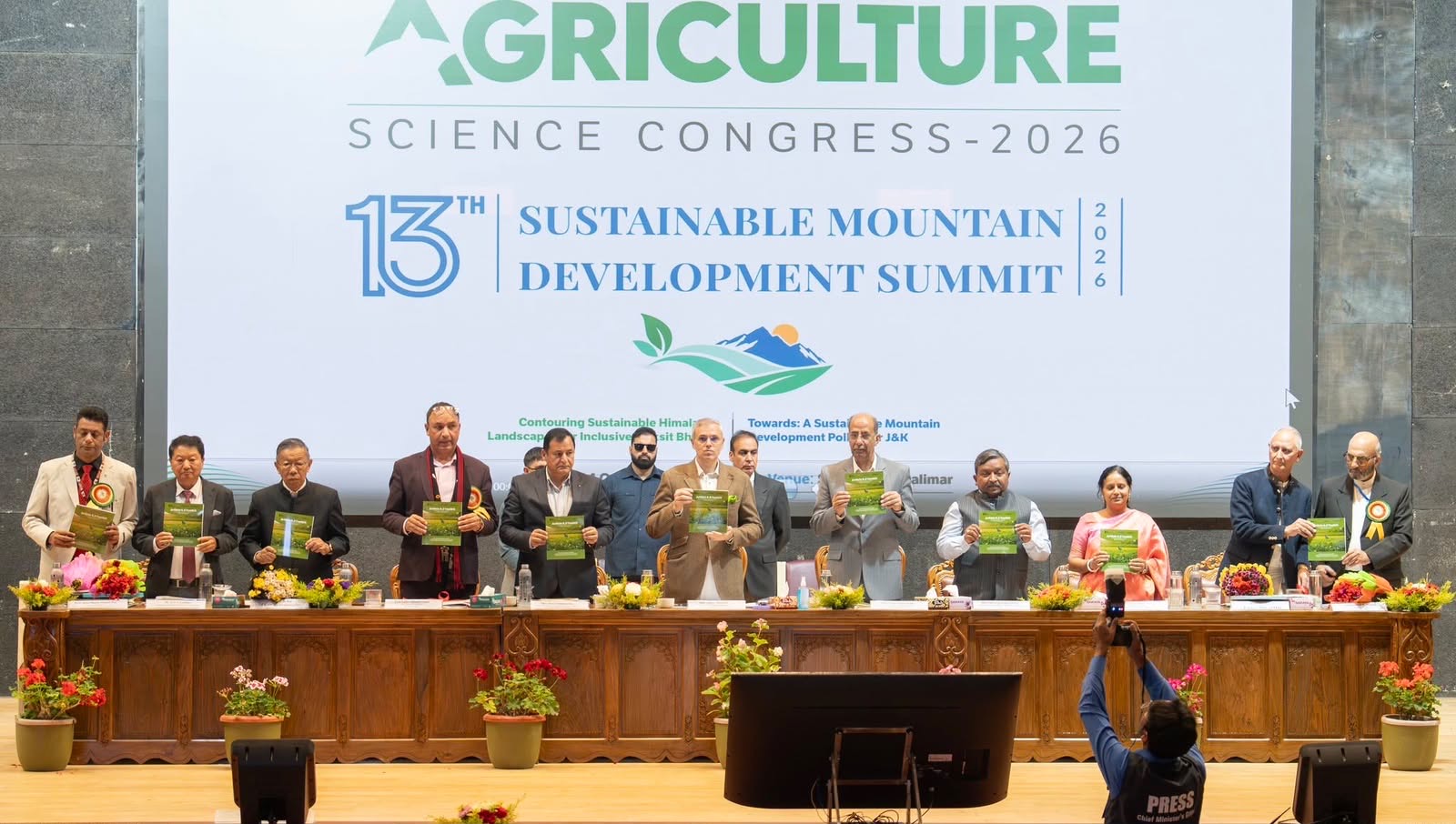
Srinagar, October 12: Chief Minister Omar Abdullah on Monday backed the proposed Jammu and Kashmir Sustainable Mountain Development Policy, calling for a practical roadmap that balances environmental protection with livelihoods, as Sher-e-Kashmir University of Agricultural Sciences and Technology of Kashmir (SKUAST-K) hosted the 13th Sustainable Mountain Development Summit (SMDS) and the J&K Agriculture Science Congress 2026.
Inaugurating the three-day events at the university’s Shalimar campus, Omar said Jammu and Kashmir aspired to become the first Himalayan territory to have a dedicated mountain development policy, adding that his government was keen to take the initiative forward.
The events, being held from October 12 to 14, have been jointly organised by SKUAST-K, the Integrated Mountain Initiative (IMI) and the J&K Science, Technology and Innovation Council (JKSTIC). Policymakers, scientists and delegates from 11 Himalayan states are participating in discussions on mountain sustainability, climate resilience and the draft Sustainable Mountain Development Policy for Jammu and Kashmir (JK-SMDP 2026).
“We cannot stop global warming on our own, but we can certainly take better care of our own environment,” the Chief Minister said, pointing to erratic snowfall, receding glaciers, including Thajiwas near Sonamarg, and recurring flash floods as signs of the worsening climate crisis.
Referring to recent disasters in Nepal, he stressed the need to translate scientific knowledge into practical policy measures.
“Those recommendations must be grounded in reality—balancing ecological sustainability with everyday economic survival,” he said.
Omar said agriculture and horticulture, rather than tourism alone, formed the backbone of Jammu and Kashmir’s economy, linking environmental resilience with food security and rural livelihoods.
He called for scientific slope-stabilisation measures during road construction to reduce landslides, planned vertical expansion to conserve scarce land, and the development of new tourist destinations supported by carrying-capacity assessments and adequate waste-management and sewage infrastructure.
On tourism management, he emphasised the need to address mounting pressure on destinations such as Gulmarg, Pahalgam and Sonamarg without abruptly undermining the livelihoods of people dependent on the sector.
SKUAST-K Vice Chancellor Prof. Nazir Ahmad Ganai outlined an 11-point policy framework aimed at making mountain governance more systematic and enforceable.
The proposed measures include carrying-capacity-based visitor management, automated early-warning systems for natural hazards, clean-in-place and zero-waste systems, cleaner mobility through designated green gateways, and stronger coordination among government departments based on scientific data.
Mandeep Kaur, Commissioner Secretary, Housing and Urban Development Department, called for closer institutional collaboration with SKUAST-K to incorporate climate-risk assessments into hill-town master plans and promote seismic-resilient urban development.
Agriculture Production Minister Javid Ahmad Dar stressed the importance of climate-resilient farming models to protect rural livelihoods from environmental shocks. Advisor to the Chief Minister Nasir Aslam Wani called for immediate measures to check unregulated exploitation of natural resources.
The inaugural session also featured addresses by Integrated Mountain Initiative President Dr S.T.S. Lepcha, former MP and former IMI president P.D. Rai, and IMI Lead Strategist Dr Rajan Kotru. They highlighted the importance of regional cooperation, inclusive green economies and collaboration across the Himalayan region.
Several publications related to the summit were released during the opening session. A documentary titled Himalayan Voice, jointly produced by SKUAST-K and IMI, was also screened.
Prof. Khursheed A. Dar, organising secretary of the Agriculture Science Congress, delivered the welcome address, while Prof. A.H. Mughal, Dean of the Faculty of Forestry and organising secretary of the summit, presented the vote of thanks.
The remaining sessions will cover 12 thematic areas, including climate-smart agriculture, digital farming innovations, the bio-economy and the proposed mountain development policy.
The summit is expected to conclude with the adoption of the Shalimar Declaration, setting out recommendations for sustainable development and climate resilience across the Himalayan region.