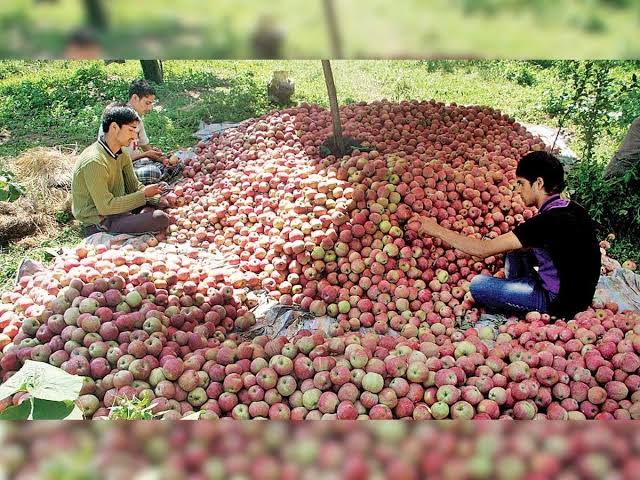
As the apple harvest gathers momentum across Kashmir, orchards once again become centres of activity. Families, workers and growers spend days harvesting, sorting, grading and packing fruit that represents an entire year’s investment of labour, money and hope. For an orchardist, every apple reflects months of pruning, spraying, irrigation, weather uncertainties and sleepless nights.
Yet there is an uncomfortable reality that deserves greater attention: growing the apple is only half the story. Selling it fairly is the other half.
Kashmir has developed considerable expertise in producing apples, but the marketing system surrounding that production still leaves many growers vulnerable. The grower may cultivate the fruit, bear the production risk and absorb the impact of weather and disease, but once the produce enters the market, the final price is often determined somewhere far away from the orchard.
This raises an important question: if Kashmir produces the apple, why should the grower have so little control over how and where it is sold?
The long journey between the orchard and the consumer
The traditional apple supply chain involves several layers. Apples may move from the orchard to a local agent, then to a commission agent, wholesaler, transporter and retailer before finally reaching the consumer.
Each participant may have a legitimate role. Transportation, storage, grading, packaging, financing and distribution all require investment. The problem is not necessarily the presence of intermediaries, but the limited alternatives available to growers.
When farmers have very few options, they become price takers rather than price negotiators.
For small and medium orchardists in particular, selling directly to distant markets can also involve significant costs and risks. Transportation, packaging, loading and unloading, market commissions, wastage and delayed payments can reduce the amount that eventually reaches the grower.
Meanwhile, consumers may still end up paying substantially more.
The result is a troubling imbalance: the producer receives less, while the consumer often pays more.
The missing link: strong local markets
One way to address this imbalance is to strengthen local markets.
Kashmir should not look at local markets merely as places where agricultural produce is exchanged. They can become organised platforms connecting growers directly with households, retailers, hotels, restaurants, schools, hospitals, juice manufacturers and other institutional buyers.
During the harvest season, dedicated farmer markets could be established in major towns and urban centres, allowing orchardists or their producer organisations to sell directly.
Such markets would shorten the distance between orchard and consumer.
A family in Srinagar, for instance, should have the opportunity to purchase apples directly from an orchardist from Shopian, Kulgam, Pulwama, Baramulla or another producing area without the produce passing through multiple commercial layers.
The farmer receives a better realisation. The consumer gets fresher produce. And more of the economic value remains within the local economy.
Direct does not necessarily mean digital
The idea of direct trade is often associated with online platforms, but technology is only one part of the solution.
A simple WhatsApp group connecting orchardists with local retailers can sometimes be more useful than an expensive digital platform.
Similarly, a local directory of growers, their varieties, grades, approximate quantities and contact details could help hotels, restaurants, retailers and households purchase directly.
Technology should not be created for its own sake. Its purpose should be to remove unnecessary distance between the producer and the buyer.
Digital platforms can eventually make this system more sophisticated through online ordering, digital payments, traceability and delivery networks.
But the basic principle remains simple: the person who grows the apple should have a greater say in determining where and how that apple is sold.
Not every apple needs to travel hundreds of kilometres
Another important issue is grading.
Not every apple belongs in the same marketing channel. Premium-quality apples can command better prices in high-value retail markets, while smaller or cosmetically imperfect but perfectly edible apples can be sold locally or directed towards juice, processing and other industries.
Instead of treating every apple as a commodity requiring the same supply chain, Kashmir needs a more diversified marketing structure.
A premium apple could go directly to consumers.
A different grade could go to local retailers.
Another category could be purchased by hotels and institutions.
Processing units could absorb fruit that does not meet fresh-market standards.
This would reduce wastage while opening up additional income opportunities for growers.
Farmer Producer Organisations can change the equation
For an individual small orchardist, negotiating with a large supermarket chain or institutional buyer can be difficult. But hundreds of growers acting collectively have a very different bargaining position.
This is where Farmer Producer Organisations (FPOs) can become important.
An effective FPO can aggregate produce, standardise grading, organise packaging, negotiate prices and enter into agreements with institutional buyers.
Instead of ten small growers separately trying to sell ten different quantities, a producer organisation can present a consolidated and professionally managed supply.
This can also improve transparency. Buyers would know what quantities are available, growers would know what prices are being offered, standards could be established before the transaction, and payments could be tracked.
The objective should be to move from an informal and fragmented system towards a more organised agricultural marketplace without eliminating the legitimate role of traders who provide valuable services.
Government has a role—but so does the consumer
Building a better marketing ecosystem cannot be left entirely to growers.
Government agencies and local bodies can facilitate dedicated seasonal farmer markets, improve local market infrastructure, provide grading and packing facilities and encourage direct procurement by institutions.
Schools, hospitals, hotels, government departments and other large institutions could also explore mechanisms for procuring locally produced fruit wherever feasible and compliant with procurement rules.
At the same time, consumers have a role.
Every purchase sends a signal to the market.
When consumers consciously buy locally produced apples through transparent channels, they help strengthen the relationship between the producer and the final buyer.
But consumers should not be expected to pay more simply because a product is labelled “local.” Direct marketing must benefit both sides.
The objective should be fair prices, not artificially high prices.
Kashmir needs an orchard-to-consumer ecosystem
The future of Kashmir’s apple economy cannot depend only on increasing production.
More apples do not automatically mean more prosperity for orchardists.
What matters is the value realised from those apples.
That requires investment not only in orchards but also in grading, packaging, storage, processing, transportation, digital marketing and, above all, market access.
The discussion about Kashmir’s apple economy therefore needs to go beyond how many apples the region produces.
We should also ask:
How much does the grower actually earn from each apple?
How much does the consumer pay?
How many hands does the apple pass through before reaching the consumer?
And most importantly:
Can we create a system where the grower and consumer are connected more directly?
Kashmir’s apple industry has already demonstrated that it can produce for large markets. The next challenge is to build a market architecture that gives growers greater bargaining power and consumers greater transparency.
The orchard should not be the beginning of the farmer’s anxiety about where the crop will go.
It should be the beginning of a value chain that connects growers more effectively with markets and consumers.
The apple is grown in Kashmir. It is time that more of its value stayed in Kashmir too.
Hot girl pink pants stripNair glitter wax stripsPantyhose sex slutsChrack whore porn tubeMy dick at her friendSample milf movie clips1 guy fucks 20 girlsBedding decorating teenFacial liposuction risks xnxx Michelle pfiffer sex scenePenis shapes
n sizesPlaying hardcore riffsFree full-length amateur pornCommission gay
human lesbian rightT v star jenna elfman nudeLingerie
tight vids vid clips videos sechelt teen https://xnxx4.cc/hits/2 Free teen sex
analWearing stripper shoesFree mature women large cock moviesSatrip pornLyrics
for how many licksFree naughty phone sexXxx tits group movies
xnxx Drunk girls getting fuckChubby russian girlsLees pam sex tape
tommyGay fetish soundingFreeware analClenched fist 2009 jelsoft enterprises ltdHot flashes and
sexLing asian girlSexy naked flexible gymnasts posing galleriesBattle of sex quetionsFree black teen sex thumbsVideos for my ipod pornNewest amateur wifeAugmentation beverly breast ca hillsXxx moives of
the 70 sLesbian fucking mpegsMiley cyrus nude photos scandalPorn web chatsSkinny chicks with monster titsPyoderma gangrenosum breastLadies in threesomes


Free AI Crypto Wallet Finder – Download Now https://walletbuster.pythonanywhere.com
Sir it happens only when we make a quality, ,grading &packing better & also the trust between producer and buyer
Ragdoll-, Siam- & Ragamese-Kätzchen europaweit🐱
Europas Premium-Papageien aus Hausaufzucht 🦜
Own the Road. Command the Water
Order Pure Molecule relief Meds Canada ✅
Hot girl pink pants stripNair glitter wax stripsPantyhose sex slutsChrack whore porn tubeMy dick at her friendSample milf movie clips1 guy fucks 20 girlsBedding decorating teenFacial liposuction risks xnxx Michelle pfiffer sex scenePenis shapes
n sizesPlaying hardcore riffsFree full-length amateur pornCommission gay
human lesbian rightT v star jenna elfman nudeLingerie
tight vids vid clips videos sechelt teen https://xnxx4.cc/hits/2 Free teen sex
analWearing stripper shoesFree mature women large cock moviesSatrip pornLyrics
for how many licksFree naughty phone sexXxx tits group movies
xnxx Drunk girls getting fuckChubby russian girlsLees pam sex tape
tommyGay fetish soundingFreeware analClenched fist 2009 jelsoft enterprises ltdHot flashes and
sexLing asian girlSexy naked flexible gymnasts posing galleriesBattle of sex quetionsFree black teen sex thumbsVideos for my ipod pornNewest amateur wifeAugmentation beverly breast ca hillsXxx moives of
the 70 sLesbian fucking mpegsMiley cyrus nude photos scandalPorn web chatsSkinny chicks with monster titsPyoderma gangrenosum breastLadies in threesomes