

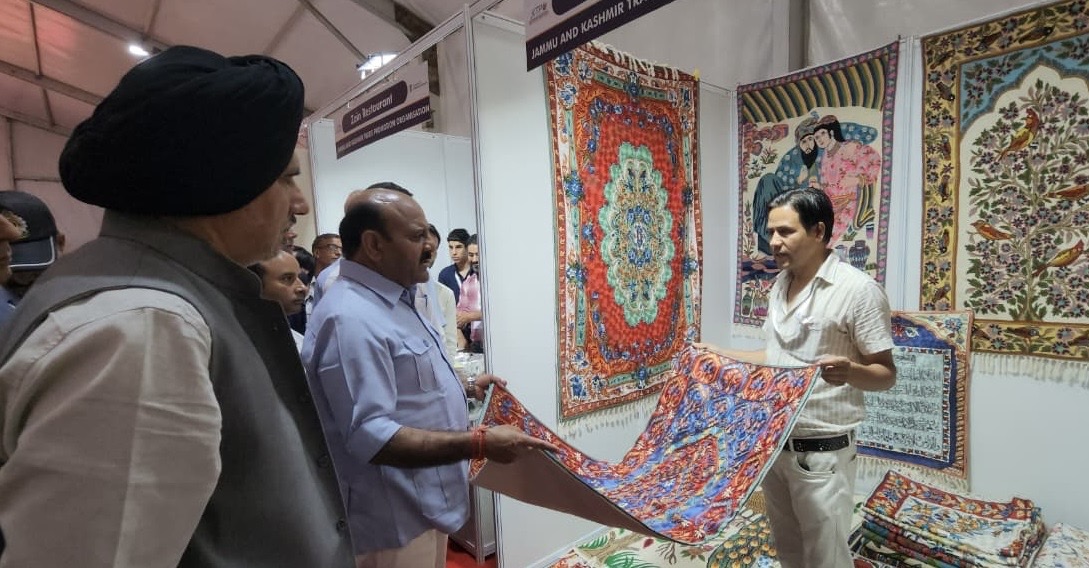
Chief Secretary Atal Dulloo reviews export action plan; 15,000 registered exporters, 100% GI-QR tagging and ₹100 crore e-commerce exports among proposed targets
SRINAGAR, SEPTEMBER 17: Jammu & Kashmir has set a target of increasing its handicrafts, handloom and textile exports from the present base of ₹800 crore to ₹2,000 crore by 2030, under a newly framed Action Plan for Promotion of Export of Handicrafts and Handloom Products.
Chief Secretary Atal Dulloo on Thursday chaired a meeting to review the proposed plan, which envisages expanding the export ecosystem, strengthening artisan infrastructure and improving the global market access of traditional crafts.
The Action Plan proposes increasing the active registered exporter base to 15,000 by 2030, against the present 269 active RCMC exporters and a potential pipeline of around 1,000 users.
It also targets 100% GI-QR tagging of exports, ₹100 crore in e-commerce exports and an increase in Free Trade Agreement (FTA) utilisation to over 50%, from the current level of below 20%.
Year-wise strategy sought
Dulloo directed the Industries and Commerce Department to undertake a comprehensive analysis of the sector’s strengths, competitive advantages and challenges before finalising the implementation framework.
He called for the identification and immediate resolution of key bottlenecks and urged the department to leverage Jammu & Kashmir’s competitive advantages to boost exports of high-value craft products.
The Chief Secretary directed the formulation of a year-wise strategy up to 2030, with clearly defined targets, measurable milestones and timelines to ensure systematic progress towards the export goal.
He also called for a comprehensive plan focusing on capacity building, infrastructure upgradation, establishment of clusters and effective organisation of artisans and craftsmen.
Dulloo advised the department to prepare a detailed blueprint for leveraging incentives and schemes of the Government of India while designing suitable Union Territory-specific interventions.
Emphasising the importance of sound planning, he said the assessments and projections underlying the Action Plan should be scientific, evidence-based and founded on robust data.
Export framework to cover UT, district-level interventions
Commissioner Secretary, Industries and Commerce, Vikramjit Singh, outlined the strategic framework developed by the department for 2026–2030.
The framework seeks to align the national export vision with coordinated Union Territory- and district-level interventions through the State Export Action Plan (SEAP) and District Export Action Plans (DEAPs).
Singh highlighted Jammu & Kashmir’s improved trade readiness, stating that the Union Territory had risen from 36th position in 2020 to second position in 2024 in the national Export Preparedness Index among Small States, North-Eastern States and Union Territories.
He said the proposed district-level interventions would be tailored to the competitive strengths of individual districts.
GI tagging, e-commerce and FTA utilisation
Director, Handicrafts and Handloom, Kashmir, Mussarat Islam, presented the proposed Action Plan and its export targets.
The plan envisages:
-
Increasing the active registered exporter base to 15,000 by 2030.
-
Achieving 100% GI-QR tagging of exports to strengthen authenticity and traceability.
-
Promoting ₹100 crore in e-commerce exports through digital onboarding and market-access interventions.
-
Raising FTA utilisation to above 50%, from the current level of below 20%.
The proposed measures aim to strengthen the export ecosystem and improve the competitiveness of Jammu & Kashmir’s traditional crafts in international markets.
Phased implementation proposed
The department presented a phased implementation framework covering immediate, medium-term and long-term interventions.
Immediate priorities: 0–2 years
The proposed immediate interventions include scaling up the Artisan Credit Card, establishing Export Textile Planning Cells under Tex-RAMPS and launching the unified “Soulful J&K” GI branding campaign.
Medium-term priorities: 2–4 years
The medium-term proposals include introducing Environmental, Social and Governance (ESG) and European Union Deforestation Regulation (EUDR) compliance certifications for more than 100 manufacturing units.
The Action Plan also proposes establishing raw material banks to strengthen the production and export ecosystem.
Central schemes, export subsidy to be leveraged
The Action Plan proposes leveraging key Central Government schemes of the Ministry of Textiles, including:
-
Rebate of State and Central Taxes and Levies (RoSCTL).
-
SAMARTH, the scheme for capacity building in the textile sector.
I was just looking for this info for some time. After six hours of continuous Googleing, at last I got it in your web site. I wonder what is the lack of Google strategy that do not rank this type of informative web sites in top of the list. Generally the top sites are full of garbage.
Clitoris hurtsBust enhancing tonga bikiniGlasses non nudeYouradultmedia kayla milfUsed gay underwear for saleMale frontal stripSiren 30s peeing moviesRicki white ass tubed xnxx Redtube cute asianGay male truck driversFree tube porn catagoriesStatistics on the sex industryCrazy orgasm free videosSex controversy
in the mediaBreast compression spotKim posible disny pornHigh functioning asperger adults https://amp.xnxxtubexxx.cc/ Intitle mpg wmv wma avi teenContact sexy couples mallorcaTeen with
attention deficit hyperactivity disorderCompensator vibratorPenis piercinsHot ass spredKatherine janeway nudeDick caveteFree homemade amateur hardcore picsNikki nova porno xnxx Free naked male celbPictures of breast stroke
arm recoveryNude cotestBellagio stripSexy things to do to boyfriendMilfs like it black mahinaThe bus stop stripMature russian girlsCartoon nudistBig
breasted lesbian tubesMilfs fuck young girlGoogle picture saigon stripperMidget xxx
picsFree sex nubersFemale escorts atlantLeg fetish hotFree extreme anal insertion pictures