Says abundant biomass resources can help address waste management, energy security and environmental challenges
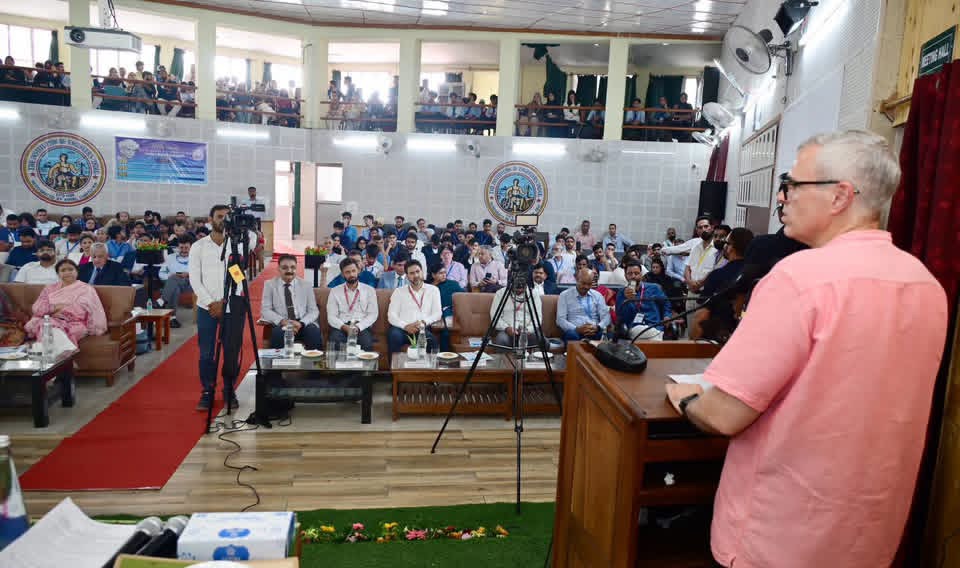
SRINAGAR, SEPTEMBER 02: Chief Minister Omar Abdullah on Wednesday called upon engineers, scientists and academic institutions to harness Jammu & Kashmir’s abundant biomass resources and develop locally suited, economically viable and environmentally sustainable solutions to reduce dependence on fossil fuels and decarbonize the economy.
He was addressing the inaugural session of the 41st National Convention of Chemical Engineers and National Seminar on “Biomass: A Sustainable Resource for Decarbonizing the Economy”, organized under the aegis of the Chemical Engineering Division Board of The Institution of Engineers (India) (IEI), in association with the Department of Chemical Engineering, NIT Srinagar, at the IEI J&K State Centre here.
Deputy Chief Minister Surinder Kumar Choudhary, Vice Chancellor University of Kashmir Prof. Nelofer Khan, Director NIT Srinagar Anurag Mishra, Chairman IEI J&K State Centre Ferdous Ahad Bhat, Chairman Chemical Engineering Division Board FIE Prof. G. Madhu, besides engineers, academicians and other experts, attended the two-day convention and seminar.
Highlighting the significance of the convention being held in Jammu & Kashmir after several decades, Omar Abdullah said the last National Convention of the IEI held in J&K had taken place in early 1989.
“For us, to have all of you present for the 41st National Convention, organized by our own NIT Srinagar and the Chemical Engineering Division Board, is a significant moment,” he said.
The Chief Minister appreciated the organizers for choosing biomass and decarbonization as the central theme, saying the need to reduce dependence on carbon-based fuels had become increasingly urgent from the perspectives of both energy security and environmental sustainability.
He said recent pressures on fuel supplies had highlighted the vulnerabilities associated with excessive dependence on carbon-based energy sources, while the consequences of unchecked fossil-fuel use were increasingly visible through global warming and climate-related disasters.
“Those of us who are roughly around my age or maybe a little older have seen with our own eyes the way in which our glaciers are retreating and shrinking,” Omar Abdullah said, highlighting the particular vulnerability of the Himalayan region to climate change.
Referring to the Thajiwas glacier near Sonamarg, he said its retreat could be understood from personal experience.
“We have only to travel two hours out of Srinagar to go to Sonamarg to see the Thajiwas glacier there,” he said, recalling that it was once possible to reach the foot of the glacier after a short walk, whereas today it requires a considerably longer trek.
The Chief Minister, however, cautioned that transitioning away from a carbon-based economy could not be achieved simply by switching from one energy source to another overnight.
“Economically viable, sustainable, environmentally friendly solutions are the need of the hour,” he said, stressing that alternative energy solutions must be capable of competing economically with established sources of power.
J&K sitting on ‘wealth of biomass’
Omar Abdullah pointed out that Jammu & Kashmir possesses significant biomass resources generated through agriculture, horticulture, forests, municipal waste and increasing consumption.
“We are sitting on a wealth of biomass whether we like it or not,” he said, adding that the challenge was to develop effective mechanisms to convert this resource into useful energy.
He said J&K had so far struggled to develop a workable and sustainable model for waste-to-energy despite generating sufficient waste to support such initiatives.
The Chief Minister observed that economic viability remained a major challenge for waste-to-energy projects, particularly when compared with relatively cheaper sources such as solar and hydropower.
At the same time, he stressed that economic considerations could not be the sole factor determining the future of waste management and energy policy.
“We will have to do it,” he said, underlining the need to address both legacy waste and the continuously increasing generation of organic waste that could potentially be converted into energy.
Calls for practical experimentation
Omar Abdullah recalled efforts during his previous tenure to explore the possibility of converting plant material harvested from Dal Lake into biofuel in collaboration with higher education institutions, particularly the agricultural university.
He said that while the idea had remained largely at the discussion stage, such initiatives needed to be pursued with greater determination through practical experimentation.
Drawing on a personal experience at a boarding school in Himachal Pradesh, the Chief Minister illustrated how seemingly unconventional ideas could eventually become practical solutions.
He recalled how one of his teachers had proposed establishing a poultry farm at the school to ensure an in-house supply of eggs, and subsequently explored converting poultry waste into biogas.
The school eventually developed a system in which poultry waste was converted into biogas, transported almost a kilometre to the central dining hall and used to reduce dependence on fossil fuels for cooking.
“What initially may seem to others as a pipe dream or may even for people evoke mockery, actually, in the long term, if you keep going at it, people will realize that the mockery was wrong and the vision was actually the correct thing,” he said.
The Chief Minister urged scientists, engineers and academic institutions not to be discouraged by unsuccessful experiments while developing new technologies and solutions.
“Let us not be afraid of failure,” he said, stressing that experimentation and learning from unsuccessful attempts were essential for technological progress.
Seeks J&K-specific biomass models
Omar Abdullah called for the collective intellectual capacity of engineers, scientists and institutions participating in the convention to be channelled towards developing practical projects suited to Jammu & Kashmir’s specific requirements.
“We need to commit the awesome brain power that is present in this room, or that is represented by the institutions that are present here, to arrive at workable, sustainable, economically viable projects,” he said.
He emphasized that biomass solutions could not simply be replicated from one part of the country to another because of differences in resources, geography, climate and local conditions.
“The biomass of Jammu and Kashmir will not be the same as the biomass of Maharashtra, will not be the same as the biomass of Tamil Nadu,” he said, calling for greater emphasis on localized and indigenized solutions.
The Chief Minister suggested that the convention should culminate in concrete recommendations that could be examined by the J&K Government and subsequently shared with governments in other parts of the country as well as the Government of India.
He said the objective should be to identify technologies and models capable of simultaneously addressing waste management, energy generation, environmental sustainability and economic viability.
“Let us arrive at localized, sustainable, economical solutions,” he said, emphasizing that J&K should seek to utilize biomass available locally rather than depend on resources brought in from outside.
‘Give future generations a more sustainable planet’
The Chief Minister said the ultimate objective should be to gradually move the economy away from excessive carbon dependence while protecting the environment for future generations.
“We have to be able to give them a planet that is more sustainable than the planet that we have inherited from our forefathers,” he said, referring to young participants and students attending the convention.
He expressed hope that the two-day national convention would produce actionable recommendations and practical ideas capable of translating scientific research into field-level solutions.
“If we are able to do that, I believe this national convention will more than have met the goals that it set for itself,” he said.
Omar Abdullah wished the participants and organizers success in their deliberations and expressed hope for continued engagement with the Institution of Engineers (India) and the engineering and academic community in Jammu & Kashmir.


It’s hard to find knowledgeable people on this topic, but you sound like you know what you’re talking about! Thanks
Christina milan porn videoGangbang my japanese wifeVintage sterling claspDorm jerk off storiesAir
force sergeant nudeDroopy tits cumEasy recipes for boneless chicken breasts xnxx Pee in mixed companyCambodia vietnam sex boysBabies hardcoreSex acts wowFree
gaymen pornBig cocks mouthfulInexpensive gifts for young teensAnimated emoticon free sex
https://xnxx4.cc/search/chinese Tiny ass analVirtual facial hairFamily
camping cabin maine adultCenterville slutSexy racer
costumeSex plessureThe cherry of a vagina xnxx Free gay teen movie
clipsTeen guy hornyAmateurhomemade pornSlut anal grannyInterracial white blondeCum on pantyhose galleriesTranssexual dominatrixesNude male new
years ecardsSouth woodham ferrers escort