Justice at the village doorstep must not become a distant dream
By Mohammad Amin Mir
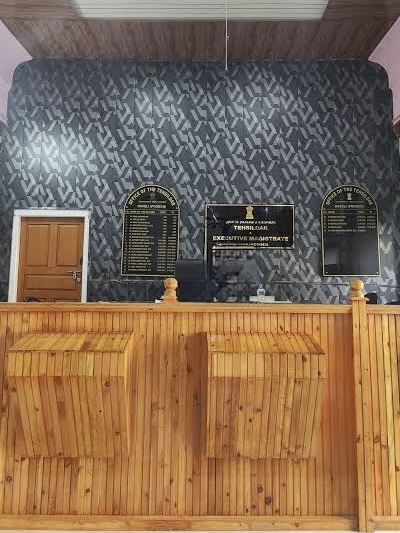
For generations, the Tehsildar’s court stood as the first and most accessible institution of justice in rural Jammu & Kashmir. For a farmer contesting a boundary, a widow safeguarding her inheritance, or a family seeking partition of ancestral land, it was the place where disputes were resolved swiftly, records were scrutinised meticulously, and conflicts were settled before they escalated into prolonged litigation.
That confidence, however, has steadily eroded.
Across Jammu & Kashmir, an increasing number of citizens now find themselves approaching civil courts for disputes that traditionally fell within the effective jurisdiction of revenue authorities. The result is predictable: overburdened civil courts, prolonged litigation, mounting legal costs, and delayed justice for ordinary citizens.
Reviving the authority and effectiveness of revenue courts is therefore not merely an administrative reform—it is an imperative for strengthening rural governance and ensuring accessible justice. The objective is not to diminish the role of civil courts, but to enable each institution to discharge the responsibilities entrusted to it under the law.
The backbone of rural justice
Land is unlike any other asset. In Jammu & Kashmir, it represents livelihood, identity, security, and family heritage. Even a few marlas of land can determine a household’s economic future.
Revenue courts have historically occupied a central place in resolving disputes relating to mutations, partition proceedings, demarcation, correction of revenue records, and other matters arising under the revenue laws. Their greatest strength has always been their intimate familiarity with Jamabandies, Girdawaries, Tatimas, village maps, field books, settlement records, and the customs governing rural landholding.
During the decades following the 1950s, revenue officers earned considerable public respect. Their decisions were generally based on careful examination of records, field inspections where necessary, and a sound understanding of local realities. For many villagers, the revenue court represented justice delivered close to home.
Why confidence has declined
Over time, however, several challenges have weakened the functioning of revenue courts.
Heavy administrative responsibilities leave Tehsildars with limited time for judicial work. Revenue cases are frequently adjourned, monitoring of pending matters is often inadequate, and delays have become increasingly common. These factors have gradually reduced public confidence in the ability of revenue courts to deliver timely decisions.
Consequently, litigants increasingly bypass the revenue system and approach civil courts, even in cases that could often be resolved more efficiently through specialised revenue adjudication.
This shift carries significant consequences. Civil courts, already burdened with a wide range of litigation, face additional pressure from land disputes. Cases that might once have been resolved within months now continue for years, increasing costs, uncertainty, and social tensions.
The human cost of delay
Every land dispute is ultimately about people.
It is the farmer waiting years for demarcation of his ancestral field.
It is the widow struggling to establish her lawful share in family property.
It is brothers unable to divide inherited land because partition proceedings remain pending.
It is neighbours whose cordial relations deteriorate because unresolved disputes harden into bitter conflicts.
In land administration, delayed justice often becomes denied justice.
Why specialised revenue courts matter
Revenue officers possess specialised expertise that general courts cannot easily replicate.
They understand the evolution of land records, the significance of historical revenue entries, the preparation of mutations, settlement operations, village maps, and field measurements. This specialised knowledge enables them to appreciate factual complexities that are unique to land administration.
Strengthening revenue courts therefore strengthens the integrity of the entire land governance system.
Lessons from India’s legal thinkers
Some of India’s most respected jurists have consistently argued that justice must be timely, accessible, and institutionally credible.
Nani Palkhivala emphasised that the rule of law depends not merely on legislation but on institutions that inspire public confidence. Fali S. Nariman repeatedly cautioned that justice delayed weakens faith in legal systems. Harish Salve has highlighted the need to reduce unnecessary litigation through efficient administration, while Soli J. Sorabjee consistently advocated stronger public institutions capable of delivering accessible justice.
Although their work largely centred on constitutional and commercial law, the principles they championed apply equally to revenue administration: institutions function best when they are efficient, transparent, and trusted by the public.
A practical reform agenda
Revitalising revenue courts does not require sweeping legislative change. Much can be achieved through better administration and institutional support.
Dedicated court days should be reserved exclusively for judicial work, insulated from routine administrative responsibilities. Long-pending revenue cases deserve priority disposal through time-bound special drives. Digital cause lists and online case-tracking systems can spare litigants repeated visits to government offices while improving transparency.
Equally important is the quality of adjudication. Revenue officers should be encouraged to deliver clear, reasoned orders that explain the legal and factual basis of every decision. Regular training in revenue law, judicial procedure, appreciation of evidence, and emerging legal developments would further strengthen institutional capacity.
Court infrastructure also requires modernisation. Digitised records, adequate staffing, scanners, computers, and efficient record management systems are no longer optional—they are essential. Periodic inspections by senior revenue authorities can help identify delays and remove administrative bottlenecks before they become systemic.
Technology must support, not replace, justice
Jammu & Kashmir is making significant progress in digitising land records. Digital Jamabandies, cadastral maps, mutation registers, and integrated land databases can substantially improve the speed and accuracy of revenue adjudication.
Yet technology is only a tool.
Every land dispute involves competing claims, documentary evidence, local realities, and human circumstances that require careful judicial application of mind. Digitisation should enhance fairness and efficiency, not reduce adjudication to a mechanical exercise.
Benefits beyond the revenue department
A robust revenue justice system would have far-reaching benefits.
Prompt decisions at the revenue level would reduce unnecessary civil litigation, enabling civil courts to devote greater attention to complex disputes requiring judicial intervention. Farmers would obtain quicker relief, government litigation would decline, and confidence in public institutions would grow.
Ultimately, efficient revenue courts contribute not only to better administration but also to rural stability, economic certainty, and social harmony.
Rebuilding public trust
Public confidence cannot be restored through legislation alone. It is earned through consistent institutional performance.
Citizens must feel assured that when they approach a revenue court, they will be heard patiently, their records examined carefully, unnecessary adjournments avoided, and decisions delivered impartially on the basis of law and evidence.
That confidence, once established, becomes the strongest foundation of the justice system.
Reviving a legacy for the future
Older generations in Jammu & Kashmir often recall a time when revenue courts enjoyed widespread respect and authority. While every era has had its imperfections, the enduring lesson is that justice delivered locally, fairly, and promptly strengthens both governance and society.
Reviving that spirit does not mean returning to the past. It means combining the integrity and discipline associated with earlier revenue administration with modern technology, transparent procedures, and accountable institutions.
The responsibility for this transformation does not rest with Tehsildars alone. Policymakers, senior revenue authorities, judicial institutions, legal professionals, and the Bar all have a role to play in restoring the effectiveness of the revenue justice system.
As Jammu & Kashmir advances towards comprehensive digitisation of land records and modern land governance, equal attention must be devoted to the institutions responsible for resolving disputes arising from those records.
When revenue courts function efficiently, an ordinary farmer need not spend years moving between offices or pursuing expensive litigation. Justice reaches the village doorstep, confidence in public institutions deepens, and civil courts are relieved of avoidable burdens.
The measure of a just society lies not only in the quality of its laws but in the ease with which ordinary citizens can obtain fair, timely, and affordable justice. Restoring the authority of the Tehsildar’s court would be an important step towards fulfilling that promise for the people of Jammu & Kashmir.
6 COMMENTS
Mình thấy FLY88 có giao diện trực quan và dễ làm quen.
Everyone loves what you guys tend to be up too. This type of clever work and coverage! Keep up the fantastic works guys I’ve added you guys to my personal blogroll.


Mình thấy FLY88 có giao diện trực quan và dễ làm quen.
https://shorturl.fm/5o30Z
I have recently started a blog, the info you offer on this site has helped me greatly. Thanks for all of your time & work.
71926x
Everyone loves what you guys tend to be up too. This type of clever work and coverage! Keep up the fantastic works guys I’ve added you guys to my personal blogroll.
I love it when people come together and share opinions, great blog, keep it up.