LG Sinha calls for quaternary-care corridor, biomedical research mission in J&K
Srinagar, August 26: Lieutenant Governor Manoj Sinha on Wednesday called for establishing a quaternary-care corridor in Jammu & Kashmir, integrating artificial intelligence-enabled diagnostics into healthcare and launching a dedicated biomedical research mission to ensure equal access to advanced medical treatment.
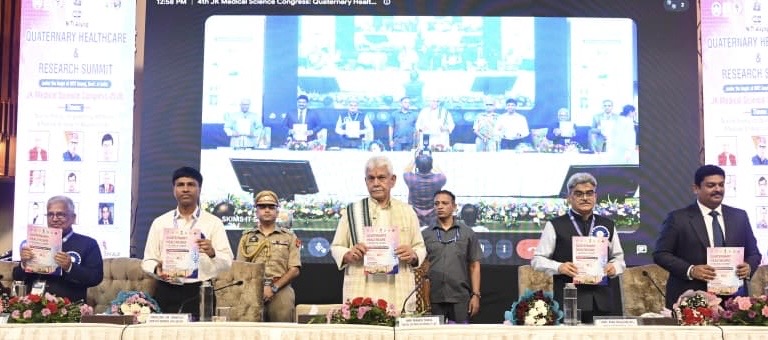
Addressing the Quaternary Healthcare & Research Summit in Srinagar, Sinha said the Union Territory and the country must now move beyond tertiary care and develop quaternary-level treatment and research facilities.
He stressed that advanced healthcare should no longer remain a privilege available only to affluent sections of society or residents of metropolitan cities.
“Quaternary care should not be a privilege reserved for the economically rich section of society. It must become a right of citizenship and a guarantee of the nation,” the Lieutenant Governor said.
Recalling his interaction with doctors during the “Back to Village” programme in Akhnoor in 2020, Sinha said discussions on rare-disease diagnosis and the need for modern medical equipment had highlighted the gap between healthcare available in district hospitals and the level of care actually required by patients.
He described bridging this gap as a national priority.
From tertiary hospitals to quaternary centres
Sinha highlighted the expansion of India’s healthcare infrastructure, noting the establishment of 23 AIIMS and 2,045 medical colleges across the country. In Jammu & Kashmir, he said, the healthcare network now includes two AIIMS, 10 medical colleges, two State Cancer Institutes, a Bone and Joint Hospital, a Paediatric Hospital, 52 nursing colleges, 23 paramedical colleges and five pharmacy colleges.
“These figures show that India has succeeded in elevating primary, secondary, and tertiary care. But the time has come to scale up tertiary hospitals into quaternary centres,” he said.
He called upon hospitals to evolve into research-oriented institutions capable of providing organ transplantation, robotic and precision surgery, advanced genomics, cellular therapies and AI-supported diagnostics.
The Lieutenant Governor also urged hospitals to make annual budgetary allocations for specialised infrastructure and technologies, including modern operating theatres, robotic surgery, gene therapy, proton-beam therapy and advanced artificial-intelligence-based diagnostics.
Proposal for quaternary-care corridor
Sinha suggested creation of a dedicated corridor connecting district hospitals and tertiary-care institutions directly with quaternary-care centres.
Such a network, he said, could facilitate faster diagnostics, advanced imaging and specialist consultations while reducing the geographical barriers faced by patients requiring highly specialised treatment.
He also called for integrating telemedicine and AI-enabled diagnostic tools into mainstream healthcare infrastructure.
“Advanced care is impossible without advanced specialists,” Sinha said, while advocating expanded fellowship and training opportunities in organ transplantation, oncology, genomics and critical care.
Call for indigenous medical innovation
The Lieutenant Governor proposed a biomedical research mission bringing together Himalayan states, Jammu & Kashmir, universities, hospitals, private institutions and innovators to advance medical research and address funding constraints.
“We must develop new inventions ourselves instead of importing innovation from abroad,” he said.
He urged hospitals and research institutions to focus on developing indigenous technologies and capabilities in advanced medical treatment and biomedical research.
Sinha also called for treating hospitals as strategic national assets on the lines of highways and ports, with their preservation, modernisation and development receiving similar institutional priority.
“We must create a robust quaternary-care framework that guarantees equal access to the son of a farmer and to a millionaire living in a city,” he said.
He acknowledged that achieving this objective would be challenging but said it must be pursued as a matter of national dedication and public service.
On the occasion, the Lieutenant Governor released the summit souvenir and several publications.
Dr M. Srinivas, Member, NITI Aayog; Atal Dulloo, Chief Secretary; Dr Digambar Behera, President, National Academy of Medical Sciences; Dr Kameshwar Prasad; M Raju, Commissioner Secretary, Health & Medical Education Department; Prof M. Ashraf Ganie, Director, SKIMS; heads of various institutions, researchers, scientists and senior officials were present at the summit.


OK9 – Nhà cái uy tín 2026. Sảnh cược đa dạng: Thể thao, Casino, Đá gà, Nổ hũ, Bắn cá. Giao dịch siêu tốc, bảo mật. Đăng ký nhận ngay ưu đãi hấp dẫn!