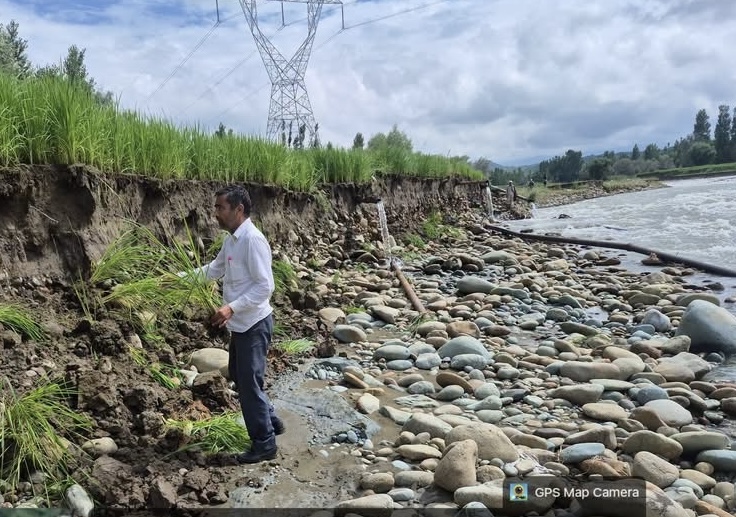
Srinagar, August 7: Jammu & Kashmir has 1,129,503 hectares of land under desertification and land degradation, according to data presented by the Union Agriculture Ministry in the Rajya Sabha, placing the Union Territory among regions with a significant extent of degraded land.
The figures, based on the Desertification and Land Degradation Atlas of India (2021) published by the Space Applications Centre (ISRO), were provided by Minister of State for Agriculture and Farmers Welfare Ram Nath Thakur in a written reply on Friday.
The government, however, clarified that it has not undertaken any assessment of agricultural land specifically affected by degradation or its direct impact on crop productivity.
Across India, the Atlas has recorded 97.85 million hectares under land degradation as of 2018–19. The J&K figure of 1.13 million hectares accounts for about 1.15 per cent of the country’s total degraded area.
J&K’s position among states and UTs
The extent of degraded land in J&K is substantial in comparison with several other Himalayan and agricultural regions. It is higher than Himachal Pradesh (2.40 million ha)? Wait, correction: J&K’s 1.13m is lower than Himachal’s 2.40m. It is higher than Assam (0.83m), Uttarakhand (0.67m), Manipur (0.61m), Meghalaya (0.56m), Kerala (0.42m), Haryana (0.36m), Mizoram (0.28m), Arunachal Pradesh (0.20m), Punjab (0.17m) and Sikkim (0.085m).
Among the larger states, the extent is considerably lower than Rajasthan (21.24 million ha), Maharashtra (14.31 million ha), Gujarat (10.25 million ha), Karnataka (6.96 million ha), Jharkhand (5.48 million ha) and Odisha (5.36 million ha).
The data also show Ladakh at 7.11 million hectares, although its geographical and ecological conditions are markedly different from those of J&K and other predominantly agricultural states.
In percentage terms, however, the raw area figures do not by themselves indicate the severity of degradation for agriculture, since states and UTs vary enormously in geographical size and land-use patterns.
No assessment of crop-yield losses
The Agriculture Ministry said the government has not carried out an assessment quantifying agricultural yield losses caused by human-induced land degradation.
This distinction is particularly important for J&K, where agriculture and horticulture are closely linked to soil health, water availability, changing weather patterns and increasingly vulnerable mountain ecosystems.
The government said the Indian Council of Agricultural Research (ICAR) has developed and recommended a range of location-specific measures for soil restoration and sustainable land management. These include contour cultivation, crop rotation, intercropping, conservation agriculture, mulching, green manuring, reduced tillage and agroforestry.
For degraded and salt-affected soils, measures include gypsum application, bio-drainage, subsurface drainage, salt-tolerant varieties and bio-reclamation.
Climate vulnerability adds to the challenge
The government also highlighted its National Innovations in Climate Resilient Agriculture (NICRA) programme, which is being implemented across 651 districts to assess climate-related risks and promote resilient farming practices.
Of the districts identified as vulnerable to climate change, 201 have been categorised as highly climate-vulnerable and 109 as very highly climate-vulnerable.
NICRA-supported interventions include climate-resilient rice technologies, in-situ crop residue management, village seed banks and community nurseries. Climate-resilient technologies are being demonstrated in 448 Climate Resilient Villages across 151 vulnerable districts in 28 States/UTs.
The government said ICAR released 2,900 crop varieties between 2014 and 2024, of which 2,661 are tolerant to one or more biotic or abiotic stresses.
J&K figure in wider land-degradation picture
The state-wise data reveal a highly uneven distribution of degraded land across India. Rajasthan has the largest recorded area at 21.24 million hectares, followed by Maharashtra at 14.31 million hectares and Gujarat at 10.25 million hectares.
J&K’s 1.13 million hectares is significantly below these figures but is larger than the recorded degraded area in most northeastern states and several other Himalayan states.
The figures also underline the importance of distinguishing between absolute degraded area and the proportion of a state’s geographical or agricultural land affected. The government data supplied in the reply do not provide a corresponding state-wise assessment of how much of the degraded land is agricultural or how much crop productivity has been lost as a result.
Government lists multiple interventions
The Centre said several schemes are being implemented to improve soil and water management, including Per Drop More Crop, the Rainfed Area Development scheme, Soil Health and Fertility, Paramparagat Krishi Vikas Yojana, the National Mission on Natural Farming, and programmes for pulses, oilseeds, horticulture, agroforestry and bamboo.
The government is also implementing crop insurance schemes, including Pradhan Mantri Fasal Bima Yojana, to provide financial protection against crop failures caused by natural calamities and climate-related risks.
It said watershed interventions under the Watershed Development Component of Pradhan Mantri Krishi Sinchayee Yojana (WDC-PMKSY) include soil and moisture conservation, drainage-line treatment, rainwater harvesting, pasture development and livelihood support.
Despite these challenges, the government said agricultural production has continued to grow. Foodgrain production increased from 252.03 million tonnes in 2014–15 to 357.73 million tonnes in 2024–25, while horticulture production rose from 280.98 million tonnes to 370.73 million tonnes during the same period.
For J&K, however, the absence of a specific assessment of agricultural land degradation and associated yield losses leaves an important gap in understanding the economic and food-security implications of the 11.3 lakh hectares identified as degraded.
3 COMMENTS
thankyou for the writing, now i can accomplish more about my research
Does your blog have a contact page? I’m having trouble locating it but, I’d like to send you an e-mail. I’ve got some recommendations for your blog you might be interested in hearing. Either way, great site and I look forward to seeing it expand over time.


thankyou for the writing, now i can accomplish more about my research
https://shorturl.fm/4rOxr
Does your blog have a contact page? I’m having trouble locating it but, I’d like to send you an e-mail. I’ve got some recommendations for your blog you might be interested in hearing. Either way, great site and I look forward to seeing it expand over time.