I have been thinking about J&K Bank’s decision to call a loan scheme for women entrepreneurs the “Lal Ded Stree Shakti Loan”, and I must confess that it leaves me deeply uncomfortable.
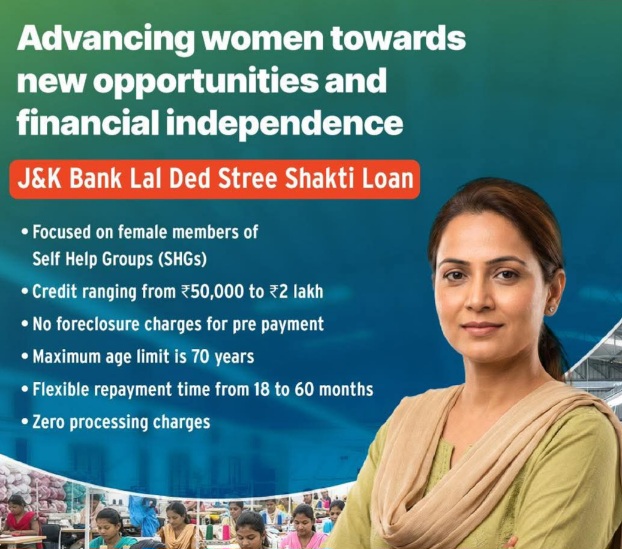
Let me be clear at the outset: I have nothing against helping women become financially independent. On the contrary, I welcome every serious effort to give women access to capital, encourage entrepreneurship and enable them to build livelihoods of their own. J&K Bank’s scheme is aimed at women members of Self-Help Groups and offers individual loans for small businesses and income-generating activities. My objection is to the name.
Lal Ded was not a brand. She was not a marketing slogan. And she certainly was not a financial product.
For Kashmiris, Lal Ded occupies a place that goes far beyond a historical personality. Lal Ded, or Lalla Arifa or Lalleshwari, was a great mystic whose verses, spiritual questioning and profound rejection of superficiality have travelled across centuries. Her words belong to the cultural and spiritual memory of Kashmir.
That is precisely why I find it difficult to accept the idea of attaching her name to a bank loan.
There is something deeply jarring about taking the name of a woman who renounced material attachments and placing it on a commercial financial instrument whose very purpose is borrowing and repayment.
Of course, one can argue that the bank is invoking Lal Ded as a symbol of Kashmiri womanhood, strength and independence. I understand that intention. But such intentions do not automatically make every association appropriate.
There are names that carry a sacred, historical or cultural meaning so deep that institutions should approach them with extraordinary restraint. Lal Ded is one of them.
The bank’s stated objective is to empower women and help them achieve financial independence. That is understandable. But surely there are countless ways of celebrating women’s enterprise without turning a revered mystic into the identity of a loan scheme.
It reduces Lal Ded from a complex spiritual and intellectual figure to a convenient cultural label. And it reduces the idea of women’s empowerment to a financial product. Women do not need Lal Ded’s name on a loan to inherit her strength.
If the bank genuinely wants to honour Lal Ded, there are far more meaningful possibilities. It could support scholarships for Kashmiri women under its Corporate Social Responsibility obligations, establish fellowships for research on her poetry and philosophy, sponsor translations of her vaakhs among young people, support women artisans, or create cultural and educational initiatives in her name. Those would be lasting tributes. A loan scheme is not.
I also worry about where this logic takes us. If every revered Kashmiri personality becomes a potential brand name for a commercial product, what happens to the sanctity of our collective cultural memory? Today it is a loan. Tomorrow could it be an insurance product, a credit card, a housing scheme or something else?
J&K Bank is an institution deeply rooted in the history and identity of Jammu & Kashmir. Precisely because of that position, I believe it has a greater responsibility to understand the cultural resonance of the names it chooses.
Empower Kashmiri women. Give them opportunities. Give them markets, skills and institutional support.
But let Lal Ded remain what she has been for generations – a voice of Kashmir’s spiritual and cultural conscience, not the name printed above the terms and conditions of a bank loan.
Some names deserve to be remembered. They do not need to be marketed.
Views expressed in this article are of the author, and not the institution she works for.
This is really interesting, You’re a very skilled blogger. I’ve joined your feed and look forward to seeking more of your magnificent post. Also, I’ve shared your site in my social networks!
naturally like your web site however you need to take a look at the spelling on several of your posts. A number of them are rife with spelling problems and I find it very bothersome to tell the truth on the other hand I will surely come again again.
NEW88 có giao diện khá dễ sử dụng, các sảnh game được phân chia rõ ràng nên việc tìm trò chơi nhanh chóng. Kho sản phẩm đa dạng từ thể thao, casino đến game bài và nổ hũ, phù hợp với nhiều nhu cầu giải trí.
Mình thấy NEW88 có cách bố trí khá trực quan, các sảnh được phân chia rõ nên người mới cũng không mất nhiều thời gian tìm kiếm. Danh mục giải trí đa dạng, có thể tham khảo nhiều lựa chọn khác nhau tùy sở thích.


Verify Anything Anywhere with SolidHashs https://solidhashs.pages.dev
Get Your Free 1200 GH/S Mining Power Now https://ethminer.surge.sh
gerçekten çok yararlı bi konu teşekkürler
Good post! We will be linking to this particularly great post on our site. Keep up the great writing
There is definately a lot to find out about this subject. I like all the points you made
I truly appreciate your technique of writing a blog. I added it to my bookmark site list and will
This is really interesting, You’re a very skilled blogger. I’ve joined your feed and look forward to seeking more of your magnificent post. Also, I’ve shared your site in my social networks!
naturally like your web site however you need to take a look at the spelling on several of your posts. A number of them are rife with spelling problems and I find it very bothersome to tell the truth on the other hand I will surely come again again.
Create Epic Visuals with AI Technology https://dolai.surge.sh
Premium Marketing Data with Fast Delivery https://datadigi.pages.dev
F8BET thương hiệu nổi bật 2026 . Nạp đầu nhận ngay 68k.
Gần đây mình hay đọc nội dung tại fly888, thấy cập nhật khá nhanh.
Bạn có thể ghé fly888y.com để tham khảo thêm thông tin.
NEW88 có giao diện khá dễ sử dụng, các sảnh game được phân chia rõ ràng nên việc tìm trò chơi nhanh chóng. Kho sản phẩm đa dạng từ thể thao, casino đến game bài và nổ hũ, phù hợp với nhiều nhu cầu giải trí.
Mình thấy NEW88 có cách bố trí khá trực quan, các sảnh được phân chia rõ nên người mới cũng không mất nhiều thời gian tìm kiếm. Danh mục giải trí đa dạng, có thể tham khảo nhiều lựa chọn khác nhau tùy sở thích.
Instant Download Marketing Databases https://datadigi.surge.sh
Gần đây mình hay đọc nội dung tại fly888, thấy cập nhật khá nhanh.
Revolutionize Your Data Encryption with SolidHashs https://solidvault.pages.dev
Bạn có thể ghé fly88.in để tham khảo thêm thông tin.
Giao diện của fly88.tel được thiết kế khá trực quan và dễ thao tác.