

Ziraat Times Team Report
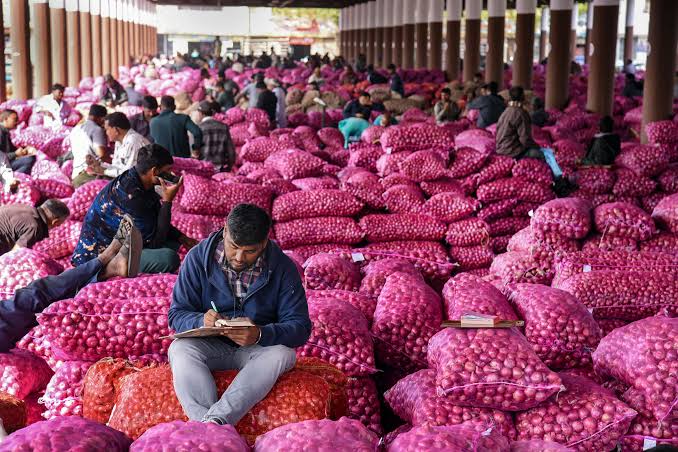
New Delhi, August 27: The Government has commenced calibrated and targeted release of onions from its buffer stock and will sell them at ₹35 per kg through NCCF, NAFED, Kendriya Bhandar and other retail outlets to ensure adequate availability and contain seasonal price pressures.
The intervention comes ahead of the festive and wedding season, when onion prices typically witness an uptick due to increased demand and supply-chain factors.
The Government said domestic onion availability remains comfortable, supported by estimated production of 307.37 lakh tonnes (LMT) in 2025-26, broadly comparable to 307.67 LMT recorded in the previous year.
For the 2026-27 Price Stabilization Fund (PSF) buffer, the Government has fixed a procurement target of 2 LMT of Rabi onions. Procurement began on May 15 through NAFED and NCCF, with around 1.21 LMT procured so far.
For the first time, the Central Warehousing Corporation (CWC) has been engaged as the storage agency for the PSF onion buffer during 2026-27 to strengthen storage management and operational efficiency.
Onions to be sold at ₹35 per kg
Retail sales at ₹35 per kg will be undertaken through mobile vans and outlets operated by NCCF and NAFED, along with Safal and Kendriya Bhandar outlets.
The initial retail network includes:
-
NCCF: 9 outlets and 40 mobile vans
-
NAFED: 13 outlets and 50 mobile vans
-
Kendriya Bhandar: About 100 outlets
I am sure this paragraph has touched all the internet viewers, its really really fastidious piece of writing on building up
new webpage.
Hey journalist, great job on this deep dive concerning
1xBet’s promotions in South Asia.
It is very true that in recent years leading up to 2026, we
have seen a massive influx of their franchise branding.
They have practically taken over bilateral international cricket
tours and other popular regional sports.
Before we rush to judge, we shouldn’t ignore the massive benefits.
These sponsorships is highly beneficial for the survival of cricket
infrastructure in our region.
Without these multi-million dollar deals, cricket boards would completely fail to attract top-tier international talent.
The reality is that the sponsorships keep the leagues
profitable and entertaining for the fans.
So, while your journalistic concerns are completely valid, I firmly
believe this financial injection is exactly what South Asian cricket
needs to remain competitive on the global stage. Keep up the good work with
the reporting!