By Asra Imtiyaz Mattoo (PhD Candidate – SKUAST Kashmir)
The latest government audit shows widespread degradation of Jammu & Kashmir’s lakes. For fisheries, the implications are immediate: declining natural productivity, rising disease risk and a widening supply gap—one that controlled aquaculture is now poised to fill.
By Asra Imtiyaz Mattoo, PhD Candidate
Division of Fisheries Resource Management, Faculty of Fisheries (Rangil), SKUAST-Kashmir
For generations, the lakes of Jammu & Kashmir have served not merely as scenic landscapes but as living economic systems—sustaining fisheries, supporting livelihoods and providing ecological balance. Today, however, these water bodies are under severe strain. The recent government audit on lake conservation signals more than environmental decline; it points to a structural crisis for the fisheries sector.
The implications are difficult to ignore. As lakes deteriorate, fisheries are confronted with shrinking natural productivity, declining fish health and growing uncertainty over long-term sustainability. Yet within this crisis lies an opportunity: to rethink fish production through science-led aquaculture while restoring the ecological foundations that once sustained the sector.
A fisheries system under pressure
The 2025 audit of Jammu & Kashmir’s lakes presents an alarming picture. Of 697 lakes documented in 1967, around 315 have reportedly disappeared, while another 203 have shrunk substantially. Together, nearly three-fourths of the region’s lakes have either degraded or lost area.
For fisheries, this loss represents far more than disappearing water bodies. Lakes have historically functioned as natural hatcheries, nursery grounds and feeding ecosystems that sustain capture fisheries and stock enhancement programmes. Their degradation effectively removes biological infrastructure that has no easy replacement.
A shrinking lake ecosystem means declining breeding spaces, weakened fish recruitment and reduced carrying capacity for aquatic life. In practical terms, the region risks moving from a naturally productive fisheries economy to one increasingly dependent on external inputs.
Water quality and the invisible collapse
The most damaging changes are often the least visible.
Untreated sewage inflows, nutrient loading and catchment degradation have altered water chemistry in many lakes. For fish populations, this creates chronic stress. Elevated ammonia and nitrite concentrations, unstable dissolved oxygen levels and increased organic load weaken growth performance and reduce survival rates.
Fish exposed to poor water quality divert energy from growth to survival. Feed efficiency declines, reproductive performance weakens and susceptibility to disease rises. Unlike controlled aquaculture systems, where environmental variables are monitored and corrected, degraded lakes expose fish populations to unpredictable biological stress.
The result is a gradual erosion of productivity that often escapes immediate public attention but steadily undermines fisheries output.
Disease risks are becoming systemic
Degraded aquatic systems rarely fail quietly.
Poor water quality creates ideal conditions for opportunistic bacterial infections, parasitic infestations and stress-induced immune suppression. This is no longer simply a concern for traditional fishers. The ripple effects extend across the entire fisheries value chain.
Hatcheries face the risk of sourcing compromised broodstock, stocking programmes confront higher mortality and neighbouring aquaculture systems face increased biosecurity threats. Fisheries management gradually shifts from prevention to crisis response—a costlier and less efficient model of operation.
The economic implications are substantial. Mortality losses, disease treatment and failed stocking efforts reduce returns on public investment while increasing risks for producers.
Why productivity declines over time
Lake degradation often creates a deceptive illusion of abundance.
Nutrient enrichment, or eutrophication, can initially increase fish productivity. But this short-term gain rarely lasts. Over time, ecological instability replaces biological balance, favouring hardy low-value species while reducing populations of commercially valuable fish.
This shift matters economically. Lower-value species generate weaker market returns and reduce income stability for fishing communities. Consumers face declining fish quality and inconsistent supply, while traditional fishers experience growing vulnerability.
The challenge is therefore not only ecological but deeply economic.
The limits of stocking without restoration
Government stocking programmes are often presented as a solution to fisheries decline. But stocking can only succeed when ecosystems remain capable of supporting life.
Releasing fingerlings into degraded water bodies frequently produces disappointing outcomes: lower survival, slower growth and weak biomass generation. In effect, hatchery outputs fail to translate into meaningful production gains.
This disconnect creates a costly paradox. Fisheries departments may increase stocking efforts while underlying ecological dysfunction prevents expected returns.
Without restoring lake health and scientifically assessing carrying capacity, stocking risks becoming an expensive intervention with limited impact.
Why aquaculture is becoming central
If natural fisheries are losing reliability, fish production cannot remain dependent on uncertain ecosystems alone.
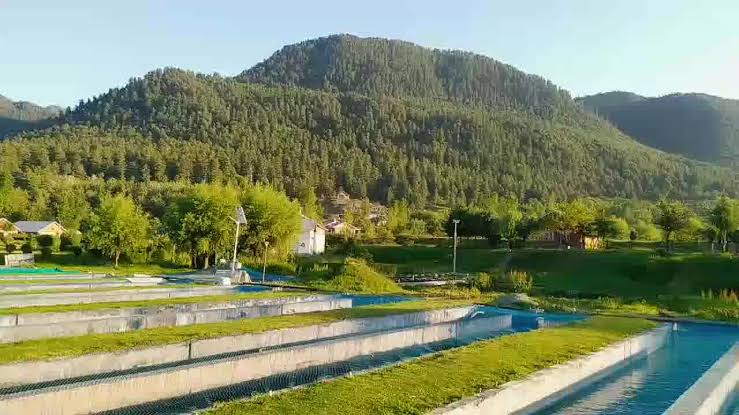
This is where controlled aquaculture—particularly Recirculating Aquaculture Systems (RAS)—becomes increasingly relevant. Unlike natural water bodies, RAS facilities allow producers to manage water quality, disease risks and environmental variables in highly controlled conditions.
Such systems provide predictable yields, stronger biosecurity and reduced dependence on shrinking natural resources. More importantly, they offer consistency in a market increasingly shaped by supply uncertainty.
For Jammu & Kashmir, aquaculture may no longer be viewed as a supplementary activity. It is gradually becoming an essential production strategy.
Conservation versus aquaculture is a false choice
The debate should not be framed as a contest between ecological restoration and fish farming.
Jammu & Kashmir’s fisheries future depends on a hybrid model that restores degraded lakes while simultaneously expanding scientific aquaculture. Lake restoration remains essential for biodiversity, ecological resilience and traditional livelihoods. At the same time, controlled aquaculture offers a stable production backbone capable of meeting future demand.
A forward-looking strategy would combine ecosystem restoration, science-based stocking, real-time water quality monitoring and investment in controlled farming systems such as RAS.
This balance between ecological sustainability and production efficiency offers the most realistic path forward.
A turning point for fisheries
The decline of Jammu & Kashmir’s lakes represents a watershed moment for regional fisheries. Natural systems that once sustained production are increasingly unable to bear historical pressures.
The challenge is undeniable, but so is the opportunity.
If fisheries policy responds with scientific urgency, aquaculture can evolve from a supporting mechanism into a reliable engine of food production—while restored lakes continue to provide ecological and social value.
When natural ecosystems begin to lose their productive capacity, the future of fisheries depends not on nostalgia, but on adaptation.


c9l9p5
I’ve been searching for this unique niche and your analysis on 2026
embroidery are exactly what I needed. Thanks for the insight!