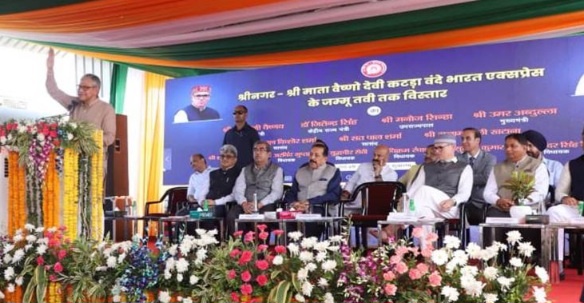
Srinagar, April 30: In a major boost to connectivity in Jammu and Kashmir, Union Railway Minister Ashwini Vaishnaw on Thursday flagged off the extended Srinagar–Shri Mata Vaishno Devi Katra Vande Bharat Express service up to Jammu Tawi railway station, marking the first-ever direct passenger train linkage between Jammu and the Kashmir Valley.
The development represents a historic milestone, transforming what was once a long-standing aspiration into reality. With a seamless rail corridor now in place, passengers can travel between Jammu and Srinagar with a single interchange, effectively connecting the Valley to the rest of India’s rail network.
Addressing the gathering, the minister described the extension as a “major milestone” in enhancing connectivity in the Union Territory. He noted that the expansion comes less than a year after Prime Minister Narendra Modi inaugurated the Jammu–Srinagar rail link on June 6 last year, laying the foundation for all-weather rail connectivity in the region.
Jammu Tawi Emerges as a Key Gateway
Jammu Tawi railway station, already a crucial hub linking northern India with major cities such as Kanyakumari, Mumbai, and Howrah, is expected to further consolidate its position as the primary rail gateway to Jammu and Kashmir. The extension of the Vande Bharat service enhances accessibility to key pilgrimage destinations, including Shri Mata Vaishno Devi and Shri Amarnath.
Railway officials said the upgraded service now operates with 20 coaches, a significant increase from the initial 8-coach configuration, reflecting high passenger demand. According to the minister, the service has witnessed near-full occupancy since its launch, underlining its growing popularity.
Designed for Harsh Terrain and Climate
Highlighting the technical aspects, Vaishnaw said the train has been specifically designed to operate in the region’s challenging climatic conditions, including sub-zero temperatures. Advanced electronics and semiconductor-based systems ensure uninterrupted functioning, while efforts have been made to incorporate regional elements such as Dogri cuisine to enrich the passenger experience.
The minister emphasized that the train not only improves travel convenience but also offers passengers a cultural experience, showcasing the landscapes, cuisine, and traditions of Jammu and Kashmir.
Boost to Tourism and Economy
The enhanced rail connectivity is expected to significantly boost tourism in the region, often described as “Paradise on Earth.” Improved accessibility will enable more tourists from across the country to visit the Valley, thereby supporting local businesses and livelihoods.
Beyond tourism, the railway link is also strengthening economic activity by facilitating the movement of goods. Jammu and Kashmir’s key products—including apples, dry fruits, Pashmina shawls, and handwoven carpets—are now reaching markets across India more efficiently.
Vaishnaw revealed that nearly 2 crore kilograms of apples have already been transported from the Kashmir Valley to other parts of the country via the railway network. He added that improved freight operations have also reduced the cost of essential commodities, citing a drop in cement prices by around ₹50 per bag due to rail-based logistics.
Strengthening Supply Chains
Rail connectivity has also enhanced the supply of essential goods into the Valley, including foodgrains, fertilizers, salt, milk, and dairy products. Recent developments include the arrival of rice consignments, industrial salt from Gujarat, and vermicompost fertilizer from Ambala to Anantnag.
E-commerce logistics have also seen a boost, with companies like Amazon initiating daily cargo movement between Adarsh Nagar in Delhi and Budgam, enabling two-way logistics in under 30 hours.
Officials said these developments are improving supply chain efficiency, reducing transit times, and ensuring greater reliability in the movement of goods.
Engineering Feat: USBRL Project
The completion of the Udhampur-Srinagar-Baramulla Rail Link (USBRL) has been central to this transformation. The project includes landmark engineering structures such as the Chenab Rail Bridge and the Anji Khad Bridge, which have enabled uninterrupted all-weather connectivity to the Valley.
The minister inspected both bridges during his visit, describing them as critical components of India’s high-altitude railway infrastructure.
Future Expansion Plans
Looking ahead, the Railways plans to further strengthen connectivity through infrastructure upgrades and new projects. These include multitracking on the Ambala–Jammu route, line doubling between Qazigund and Baramulla, and proposed rail links to Poonch and Rajouri.
The redevelopment of Jammu Tawi station is also underway, with plans to expand platforms, improve passenger amenities, and increase handling capacity.
Officials said these initiatives aim to reduce dependence on road transport, which is often disrupted by landslides, snowfall, and harsh weather conditions, while promoting economic integration and regional development.
Transformational Impact
The extension of the Vande Bharat Express to Jammu Tawi is being seen as a transformative step in integrating Jammu and Kashmir more closely with the national mainstream. By improving mobility, boosting tourism, and strengthening supply chains, the project is expected to drive long-term economic growth and enhance the quality of life for residents.
Railway authorities said the initiative would pave the way for stronger people-to-people connections and deeper economic linkages, marking a new chapter in the region’s connectivity story.
1 COMMENT
I’ve been researching this specific trend and your take
on 2026 embroidery is incredible. Thanks for the share!


I’ve been researching this specific trend and your take
on 2026 embroidery is incredible. Thanks for the share!