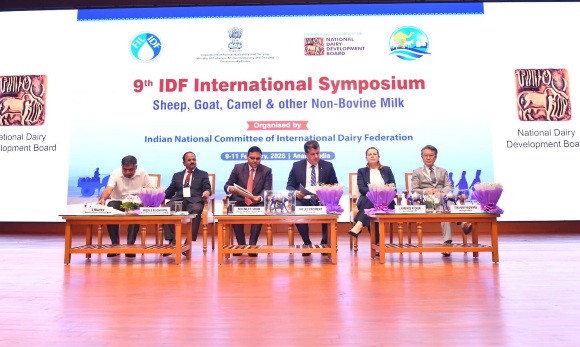
Anand, Feb 10: The 9th International Dairy Federation (IDF) Symposium on Sheep, Goat, Camel and other Non-Bovine Milk commenced at the National Dairy Development Board (NDDB), Anand, on February 9 and will continue till February 11, bringing together global experts to deliberate on the role of non-bovine dairy in sustainable nutrition, climate resilience and rural livelihoods.
The symposium is being organised by the Indian National Committee of the International Dairy Federation (INC-IDF) and has drawn more than 90 national and international delegates, including policymakers, academics, industry leaders, milk producers, processors and professionals from across the dairy sector.
The inaugural session was attended by IDF President Mr Gilles Froment; NDDB Chairman, IDF Board Member and INC-IDF Secretary Dr Meenesh Shah; Animal Husbandry Commissioner Dr Naveena B. Maheswarappa; FAO Representative in India Mr Takayuki Hagiwara; IDF Director General Ms Laurence Rycken; and members of the IDF Board.
The three-day programme includes seven technical sessions covering emerging markets and consumer trends, smallholder livelihoods, sustainable farm management, processing technologies, product development, biosecurity and disease management, and global standards and policies related to non-bovine milk. Posters and exhibitions showcasing innovations, technologies and services in the non-bovine dairy sector are also part of the event.
Addressing the inaugural session, Mr Gilles Froment highlighted the potential of goat, sheep and camel milk as sustainable options for regions with harsh climatic conditions. He outlined six priority areas—environment, animal welfare, nutrition, food safety, health and inclusivity—and noted uneven growth in global milk production despite surpassing one billion tonnes. Emphasising India’s 25 per cent share in global milk output, he called for expanding non-bovine dairy through innovation, food safety and robust nutrition data, particularly in the lead-up to the FAO’s International Year of Rangelands and Pastoralists in 2026.
Dr Meenesh Shah stressed the growing importance of non-bovine milk as climate-resilient and nutrition-supporting, often managed by women farmers. Recalling India’s transformation from milk scarcity to self-sufficiency through Operation Flood, he underscored the role of cooperatives and scientific programmes such as the National Dairy Plan. He highlighted NDDB initiatives including disease control programmes, free vaccination against foot-and-mouth disease and brucellosis, advanced breeding technologies and progress in goat artificial insemination. Dr Shah also cited the marketing of camel milk through Amul’s Sarhad Dairy and urged scaling up such models to ensure better value realisation for farmers.
Dr Naveena B. Maheswarappa said the symposium assumes added significance in view of the United Nations’ declaration of 2026 as the International Year of Grazing Lands and Pastoralists. He called for the promotion of non-bovine milk as nutrient-rich and climate-friendly, highlighting sheep, goat and camel value chains as low-carbon systems. Emphasising advanced processing technologies and robust certification mechanisms, he advocated science-led, cluster-based approaches with traceability to build resilient and nature-positive value chains.
Mr Takayuki Hagiwara emphasised the role of camel, goat and sheep milk in India’s evolving dairy landscape, citing experiences from Rajasthan and Kutch, including Sarhad Dairy. He highlighted growing recognition of camel milk’s nutritional value and called for enhanced scientific research in collaboration with institutions such as the Indian Council of Medical Research. Reaffirming FAO’s commitment, he said the organisation would continue working with NDDB and the Government of India to strengthen pastoralist livelihoods.
Ms Laurence Rycken acknowledged India’s leadership in science-driven and inclusive dairy development, noting that climate change, urbanisation and changing consumer preferences are reshaping the global dairy sector. She described non-bovine milk as vital for regions such as India, the Middle East and Africa, and called for data-driven and practical strategies to address value-chain challenges while strengthening sustainability and livelihoods.