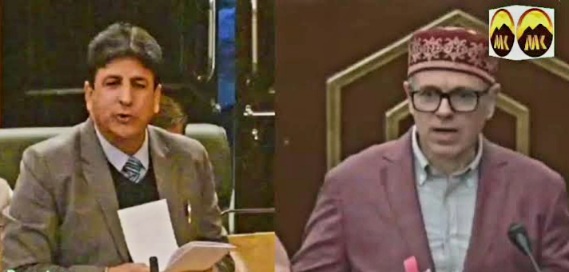
Srinagar, Feb 23 – A heated exchange in the Jammu & Kashmir Legislative Assembly last week has sparked a big debate on the question of inner-party democracy in J&K’s political parties, including the ruling party and the accountability of the executive to the legislature.
Chief Minister Omar Abdullah, who also holds the Power portfolio, faced intense social media criticism following a sharp retort to his own party colleague, Dr. Bashir Ahmad Shah Veeri (MLA Bijbehara), over the issue of inflated electricity bills.
The duel: What was asked and said
The confrontation began during the Question Hour when Dr. Veeri raised a supplementary question regarding the “arbitrary and steep hike” in power tariffs in his constituency.
Dissatisfied with the written reply stating no tariff hikes had occurred since December 2023, Veeri produced empirical evidence.
“I Simply don’t agree with the reply given. Sir, a wrong reply has been given… In May 2023, under the Sangam-Bijbehara feeder, ₹920 was charged. This increased to ₹1,300 in 2024, and by December 2025, it spiraled to ₹1,820. This is a 100% increase. I have to face the music from my voters; their electricity bills are inflated while the supply remains erratic.”
The response from CM Omar Abdullah:
The Chief Minister, visibly irked by the suggestion that the government’s reply was “a lie,” defended the Power Development Department (PDD) and issued a stinging warning to the MLA.
“Before becoming a Minister, we all are MLAs first. We have to face protests and people’s anger. If he [Veeri] finds it so difficult to face his constituents or if he cannot face them, in the next election, we can provide him with a remedy to that… it will not be a problem for me.”
The online opinion:
The Chief Minister’s “remedy” remark, widely interpreted as a threat to deny Veeri a party ticket in the next election, triggered a wave of online support for the MLA. Netizens accused the CM of stifling internal dissent and behaving like a “monarch” rather than a representative.
Fayaz Nabi wrote on Facebook: “Shocking to see Omar Abdullah threaten his own MLA for speaking the truth about power bills. Is this the ‘democracy’ we voted for? Veeri was only representing his people.”
Another citizen on X – The Rationalist (Reddit) – wrote “The arrogance of ‘I can provide him a remedy in the next election’ is peak entitlement. An MLA’s job is to question the Minister, even if they are from the same party. Disappointing from Omar.”
Another journalist from Srinagar expressed his surprise: “Veeri showed guts. Most NC MLAs are silent spectators. To call his factual data ‘a lie’ and then humiliate him on the floor of the House is a new low for the treasury benches.”
A resident of Bijbehara and a voter of the ruling party, Zubair Ahmad wrote on Facebook: “Omar Sahab, you are the Power Minister. Answer the question about the ₹1,820 bills instead of bullying the man asking it. The public is siding with Veeri on this one.”
On Instagram, another Bijbehara voter, ValleyVoice_JK expressed his views as: “Inner party democracy in NC seems to be a myth. If an MLA can’t ask about his constituency’s electricity without being threatened with his career, what hope does a common man have?”
“The ‘duel’ in the assembly shows a disconnect. Veeri is grounded in the reality of Bijbehara’s lanes; the CM seems grounded only in the secretariat’s files.”, another voter, identified as Political_Analyst_JK on Instagram said.
Another netizen from north Kashmir, KupwaraFirst, joined the chorus: “Supporting Veeri here. Power bills are indeed crushing the middle class. Warning an MLA for highlighting public distress is not leadership, it’s authoritarianism.”
“If an MLA from the ruling party cannot question inflated power bills in his own constituency, what kind of democracy are we practicing?”, Faheem Lone, a student asked.
While the government maintains that the “hikes” are actually load revisions based on actual consumption, the optics of the exchange have left the National Conference on the defensive.
Supporters of the Chief Minister, however, defended his remarks, arguing that “procedural norms and party discipline” must be maintained and that administrative matters are better addressed through established channels.
Citizens largely said that the incident highlights a growing tension within the ruling dispensation, where the line between administrative discipline and legislative freedom is increasingly blurred.