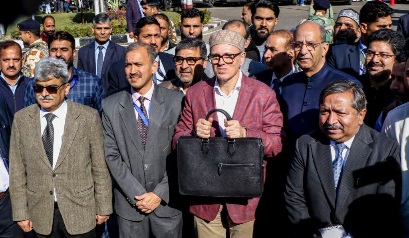
Srinagar: The Federation of Chambers of Industries Kashmir (FCIK) on Friday described the Jammu and Kashmir Budget 2026–27, presented by Chief Minister Omar Abdullah, as a reform-oriented and forward-looking roadmap aimed at building a resilient and self-sustaining economy in the Union Territory.
In a statement, the federation said the Budget reflects the government’s focus on economic revival, inclusive growth and participatory governance, while signalling intent to create a business-friendly environment that encourages innovation and investment.
FCIK noted the macroeconomic projections outlined in the Budget, including a Gross State Domestic Product (GSDP) estimate of Rs 2,88,422 crore for 2025–26 with an 11 per cent growth rate. It pointed to the sectoral composition—20 per cent primary, 18 per cent secondary and 62 per cent tertiary—as underlining the need for production-led growth alongside services to ensure balanced and sustainable development.
The federation welcomed the continued emphasis on capital expenditure, infrastructure development and reform-linked investments, which it said are critical for building long-term economic capacity. While stressing the importance of fiscal discipline, FCIK said higher capital spending, even with a temporarily elevated fiscal deficit, is necessary to create durable economic assets.
FCIK also lauded the Budget’s focus on agriculture and allied sectors such as horticulture, dairy, fisheries, apiculture, irrigation, protected cultivation and digital farmer services. It said the Holistic Agriculture Development Programme, comprising 29 projects and implemented in a challenge mode, has the potential to strengthen rural livelihoods, improve productivity, expand value chains and reinforce the primary sector’s role in the economy.
On the industrial front, the federation welcomed proposed amendments to the Industrial Policy aimed at sustaining growth, while urging that corrective measures be closely aligned with stakeholder inputs. It called for the finalisation and implementation of a comprehensive industrial policy, including a revised public procurement framework and measures for reviving sick industrial units, before the start of the new financial year.
FCIK described the decision to extend incentives to sick industrial units on par with new units as a progressive step that could aid rehabilitation, modernisation, capacity expansion and employment protection. It also welcomed the move to allow self-certified regulatory compliances and said the reform should be extended across the entire industrial ecosystem.
However, the federation expressed disappointment over the absence of certain long-pending measures in the Budget, including power amnesty on interest and demand charges for outstanding arrears, VAT relief on regulatory compliances and solutions to other industrial bottlenecks. It said these interventions should be announced alongside the broader policy framework.
The federation appreciated the Budget’s people-centric measures, including the provision of six free LPG cylinders for eligible households and the solarisation programme, which it said would lower energy costs, improve power security and support sustainable growth.
At the same time, FCIK raised concerns over rising revenue expenditure on salaries, pensions and debt servicing, warning that it continues to constrain fiscal space. It also pointed to the Union Territory’s heavy dependence on central devolution and urged steps to strengthen own-revenue mobilisation to support ambitious expenditure plans.
The federation said that growth and investment projections must be matched with strong implementation capacity at district and grassroots levels. Expressing optimism, FCIK said that with effective execution, policy continuity and sustained stakeholder engagement, the Budget 2026–27 could play a transformative role in shaping a self-reliant, inclusive and future-ready economy for Jammu and Kashmir.