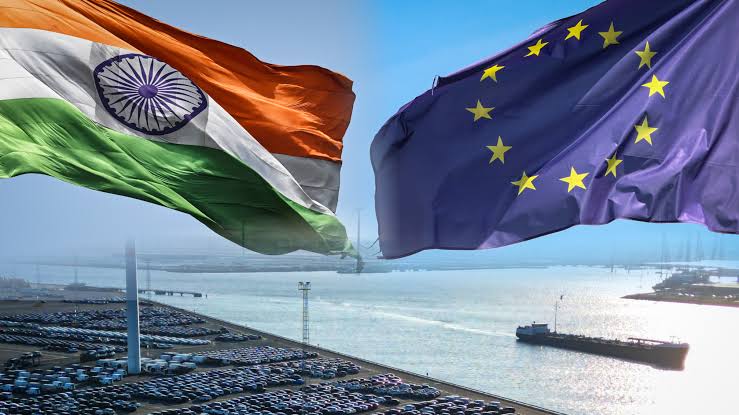
New Delhi, Jan 27: India has offered phased tariff reductions and tariff-rate quotas (TRQs) for apples and other select fruits under its proposed Free Trade Agreement (FTA) with the European Union, a move that is expected to give domestic growers —particularly apple farmers in Kashmir—time to prepare for increased competition from European imports. The offer also brings significant market access for Indian wooden crafts and furniture, boosting prospects for artisans and manufacturers, especially from Jammu and Kashmir, while opening the door to wider trade, services and investment cooperation between India and the EU.
Under India’s offer, 3 per cent of products, including apples, pears, peaches and kiwi fruit, will be subject to phased tariff reductions and TRQs. The phased approach, officials said, would cushion the impact of cheaper European fruits entering the Indian market while allowing gradual adjustment by local farmers. In parallel, lower duties of up to 10.5 per cent on Indian home décor, wooden crafts and furniture are expected to enhance competitiveness of Indian wooden, bamboo and handcrafted products in Europe, strengthening India’s role in global furniture supply chains.
The India–EU FTA, described as a deal of strategic significance, covers a combined market estimated at over INR 2,091.6 lakh crore (USD 24 trillion), offering opportunities for nearly two billion people. The agreement provides unprecedented market access for more than 99 per cent of India’s exports by trade value, while preserving policy space for sensitive sectors and reinforcing India’s development priorities.
Bilateral trade between India and the EU has shown steady growth, with merchandise trade valued at around INR 11.5 lakh crore (USD 136.54 billion) in 2024–25. India’s exports to the EU stood at approximately INR 6.4 lakh crore (USD 75.85 billion), while services trade reached INR 7.2 lakh crore (USD 83.10 billion). Despite this growth, both sides have acknowledged substantial untapped potential given the size of their respective markets.
As part of the agreement, India is offering 92.1 per cent of its tariff lines, covering 97.5 per cent of EU exports. Of these, 49.6 per cent will see immediate duty elimination, while 39.5 per cent will undergo phased elimination over five, seven and ten years. The arrangement is expected to facilitate imports of high-technology goods from the EU, reducing input costs for Indian businesses and helping them integrate into global value chains.
On the export side, India has secured preferential access to EU markets across 97 per cent of tariff lines, covering 99.5 per cent of trade value. Labour-intensive sectors such as textiles, apparel, leather, footwear, marine products, toys, sports goods, gems and jewellery will benefit from immediate or phased tariff elimination, improving competitiveness and supporting employment generation.
The agreement is also expected to have a positive impact on agriculture and processed food exports, with improved access for products such as tea, coffee, spices, grapes, gherkins, cucumbers, dried onion, fresh vegetables and fruits. Safeguards have been built in for sensitive sectors including dairy, cereals, poultry, soymeal and certain fruits and vegetables to balance export growth with domestic priorities.
Beyond goods, the FTA places strong emphasis on services, mobility and investment. Commitments across 144 services subsectors from the EU and 102 subsectors from India are expected to boost trade in IT, professional services, education and business services. A dedicated mobility framework will facilitate temporary entry and stay for professionals, contractual service suppliers and independent professionals, expanding opportunities for Indian talent in Europe.
The agreement also strengthens cooperation on product-specific rules of origin, intellectual property rights, sanitary and phytosanitary measures and technical standards, aimed at easing compliance and improving ease of doing business. Officials said the India–EU FTA marks a shift from a traditional trade relationship to a modern, multifaceted partnership, providing predictability for exporters, supporting MSMEs and laying the foundation for long-term economic integration amid global uncertainties.