For much of my life in Jammu & Kashmir, I watched seasons turn and rivers swell, yet one of the clearest lessons about the weather came not from books or forecasts but from my mother. “When the wind blows from the west,” she would say, “it brings rain and snow.” She had no scientific training, yet her words carried a truth that modern meteorology now explains through what we call Western Disturbances.
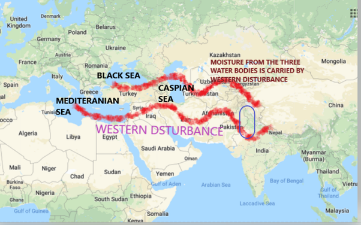
Today, scientists describe these systems with precision. Western Disturbances are extra-tropical storms that originate over the Mediterranean and surrounding regions, carried eastward by the westerly jet stream. When they reach the Himalayas, their moisture is forced upward, cooling and condensing into rain in the valleys and snow in the high mountains. This process sustains the winter climate of Jammu & Kashmir, replenishing rivers, feeding agriculture, and shaping daily life during the long months when the monsoon is absent. What science articulates through models and satellites, my mother understood through decades of observation.
Her wisdom was not unique. Across the region, farmers, shepherds, and households have long read the signs of the sky—the shift in wind, the thickening clouds, the chill that deepens before snowfall. This lived knowledge guided sowing, travel, and survival long before weather stations arrived. It does not contradict science; it complements it. One offers mechanisms and forecasts, the other patterns and intuition refined over generations.
Western Disturbances, however, are not gentle visitors alone. They are central to water security, storing snow in the mountains that later feeds rivers like the Jhelum and sustains agriculture and hydropower. They support winter tourism in places such as Gulmarg and Sonamarg, where snowfall is economic lifeblood. Yet they also bring hazards—avalanches in high terrain, landslides in lower reaches, and disruptions to roads and livelihoods when snowfall or rain becomes excessive.
Climate change is now adding uncertainty to this ancient rhythm. Western Disturbances are becoming more variable, sometimes arriving out of season or delivering extreme precipitation. Warmer seas and shifting wind patterns are altering their behaviour, increasing the risk of erratic weather, floods, and infrastructure damage. In this changing climate, understanding these systems is no longer academic; it is essential for planning, safety, and resilience.
The convergence of my mother’s simple observation and scientific explanation offers a deeper lesson. Nature speaks in patterns that attentive people can learn to read, even without instruments. Science, in turn, gives those patterns structure and predictive power. Together, they provide a fuller understanding of the skies over Jammu & Kashmir.
When the west wind blows and snow settles on the ridges or rain falls softly in the valley, the weather is telling a story—of distant seas, high mountains, and a land shaped by both. Listening to that story requires humility: respect for traditional wisdom and trust in scientific insight. In that balance lies our best hope of understanding—and living wisely with—the changing climate of this region.


Comments are closed.