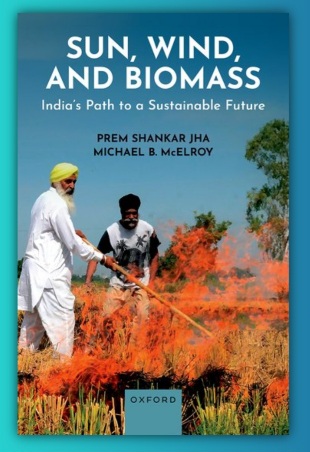
New Delhi: Sun, Wind, and Biomass — India’s Path to a Sustainable Future, a new book co-authored by Prem Shankar Jha and Harvard environmental scientist Michael B. McElroy, presents a policy-oriented case for using biomass at scale to address persistent weaknesses in the global and Indian renewable energy mix.
Jha, a noted economist and public intellectual, and McElroy, Gilbert Butler Professor of Environmental Studies at Harvard, contend that while renewable technologies have made inroads in electricity generation, they have so far done little to displace fossil fuels used for transport fuels and industrial heat. They also highlight the unresolved problem of intermittency in solar and wind generation.
The authors argue that harnessing biomass — in particular crop and forestry residues and municipal solid waste — offers a low-cost, readily available route to fill these three gaps. “Our book shows how all the above three lacunae can be filled, simply and cheaply, through the harnessing of biomass,” Jha writes in the book’s foreword. According to the authors, a coordinated biomass strategy could not only supply reliable fuel for industry and transport but also complement intermittent electricity from solar and wind through integrated systems.
Beyond energy supply, the book places strong emphasis on socioeconomic and environmental co-benefits. Jha and McElroy outline how decentralized biomass value chains can generate substantial, permanent employment in rural areas and create new livelihood opportunities. They further argue that systematic use of crop residues for energy would reduce the seasonal spike in air pollution across northern India caused by stubble burning, delivering public-health gains at low marginal cost.
The book, published by Oxford University Press, combines technical analysis with policy prescriptions aimed at central and state governments, industry stakeholders and development agencies. It advocates reforms to procurement, finance and logistics to enable mass collection, processing and conversion of residues and urban waste into energy and feedstock.
Sun, Wind, and Biomass is being launched in New Delhi on 8 January 2026. Organisers said the authors will outline policy priorities and respond to audience questions; a recording of the event will be made available online after the launch. The book is positioned as a practical contribution to debates on India’s energy transition, with an emphasis on solutions that align climate goals, rural development and air-quality improvements.