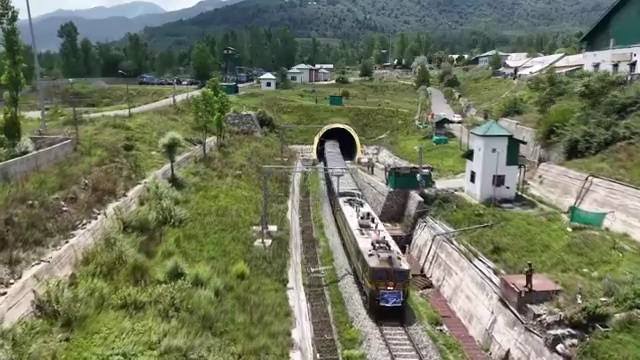
New Delhi, Dec 17: Jammu and Kashmir has achieved 100 per cent electrification of its broad gauge railway network, as Indian Railways moves close to completing electrification of the entire national network, reaching 99.2 per cent coverage nationwide, the government informed Parliament on Tuesday.
According to official data, electrification has now been completed across 25 States and Union Territories, including Jammu and Kashmir, placing the region among the fully electrified rail networks in the country. The achievement marks a significant milestone for connectivity, operational efficiency, and sustainable transport in the Union Territory.
The Ministry of Railways said electrification has been pursued in mission mode, with 46,900 route kilometres electrified between 2014 and 2025—more than double the 21,801 route kilometres electrified in the six decades prior to 2014. Work on the remaining unelectrified sections is currently underway.
Globally, Indian Railways’ progress compares favourably with major railway systems. As per the June 2025 report of the International Union of Railways, India has surpassed countries such as the United Kingdom (39 per cent), Russia (52 per cent), Japan (64 per cent) and China (82 per cent) in railway electrification, while matching Switzerland’s 100 per cent coverage in several zones.
Fourteen railway zones, including Northern Railway, North Central Railway and Western Railway, have achieved full electrification. At the state and UT level, Jammu and Kashmir joins Bihar, Jharkhand, Himachal Pradesh, Punjab, Delhi and several northeastern states in attaining complete electrification.
Railway electrification during 2023–24 and 2024–25 stood at 7,188 route kilometres and 2,701 route kilometres respectively. The Railways has also mandated electrification for all new line and multi-tracking projects.
The government noted that project timelines are influenced by factors such as forest and statutory clearances, difficult terrain, climatic constraints and law and order conditions. Despite these challenges, electrification in the remaining sections of Assam and other partially covered states is progressing.
Highlighting environmental benefits, the ministry cited a NITI Aayog report showing that rail transport emits nearly 89 per cent less CO₂ per tonne-kilometre compared to road transport. Indian Railways is also expanding the use of renewable energy, including solar and wind power, to further reduce its carbon footprint.
The information was provided by Union Minister for Railways, Information and Broadcasting, and Electronics and Information Technology, Ashwini Vaishnaw, in a written reply to a question in the Lok Sabha.


Comments are closed.