

Ziraat Times Team Report
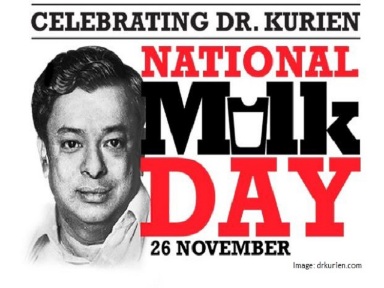
New Delhi, November 25: India will observe National Milk Day on November 26, commemorating the birth anniversary of Dr. Verghese Kurien, the architect of the country’s White Revolution and founder of the modern cooperative dairy movement. Marking the occasion, the government released an extensive review of the country’s dairy landscape, highlighting rapid growth, expanding farmer participation, major reforms and new programmes designed to sustain India’s position as the world’s largest milk producer.
Milk continues to hold a central place in India’s nutritional and economic framework, contributing nearly one-fourth of global output and accounting for about 5 percent of the national economy. The sector provides direct employment to over eight crore farmers, a large proportion of whom are women, reaffirming the dairy economy’s role as a driver of inclusive rural growth.
From Milk Deficit to Global Leader
India’s dairy journey has undergone remarkable transformation. In the decades following independence, milk shortages forced the country to depend heavily on imports. Despite having the world’s largest cattle population, milk production grew slowly: only 1.64% annually in the 1950s and 1.15% in the 1960s.
This changed with the creation of the National Dairy Development Board (NDDB) in 1965 under Dr. Kurien, and the launch of Operation Flood in 1970, which built a nationwide cooperative network linking rural producers to major urban markets. The initiative—modelled on the success of the Anand cooperative led by Amul—fueled the White Revolution, transforming India into a self-sufficient and eventually global milk leader. In 1987, NDDB was declared an Institution of National Importance.
Dairy Growth Accelerates in the Last Decade
Over the last ten years, India’s dairy sector has expanded rapidly.
-
Milk production climbed from 146.3 million tonnes in 2014–15 to 239.3 million tonnes in 2023–24, an increase of 63.5%.
-
Per capita availability of milk rose from 124 grams to 471 grams per day.
-
India’s bovine population stands at 303.76 million, with productivity increasing by 27.39%, the highest growth rate globally.
Indigenous cow breeds have also seen improved performance, with their milk output rising from 29 million tonnes to 50 million tonnes. Goats and sheep continue to support milk production in arid regions.
Government initiatives such as the Rashtriya Gokul Mission, the Livestock Health and Disease Control Programme, and growing interest in ethno-veterinary medicine aligned with Ayurveda have contributed to improved breeding practices and healthier livestock.
Rashtriya Gokul Mission: Expanding Genetic Improvement
Revised in March 2025, the expanded Rashtriya Gokul Mission now has an outlay of ₹3,400 crore. Over 92 million animals and 56 million farmers have benefited so far. Artificial insemination coverage stands at 33%, and 565.55 lakh inseminations were conducted in 2024–25.
The National Artificial Insemination Programme has reached 9.16 crore animals, performing 14.12 crore inseminations while providing doorstep services to farmers. Twenty-two IVF labs and more than one crore doses of sex-sorted semen strengthen breeding advancement.
To address rural service gaps, 38,736 MAITRIs, or trained technicians, have been deployed in villages.
Strengthening Dairy Infrastructure: NPDD Progress
The National Programme for Dairy Development (NPDD) continues to expand organised milk procurement and processing. Since 2014:
-
31,908 dairy cooperative societies have been revived or newly established.
-
17.63 lakh new milk producers have joined cooperatives.
-
Daily milk procurement increased by 120.68 lakh kg.
-
61,677 village testing labs and nearly 6,000 bulk milk coolers have been set up.
Major plants in Mehsana, Indore, Bhilwara and Telangana were inaugurated this year, while large investments flow into new dairy and cattle-feed units.
Women remain central to this ecosystem—70% of India’s dairy workforce are women. More than 48,000 women-led cooperatives and 16 all-women Milk Producer Organisations now represent over 12 lakh female producers.
GST Reform Brings Relief to Dairy Sector
The 56th GST Council meeting approved sweeping tax rationalisations for milk and dairy products, effective from September 22, 2025.
-
UHT milk and pre-packaged paneer are now tax-free.
-
Butter, ghee, cheese, spreads, condensed milk, dairy beverages shifted from 12% to 5%.
-
Ice cream reduced from 18% to 5%.
-
Milk cans taxed at 5% instead of 12%.
Comments are closed.