

Ziraat Times News Desk
MeitY launches framework under IndiaAI Mission; ‘Do No Harm’ set as core principle for AI development
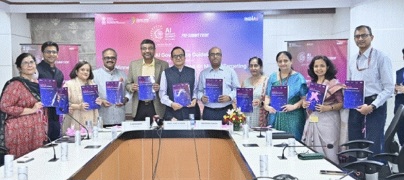
NEW DELHI: The Ministry of Electronics and Information Technology (MeitY) on Wednesday unveiled the India AI Governance Guidelines — a comprehensive national framework aimed at ensuring safe, inclusive, transparent, and responsible adoption of Artificial Intelligence (AI) across all sectors. The launch marks a major milestone under the IndiaAI Mission, ahead of the upcoming India AI Impact Summit 2026.
The guidelines were released by Prof. Ajay Kumar Sood, Principal Scientific Adviser to the Government of India, in the presence of Shri S. Krishnan, Secretary, MeitY; Shri Abhishek Singh, Additional Secretary, MeitY, and CEO IndiaAI Mission; and other senior officials and researchers, including representatives from IIT Madras and the Office of the Principal Scientific Adviser.
Human-Centric, Ethical AI at the Core
The new framework outlines seven guiding principles (“Sutras”) for ethical AI, built on the overarching value of “Do No Harm.” It emphasizes human-centric development, risk mitigation, innovation sandboxes, and flexible governance models to balance innovation with accountability.
“The guiding principle that defines the spirit of the framework is simple — Do No Harm. We are creating innovation sandboxes and a flexible, adaptive system for risk mitigation,” said Prof. Ajay Kumar Sood, underlining India’s intent to lead in responsible AI governance.
Shri S. Krishnan, Secretary, MeitY, said the framework aims to ensure that “AI serves humanity and benefits people’s lives while addressing potential harms.” He added that the focus would remain on leveraging existing legislation wherever possible to support implementation.
A Foundation for Responsible AI Ecosystem
The India AI Governance Guidelines lay out:
-
Seven ethical principles for AI use and development.
-
Recommendations across six governance pillars, including safety, accountability, inclusivity, and transparency.
-
An implementation roadmap with short-, medium-, and long-term action plans.
-
Practical guidance for industry, developers, and regulators to ensure responsible deployment.
Shri Abhishek Singh, Additional Secretary and CEO, IndiaAI Mission, said the final guidelines were developed after “extensive deliberations and public consultations,” reflecting India’s multi-stakeholder approach. “The Government remains focused on ensuring AI is accessible, affordable, and inclusive while strengthening a trustworthy innovation ecosystem,” he said.
Expert Committee and Global Outlook
The framework was drafted by a high-level expert committee chaired by Prof. Balaraman Ravindran of IIT Madras, with members including Ms. Debjani Ghosh (NASSCOM/NITI Aayog), Dr. Kalika Bali (Microsoft Research India), and policy experts from MeitY, NITI Aayog, iSPIRT Foundation, and Trilegal.
The document, available on indiaai.gov.in, is envisioned as a foundational reference for policymakers, researchers, and industry, promoting global cooperation on responsible AI adoption — particularly across the Global South.
IndiaAI Hackathon Winners Announced
The event also saw the announcement of winners of the IndiaAI Hackathon for Mineral Targeting, organized under the IndiaAI Mission’s Applications Development Pillar in collaboration with the Geological Survey of India (GSI) and the Ministry of Mines.
The hackathon encouraged the use of AI and machine learning to enhance mineral mapping, exploration, and resource discovery.
-
First Prize (₹10 lakh): CricSM AI – for AI-based critical and strategic mineral mapping.
-
Second Prize (₹7 lakh): Knowledge and Data-Driven Mineral Targeting project.
-
Third Prize (₹5 lakh): SUVARN: Semi-Unsupervised Value-adaptive Artificial Resource Network.
-
Special Prize (₹5 lakh): AI/ML solutions identifying potential zones for minerals such as REE, Ni-PGE, copper, and gold.
Comments are closed.