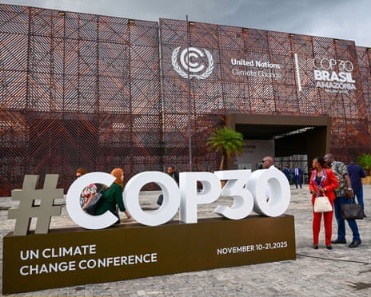
Belem, Brazil — The COP30 UN climate summit closed on Saturday with a watered-down agreement that fell far short of expectations, as negotiators failed to reach consensus on phasing out fossil fuels despite marathon overnight talks and mounting warnings from vulnerable nations.
The talks were overshadowed by the continued absence of the United States from global climate negotiations following Washington’s withdrawal from the Paris Agreement, a move that has created a geopolitical vacuum and emboldened countries opposing stronger action. Former US administrations have dismissed climate change as “a con” and rolled back federal climate measures, a stance widely criticised by climate-vulnerable nations and civil society groups.
No Consensus on Fossil Fuels
More than 80 nations had pushed for a roadmap to “transition away from fossil fuels,” echoing a commitment adopted at COP28. The proposal, already viewed by campaigners as weak for lacking a deadline or enforcement mechanism, was further diluted after resistance from Saudi Arabia, Russia, China, India and several African petro-economies.
The final text reduced the proposal to a voluntary initiative, with countries merely “invited” to discuss future pathways. Analysts said the absence of the US—historically a key broker in climate diplomacy—removed a major counterweight to fossil-fuel-producing countries.
Johan Rockström of the Potsdam Institute called the outcome a missed chance:
“Our only chance of keeping 1.5C alive is to bend the emissions curve by 2026. That requires concrete phase-out plans for fossil fuels. We got neither.”
Weak Action on Climate Finance
Developing countries secured a commitment to “efforts” to triple adaptation finance to $120bn a year by 2035—far below the estimated $360bn annually they need. Critics said the ambiguous language leaves too much to interpretation and too little binding responsibility.
“Ten years from now is unimaginably long for communities facing life-threatening impacts now,” said Action Aid’s Brandon Wu. “This decision locks in climate injustice.”
National Climate Plans Lagging
One of the biggest setbacks was the lack of progress on strengthening national climate plans (NDCs).
More than 70 countries—including India and Saudi Arabia—failed to submit their updated NDCs. Current commitments would put the world on a 2.5C warming trajectory, far above the Paris target.
China, India and several others refused any binding discussion on improving NDCs at COP30, pushing the issue to future “voluntary consultations”.
Human Rights Concerns Over Critical Minerals Scrubbed Out
Civil society groups welcomed the inclusion of a “just transition mechanism”, but expressed alarm that China and Russia successfully removed language addressing abuses in critical mineral extraction.
“This omission glosses over the human cost of mineral extraction,” said Mohamed Adow of Power Shift Africa, citing the recent deaths of cobalt miners in the Democratic Republic of Congo.
Australia Faces Heavy Lifting at COP31
With unresolved disputes over fossil fuels, finance, NDCs and emissions reductions, responsibility now shifts to Australia, which will lead COP31 in Turkey next year.
Environmental groups said incremental progress was no longer enough.
“The world needs giant leaps to cut emissions,” said Asad Rehman of Friends of the Earth. “If words aren’t turned into action soon, the consequences will be terrifying.”
The final agreement stated only that countries should aim for “full implementation of NDCs while striving to do better”—a phrase that observers say reflects the limits of what negotiators could agree on in a deeply fractured geopolitical landscape.