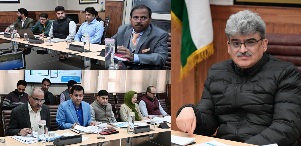
Srinagar: Jammu & Kashmir is poised to generate about ₹220 crore in revenue from mining operations this year, with 207 of 235 minor mineral blocks already leased out and 98 currently operational, officials revealed during a high-level review meeting chaired by Chief Secretary Atal Dulloo on Monday. The Union Territory also has 48 limestone blocks, while 79 mineral blocks await Environmental Clearance (EC) and 30 are at the Consent to Operate (CTO) stage.
The meeting, which focused on the performance of the Mining Department and implementation of the Integrated Mining Surveillance System (IMSS), was attended by the Principal Secretary, Mining; Chairperson, Pollution Control Committee; Director, Geology & Mining; and other senior officers.
Chief Secretary Dulloo emphasized the need to leverage the technology-driven IMSS platform for real-time monitoring of mining operations and to ensure transparency, accountability, and effective action against illegal mining. He directed that every alert generated through IMSS must be promptly verified on the ground and followed by strict legal measures against violators or delinquent officers.
He further instructed that Deputy Commissioners be given direct access to the IMSS platform to enable swift action at the district level. The Mining Department was also asked to furnish periodic performance briefs to the Chief Secretary’s office and to regularly monitor field-level responses to IMSS alerts.
Principal Secretary, Mining Anil Kumar Singh, informed that the IMSS had so far generated 114 triggers identifying suspected illegal mining sites using geo-spatial coordinates and satellite imagery. Of these, 29 sites were physically verified, confirming unauthorized mining at 16 locations. All alerts, he said, are shared in real-time with Deputy Commissioners, SSPs, and District Mineral Officers for immediate action.
The IMSS is also being integrated with e-Challan and e-Market platforms to improve enforcement and operational efficiency. The department plans to add vehicle tracking and on-spot e-challaning capabilities in the next phase.
During the meeting, Dulloo commended the BISAG-N team for developing the IMSS and appreciated the live demonstration showcasing its precision in detecting and locating illegal mining activities.
The Chief Secretary also reviewed the progress on exploration and auction of major and minor mineral blocks, urging the Pollution Control Committee to prepare a comprehensive checklist of required clearances to fast-track the approval process.
He further took stock of ongoing exploration of key minerals including Lithium, Sapphire, Lignite, Granite, Dolomite, Graphite, and Gypsum, and reviewed biogas exploration projects being undertaken in collaboration with ONGC.
To strengthen enforcement, Dulloo directed the constitution of Quick Response Teams (QRTs) under respective District Mineral Officers and establishment of control rooms under the District Mineral Foundation Trust (DMFT) framework for coordinated surveillance and response across all districts.