Srinagar: The Kashmir Chamber of Commerce and Industry (KCCI) has called upon the government to take stringent measures against those involved in the recently unearthed rotten meat scandal, while also recommending a set of revival measures for Kashmir’s hospitality, poultry, and handicrafts sectors.
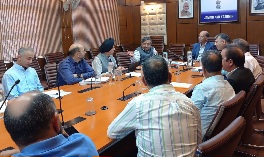
In a meeting with Advisor to the Chief Minister, Nasir Aslam Wani, held at the Civil Secretariat, a KCCI delegation led by President Javid Ahmad Tenga and comprising Senior Vice President Ashiq Shangloo, Secretary General Faiz Ahmad Bakshi, and Past President Mushtaq Ahmad Wani, expressed deep concern over the economic and social fallout of the scandal. The meeting was also attended by senior government officials including Additional Chief Secretary to the Chief Minister, Dheeraj Gupta, and Commissioner Industries and Commerce, Vikramjeet Singh.
KCCI demanded that the government publicly disclose the names and supply chains of those involved in the sale of rotten meat. It said a fast-track investigation was essential to restore public confidence, warning that the scandal had “shaken trust in the food supply chain” and put genuine businesses at risk.
The Chamber appreciated the government’s prompt action in busting the rotten meat network but highlighted its “severe aftershocks.” According to KCCI, restaurants and cafés have witnessed an 80 percent decline in customer footfall, pushing hospitality businesses into deep financial stress and threatening thousands of jobs.
The poultry sector has also suffered a sharp decline, with local production dropping from nearly 85 percent of demand to just 15 percent, making the Valley dependent on outside imports of “doubtful quality,” the Chamber noted.
To address the crisis, KCCI proposed a multi-pronged strategy. For the hospitality industry, it recommended strict food safety enforcement, establishment of modern slaughterhouses under veterinary supervision, and the launch of an “Eat Safe Kashmir” certification programme with QR-coded hygiene records. It also sought suspension of frozen meat imports until robust traceability systems were in place.
For revival of poultry, the Chamber proposed temporary suspension of dressed chicken imports, land allocation for hatcheries and feed mills, loan relief for struggling farmers, and the creation of a UT-level Poultry Task Force.
The delegation further pressed for reduction of Goods and Services Tax (GST) on handicrafts from 12 percent to 5 percent, saying the sector—deeply rooted in Kashmir’s six-century-old tradition inspired by Shah-i-Hamdan (RA)—was under immense stress. It urged expedited certification of GI-tagged crafts at the PTQCC lab to protect artisans and ensure market trust.
Advisor to the CM, Nasir Aslam Wani, assured the delegation that the government was committed to “firm and transparent” enforcement of food safety standards while protecting genuine businesses. He said KCCI would play a key role in helping restore consumer confidence in the Valley’s food and restaurant sectors.


Comments are closed.