

By: Imtiyaz Shah and Ambreen Khan (Ziraat Times)
Srinagar: As the Jammu & Kashmir administration prepares to roll out a new hydropower policy focused on micro and mini hydroelectric projects, experts and energy analysts are sounding caution that the region’s clean energy plans may be heading toward direct competition with an emerging solar power revolution — both within J&K and from neighboring Ladakh.
A series of developments, including the rapid expansion of rooftop solar programs under the country’s Surya Ghar: Muft Bijli Yojana, solar infrastructure on government buildings and a planned 10 GW solar power generation project in Ladakh are likely to significantly influence the financial and strategic viability of J&K’s hydropower ambitions over the coming decade.
J&K’s new Hydro Policy
The Jammu & Kashmir government recently said it is finalizing a new energy policy aimed at promoting small hydropower units — especially run-of-the-river micro and mini plants below 25 MW capacity. These projects are being planned across remote and hilly regions to decentralize power generation, create jobs and strengthen local energy resilience.
The policy also encourages community participation, with local panchayats and cooperatives invited to manage operations and maintenance of the plants, along with public-private partnerships.
However, stakeholders in the energy sector caution that these hydro investments — which typically have long gestation periods and high capital costs — could face mounting viability and sustainability risks due to the fast-falling cost and rapid deployment of solar power across the world and within the country.
What is happening elsewhere?
In recent years, the global energy sector has witnessed a paradigm shift. The rise of distributed solar power —affordable, scalable, and increasingly efficient — is disrupting traditional grid-based electricity systems.
From South Africa to Pakistan, the proliferation of rooftop solar installations and community-scale solar grids is has raised reg flags for countries heavily invested in large-scale traditional energy infrastructure. This month, two major in-depth reports by The Economist and Bloomberg have warned of a “utility death spiral,” where large investments in conventional energy generation could become stranded assets as solar energy becomes ubiquitous and cheap.
Solar’s steady rise in J&K
India’s solar revolution is making inroads in J&K too. While J&K may not have as much sunshine as Rajasthan or Gujarat, technological improvements and central subsidies are making solar a viable option—even in Kashmir Valley and the hilly areas of Jammu.
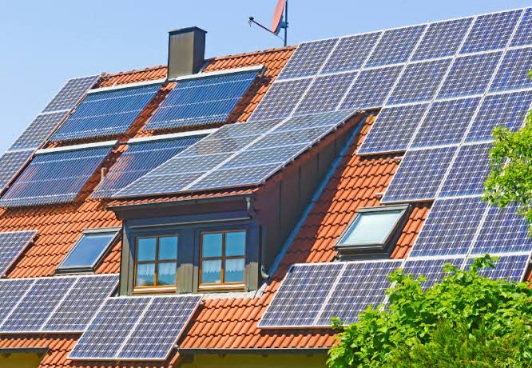
The solar energy push under Surya Ghar and other state and central schemes is beginning to reshape the energy landscape in Jammu & Kashmir. Thousands of rooftops — including homes, government offices, schools, and health centres — are being fitted with solar photovoltaic (PV) panels, said Sheikh Naseer, a engineer, involved in executing these schemes.
Under Surya Ghar, households are being provided subsidies of up to ₹78,000 for installations up to 3 kW, resulting in a new increase in demand for off-grid and net-metered solar systems.
Although the transition is slow, yet, as more and more people begin to realise the benefits, the switch could get faster.
The Kashmir Power Distribution Corporation Ltd (KPDCL) has also started procurement planning for purchasing distributed solar power from private and household producers. Together, these trends are leading to decentralization of electricity generation and reducing reliance on grid-supplied power, a development that could eat into the future demand for new hydro capacity.
Ladakh’s 10 GW solar plan: A game-changer?
Perhaps the biggest disruption to J&K’s power sector may come not from within, but from Ladakh’s ambitious 10,000 MW (10 GW) solar power generation plan, currently under active development. With projects planned in Zanskar, Hanle, Pang and other high-insolation zones, Ladakh is positioning itself as a major solar power hub for northern India.
To export this energy, a dedicated transmission corridor connecting Ladakh to the national grid via Kashmir and Jammu is already under construction. This makes Jammu & Kashmir the first and most accessible market for surplus solar power from Ladakh, said Er Imtiyaz Hussain, an expert on transmission issues.
Analysts say this could influence the financial planning for J&K’s planned hydro units.
“If J&K is flooded with low-cost solar power from Ladakh, the new micro-hydro projects may become financially unviable, especially in regions already connected to the grid,” said a senior energy consultant based in Srinagar.
With solar tariffs dropping to as low as ₹2.5–3 per unit, compared to ₹5–7 per unit from small hydropower plants, the fear is that new hydro investments could struggle to find buyers — or be forced to sell at a loss.
Industry comparisons show that solar energy — particularly decentralized rooftop and utility-scale solar — has significant advantages over hydro in terms of speed of deployment, low operating costs, and environmental footprint.
Aspect |
Micro Hydropower |
Solar Power |
|---|---|---|
Capital Cost |
₹7–10 crore/MW |
₹3–5 crore/MW |
Time to Deploy |
2–4 years |
3–6 months |
Seasonal Dependency |
High (water flow) |
Moderate (sunlight, mitigated by batteries) |
O&M |
Technically intensive |
Simple, low cost |
Levelized Cost |
₹5–7/unit |
₹2.5–4/unit |
Comments are closed.