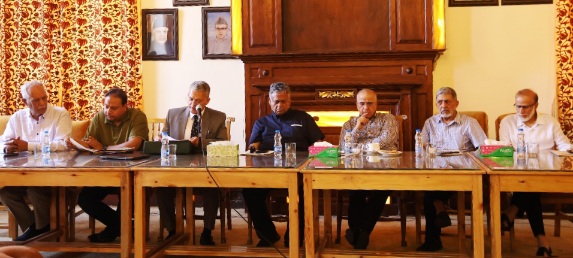
Srinagar: Amid growing concerns over unethical practices in the healthcare sector, Amar Singh Club, Srinagar, held an intense and thought-provoking seminar titled “Healing with Honor – Ethics and Empathy in Medical Practices” as part of its ‘Common Interest Conversations’ series. The seminar brought together prominent voices from law, medicine, and civil society to examine malpractice, accountability, and the human dimension of healthcare.
The session was chaired by renowned neurologist Dr. Sushil Razdan and presided over by senior advocate Zaffar A. Shah, with leading experts like Dr. Mushtaq Margoob, Dr. Abdul Wahid, Dr. Naveed Nazir, and Dr. Nasir Hamid Khan, Secretary of Amar Singh Club, offering wide-ranging insights.
Mr. Shah highlighted glaring gaps in accountability for medical professionals. Drawing parallels with the judiciary, he said, “When an advocate is negligent, there is a system to take action. But with doctors, even blatant malpractice goes unchecked.” He narrated personal anecdotes, including conflicting diagnoses on cancer treatment and post-surgical infections, stressing the urgent need for a regulatory oversight body.
Dr. Sushil Razdan underlined how both doctors and patients are under pressure. “Patients feel unheard, over-tested, and under-cared for. Doctors, especially in corporatized hospitals, face unrealistic targets and bureaucratic controls,” he said. He cautioned against seeing medicine as an exact science. “Every patient is different, and many conditions still lack definitive treatments.”
Dr. Abdul Wahid shared cases of misdiagnosis and overmedication, including unnecessary C-section surgeries and prescribing heavy antibiotics where they were not required. He also reflected on acts of compassion by Kashmir’s legendary doctors like Dr. Ali Jan and Dr. Naseer.
Dr. Mushtaq Margoob called for a cultural revival of empathy in medicine. “In earlier times, doctors were deeply connected with patients. Today, commercial pressures and online misinformation have eroded that trust.”
Dr. Naveed Nazir emphasized the lack of a proper referral system in Kashmir and highlighted the burden on tertiary care hospitals. He also stressed the need to define ‘generic drugs’ clearly and called for counseling of new doctors to understand the human side of patient care.
Participants raised concerns over corruption, inaccessibility, overcharging, and neglect. Senior journalist Peerzada Ashiq recommended an audit system for prescriptions. Others spoke of unprofessional practices in private clinics and physical inaccessibility for vulnerable patients.
In a passionate closing, Mr. Shah asserted that doctors, like judges, must never compromise ethics for profit. “Service is a choice. If you want to make money, become a businessman. But if you’ve chosen to serve, there can be no justification for corruption.”
He called for an independent monitoring body, prescription audits, and stringent penalties for medical negligence, asserting that, “Society does not just need good doctors; it needs ethical doctors.”
The seminar concluded with a strong consensus on the need for a balanced approach—protecting doctors from burnout while holding them accountable for ethical lapses, thereby restoring faith in Kashmir’s healthcare system.


Comments are closed.