

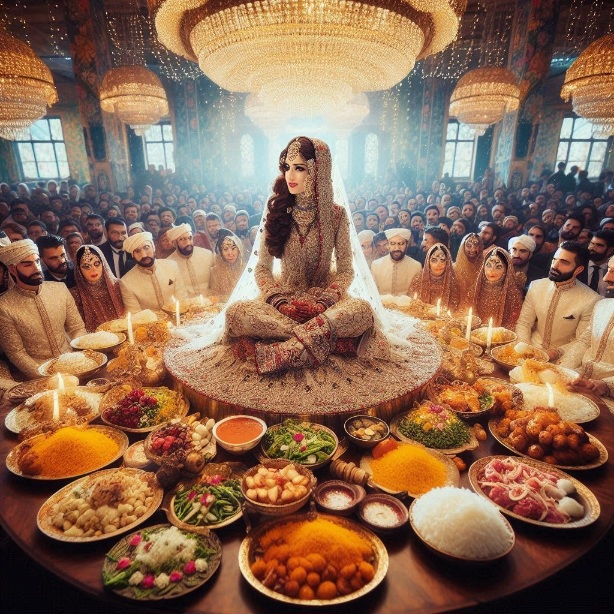
Srinagar, Sept 1: Kashmiri weddings, known for their grandeur and cultural richness, have increasingly become a source of environmental waste and financial strain, particularly for the bride’s family. Several reformers have been calling to bring moderation in these weddings so that the institution of marriage is simplified.
Today, the main concern in Kashmiri society are the late marriages because weddings have become too expensive.
Mohammed Maroof Shah, a writer, civil servant, and founder trustee of Zakat, Infaq and Sadaqat Trust (ZIST), a institution which has introduced a novel idea of micro investment in J&K’s multi-crore livestock sector and affordable Eid Qurbani, has highlighted the unnecessary practices that contribute to these issues and has suggested solutions to make weddings more sustainable and economically manageable.
Unnecessary waste in Kashmiri weddings
There is an increasing feeling in Kashmiri society that the traditional opulence of Kashmiri weddings often leads to significant waste, both environmentally and financially. According to Shah, several customs and practices that have become standard in these ceremonies are not only wasteful but also avoidable.
1. Marriage invitations: Expensive wedding invitations are printed on high-quality paper, often with elaborate designs. Shah argues that these could easily be replaced by simpler, more eco-friendly alternatives, or even digital invitations.
2. Multiple functions: Separate functions for the Nikah (marriage contract) and the wedding ceremony itself are common, but Shah suggests that combining these events could reduce costs and the environmental footprint.
3. Extravagant food and beverages: The tradition of serving lavish meals with multiple dishes, including the Trami system (where food is served in large communal plates), leads to considerable food wastage. Shah points out that many items on the menu, such as pastries and carbonated drinks, are both wasted and unhealthy. He also notes that serving food to hundreds of guests in one sitting often results in guests not being properly hosted, without any interaction between guests and hosts.
4. Disposable items: The use of disposable plates, cups, and cutlery, along with bottled water, contributes significantly to environmental pollution. These items are often made from plastic, which is not biodegradable and poses a long-term environmental hazard.
5. Unnecessary expenses: Elaborate wedding halls, expensive tents, and excessive decorations are a financial burden. Shah argues that these are not essential to the celebration and that community spaces or simpler arrangements would suffice.
6. Burden on the bride’s family: In many Kashmiri weddings, the bride’s family is responsible for bearing most of the expenses, including gifts for the groom’s family, elaborate meals, and decorations. Shah emphasizes that this tradition is not only unfair but also places an unnecessary financial burden on the bride’s family.
7. Cultural and religious concerns: Shah also highlights practices that are not only wasteful but also explicitly discouraged in Islam. For instance, the practice of Mahraz Sal, where large groups of people accompany the groom to the bride’s house, is considered an unnecessary display of wealth and is discouraged in Islamic teachings. Similarly, the tradition of Gulemeuth, a costly and elaborate ritual, is another example of how cultural practices have overshadowed religious teachings that advocate simplicity.
Practical solutions for sustainable weddings
To address these issues, Shah proposes a series of practical solutions that could make Kashmiri weddings more sustainable and financially manageable:
1. Simplification of traditions: Shah advocates for the simplification of wedding traditions, such as reducing the number of functions and cutting down on the number of dishes served. He suggests limiting the guest list to 300 people and serving meals to men and women at the same time, which would reduce food waste and improve the overall hosting experience.
2. Use of community resources: Instead of renting expensive tents and utensils, Shah recommends that local mosque committees or Baitul Mal (community welfare funds) should maintain a stock of these items that can be used by anyone in the community for a nominal fee. This would not only reduce costs but also promote a sense of community.
3. Promoting sustainable practices: Shah emphasizes the importance of reducing the use of disposable items and bottled water. Instead, traditional methods of serving and drinking water, such as using Tesh Naer (traditional Kashmiri hand-washing tool) and simple towels, should be encouraged.
4. Formation of marriage committees: Shah proposes the formation of marriage committees within local communities, overseen by the Baitul Mal or mosque committees. These committees would ensure that weddings are conducted in an environmentally friendly and financially responsible manner, in line with Islamic principles. They could also offer support in organizing affordable and sustainable weddings.
5. Investment in livelihoods: Shah argues that the money spent on extravagant weddings could be better invested in creating passive income for the newlyweds. For instance, instead of spending lakhs on a single event, a portion of that money could be used to start a business or invest in property, which would provide financial security for the couple.
6. Emphasizing islamic values: Shah calls for a return to Islamic values of simplicity and modesty in weddings. By avoiding unnecessary expenses and focusing on the spiritual and communal aspects of the event, Kashmiri weddings could become more meaningful and less of a financial burden.
The role of social pressure
One of the major obstacles to implementing these changes, according to Shah, is social pressure. Many families continue to follow wasteful traditions out of fear of social judgment or to maintain their status in the community. Shah stresses the need for a cultural shift where simplicity and sustainability are valued over extravagance.
“We can host kith and kin get-togethers every month for years if we don’t destroy resources on the day of marriage”, Shah eloquently says. His call for reform is not just about reducing waste, but about rethinking the very essence of what makes a wedding meaningful in the first place.
Comments are closed.