Srinagar, October 19: Secretary, Planning, Development and Monitoring Department, Dr. Owais Ahmad, has directed the Jammu & Kashmir Economic Reconstruction Agency (JKERA) to prepare a sustainable, region-wide roadmap with a shelf of innovative, fund-ready projects and proactively explore external funding opportunities to accelerate infrastructure development.
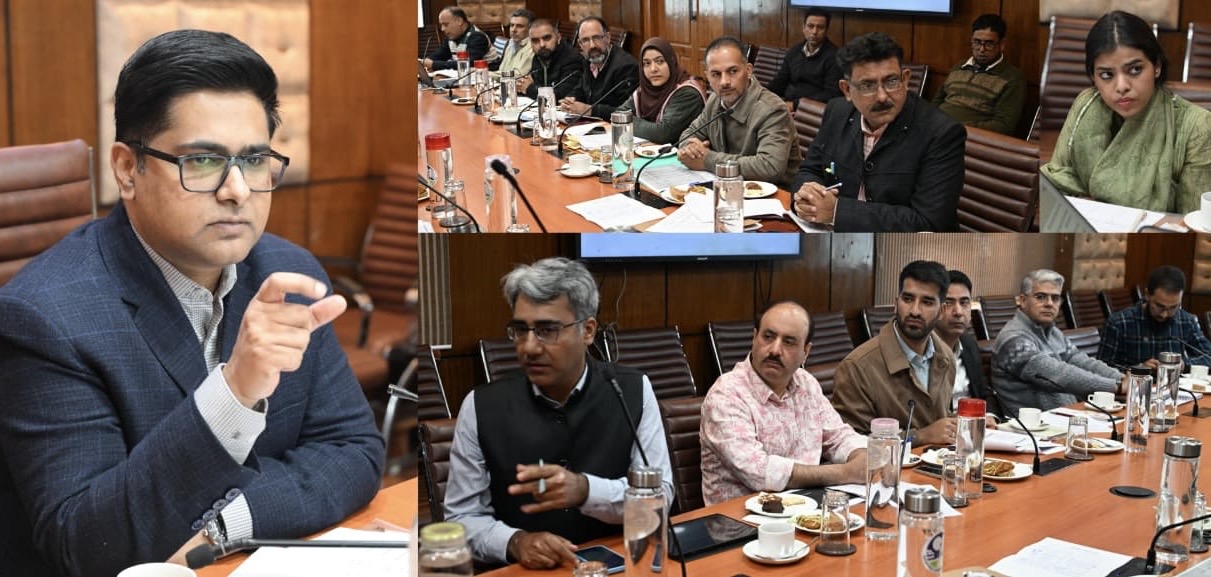
Dr. Ahmad issued the directions while chairing a meeting to review the functioning of JKERA, the nodal agency for implementing externally aided projects in Jammu & Kashmir.
During the meeting, JKERA Chief Executive Officer Akriti Sagar said the agency, established in 2004, had played a significant role in upgrading basic infrastructure across the Union Territory.
She said JKERA had successfully implemented three major externally aided projects: the Multisector Project for Infrastructure Rehabilitation in J&K (MPIR) and the Jammu and Kashmir Urban Sector Development Investment Programme (JKUSDIP), both funded by the Asian Development Bank, and the World Bank-funded Jhelum Tawi Flood Recovery Project (JTFRP).
According to the agency, its interventions have covered infrastructure in health, education, livelihoods and disaster management, besides urban transportation projects, including flyovers and grade separators, major stormwater drainage systems, rural roads and bridges.
Other projects have included buildings for health and educational institutions, livelihood initiatives, disaster management infrastructure and urban reforms such as water metering and capacity building of urban local bodies.
The meeting was also informed that JKERA had introduced technologies and construction practices such as earthquake-resistant structures, rigid concrete pavements, Building as Learning Aid (BaLA)-designed schools, certified green buildings, pneumatic tube systems, arch bridges, gaseous chlorination, trenchless drainage and restoration using devar stone and dhajji-dewari designs.
Under the World Bank-funded JTFRP, the agency has completed 225 sub-projects covering roads, bridges, health and education infrastructure, oxygen plants in remote areas, medical equipment, ambulances, modern fire tenders and rescue equipment.
The project also supported information technology systems for disaster management, including Decision Support Systems (DSS), the Integrated Online Flood System (IOFS) and a disaster risk database, besides flood mitigation studies for the Jhelum and Tawi basins.
Dr. Ahmad stressed the need for sustainable project formulation and directed the agency to develop a pipeline of innovative proposals that could be taken up for funding through Central schemes and other external funding agencies.
The meeting was attended by the Director Kashmir, JKERA; Director Jammu, JKERA; Chief Accounts Officer, JKERA; Additional Secretary Legal, JKERA; Collector, JKERA; and Law Officer, Planning, Development and Monitoring Department.


zeiniez.fashion