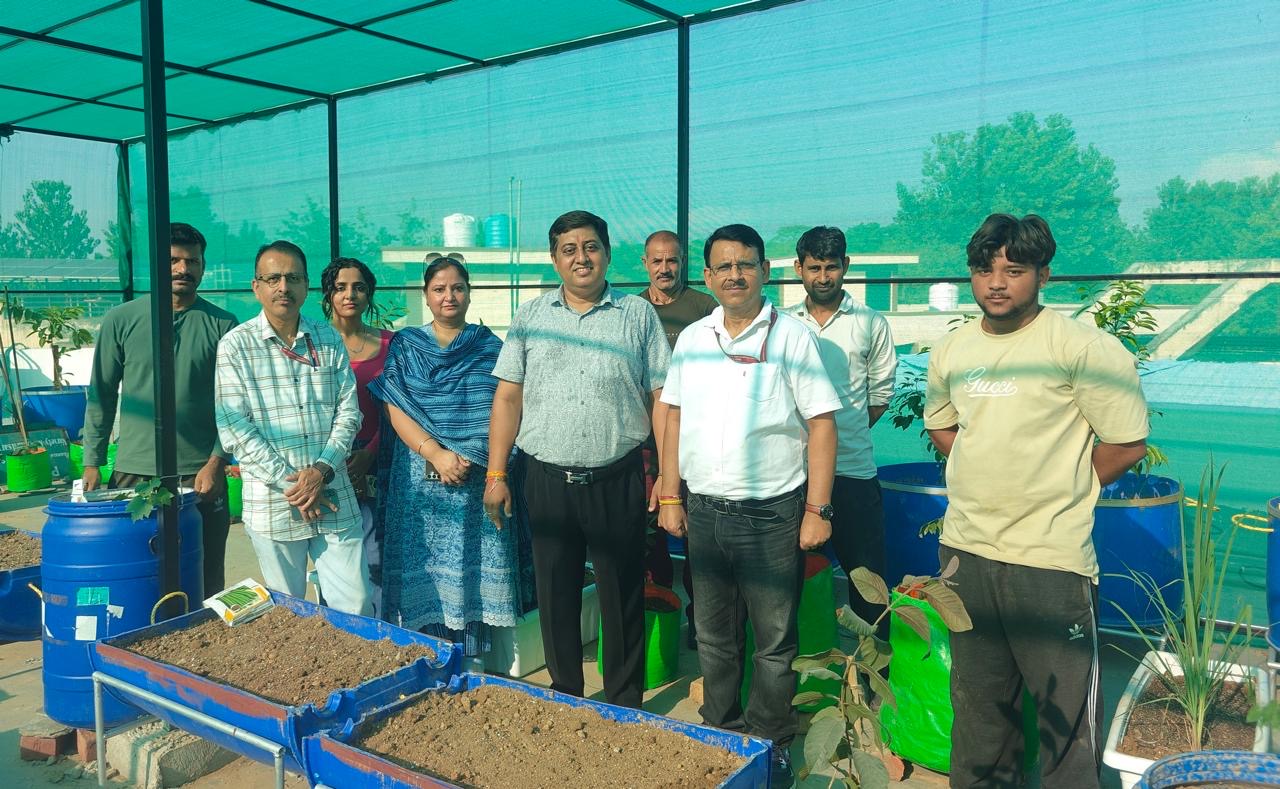
Model demonstrates year-round production of fruits, vegetables and herbs under Jammu conditions
JAMMU, October 4: The Division of Fruit Science, Sher-e-Kashmir University of Agricultural Sciences and Technology-Jammu (SKUAST-Jammu), Chatha, has developed a Nutritional Rooftop Garden to demonstrate how unused rooftop spaces can be converted into productive areas for growing fresh, nutritious and safe food.
The initiative focuses on promoting urban and semi-urban horticulture in areas where availability of land for conventional horticultural production is limited. The model demonstrates the potential for year-round cultivation of seasonal vegetables, fruits and herbs suited to Jammu’s climatic conditions.
The initiative has been developed under a project funded by the DST JK Science, Technology & Innovation Council, Government of Jammu & Kashmir, titled “Standardization of Rooftop Nutritional Garden for Integrating Urban Horticulture for Sustainable Development Policies of Jammu Region”.
Prof. (Dr.) Kiran Kour is the Principal Investigator of the project, while Prof. (Dr.) Parshant Bakshi, Head, Division of Fruit Science, SKUAST-Jammu, is the Co-Principal Investigator.
Diverse crops demonstrated
The rooftop garden includes a range of seasonal vegetable crops and herbs suitable for the Jammu climate. Fruit crops including cape gooseberry, guava, citrus, papaya, grapes, mango and dragon fruit are also being established to create a diversified nutritional garden under rooftop conditions.
As part of the seasonal programme, winter vegetable crops including radish, turnip, pea, carrot, coriander, spinach, methi, broccoli and knol-khol were sown on September 30, 2026.
The sowing programme was carried out under the supervision of Prof. Sandeep Chopra, Head, Division of Vegetable Science and Co-PI, along with Dr. Anil Bhushan, Professor, Division of Vegetable Science.
Technology-transfer and learning platform
The project is intended not only as a demonstration of rooftop cultivation but also as a technology-transfer and learning platform for farmers, urban residents, students, entrepreneurs, institutions and other stakeholders.
The technologies demonstrated through the garden can help individuals establish their own nutritional gardens by selecting suitable vegetables, herbs and fruit crops according to the available space and local climatic conditions.
Prof. (Dr.) Parshant Bakshi said rooftop gardening could help bring horticultural production closer to urban households while encouraging the consumption of fresh fruits and vegetables.
He said the model would also provide practical learning opportunities for PG students pursuing Urban Horticulture, besides serving as a demonstration for farmers and urban communities interested in adopting small-scale horticulture.
Scope for youth entrepreneurship
The initiative also has potential to create avenues for youth entrepreneurship and employment generation.
Young entrepreneurs can develop services related to rooftop-garden planning and establishment, nursery raising, garden maintenance, input supply, technical consultancy and management of rooftop gardens for households, institutions and urban communities.
The garden integrates horticulture, nutrition, sustainability, urban agriculture, skill development and entrepreneurship, while demonstrating how otherwise unused rooftop spaces can be converted into productive green areas.
Wider adoption envisaged
The project will facilitate sharing of technologies and experiences generated through the demonstration garden with interested stakeholders, with the aim of encouraging wider adoption of nutritional rooftop gardens across Jammu and other areas having similar agro-climatic conditions.
The initiative is part of SKUAST-Jammu’s efforts to develop practical and sustainable horticultural technologies oriented towards farmers and communities, while creating awareness about healthy food production and opening new avenues in urban horticulture and youth entrepreneurship.