People call me a social reformer, but on most days, I am just a listener.
I sit on a broken charpoy in a village in Udhampur, or on the floor of a one-room jhuggi in the urban slums of Jammu, and I hold a hand that is trembling. That very hand tells me a story that will never come in the newspaper.
It is not just a hand. It is a lifetime of fear, folded into those shaking fingers. When I hold it, I feel her heartbeat in my own palm.
The fields where I have walked
In the rural belts of our J&K — in Doda, Kishtwar, Samba, Kathua, Akhnoor. In the far-flung villages of Poonch and Rajouri — I met a 14-year-old girl who walks 4 kilometers to school.
Every day, her mother gives her a small sharp stone and some chilly powder to keep in her pocket. Not for protection from animals. For protection from men. From men of her own village, of the neighbouring villages.
Her mother told me, with tears that she tried to hide, “Madam jee, iski jaan se zyada iski izzat ka khauf hai.”
I still remember that girl’s eyes. She wanted to become a teacher but her eyes kept looking down at the road, checking who was coming behind her.
A child should look up at the sky and dream. Our daughters are forced to look down at the road and worry.
In those villages, there is no street light. No police chowki. No bus or matador.
If something happens to her, where will she go? Who will listen to her in a language she understands, without shaming her?
So she stays quiet and is muted, holding her pain within her which is buried down deep inside her. A pain so deep that she starts believing that maybe her dream itself was a mistake.
Her parents get her married at 16. Her dream ends before it even begins.
The city within a city
Then I return back to my own City, Jammu, the City of temples.
Where every day devi Poojan in most of the temples is done. We worship the Goddess with flowers and mantras, but outside the temple, we forget to see the goddess living next to us, working in our own homes.
We talk about Smart City but have you been to the urban slums behind the railway station, in Rajiv Nagar, in Gujjar Nagar, in Qasim Nagar?
There lives our city within a city.
There lives Gauri.
Gauri is 23. She comes to clean three houses in Gandhi Nagar and Trikuta Nagar. She leaves her basti at 5:30 am. To catch the first matador.
In that cold, dark morning, she is not just carrying her tiffin. She is carrying the responsibility of three little stomachs.
She told me, crying, not shouting — crying — “Didi, ghar mein kaam karte hue, kabhi kabhi malik ke bete ki nazar…”
She stopped. She couldn’t complete the sentence. Her voice broke.
And in that broken pause, I heard what thousands of Gauris never say.
I put my hand on her shoulder and said, “You don’t need to complete it, I understand.”
She cried like a child. Acknowledging for the first time, someone didn’t ask her for proof. Someone just believed her.
She is a domestic help. She works inside our homes. The place which we consider the safest unfortunately are the most unsafe for these young women.
She is touched, taunted, propositioned by the teenage son of the house, by the old father, by the driver.
Imagine the every day struggle of these young women who have no option but to live through it day after day, month after month, year after year.
She washes our dishes, she sweeps our floors, she feeds our children, and she goes back home feeling unclean herself.
The fear of losing that three thousand five hundred Rupees per month is so grave that her screams and fear are buried deep inside her.
This desperation of this young mother of three, is so much greater than the humiliation and the compromise she has to make day after day.
How many Gauri’s are cleaning our houses today?
How many of them have gone home with a pain they cannot share with their own husbands, because their husbands will say — “Toh kal se kaam par mat ja.”
So she wipes her tears with her own dupatta, ties her hair again, and gets ready for the next day.
Because her children cannot sleep hungry.
This is the unsafe environment we have created — where her poverty becomes her prison.
Why she does not report — I will tell you why
I have asked hundreds of girls — “Why didn’t you tell anyone?”
They never said — “I didn’t want to.”
They said:
“Didi, Thana gayi toh police wala hasa. Bola — ‘tum jaisi ladkiyan toh aisa bolti hi rehti ho’.”
“Didi, ghar walon ne kaha — chup ho ja, teri shaadi nahi hogi.”
“Didi, mere paas apne kapde dhone ka time nahi hai, Police Station kay chakkar kaun lagayega?”
“Didi, uska chacha sarpanch hai.”
Can you feel the helplessness in these four lines?
One is mocked by the system. One is silenced by her own family. One is too tired from survival to fight for justice and one is scared of power.
In J&K, a woman’s complaint is still weighed against a man’s status. A domestic worker’s truth is weighed against her employer’s money. A rural girl’s izzat is weighed against her village’s so-called honour.
So they don’t report.
Not because nothing happened.
But because reporting costs them more than suffering silently.
For the atrocities happening in Urban slums, there is no reporting done for such cases. There is just silence with a heart squeezed with pain.
This silence is not her failure.
It is our failure as a society.
So what does awareness really mean? It is not a poster
Awareness is not a seminar in a 5-star hall in Jammu where we click photos.
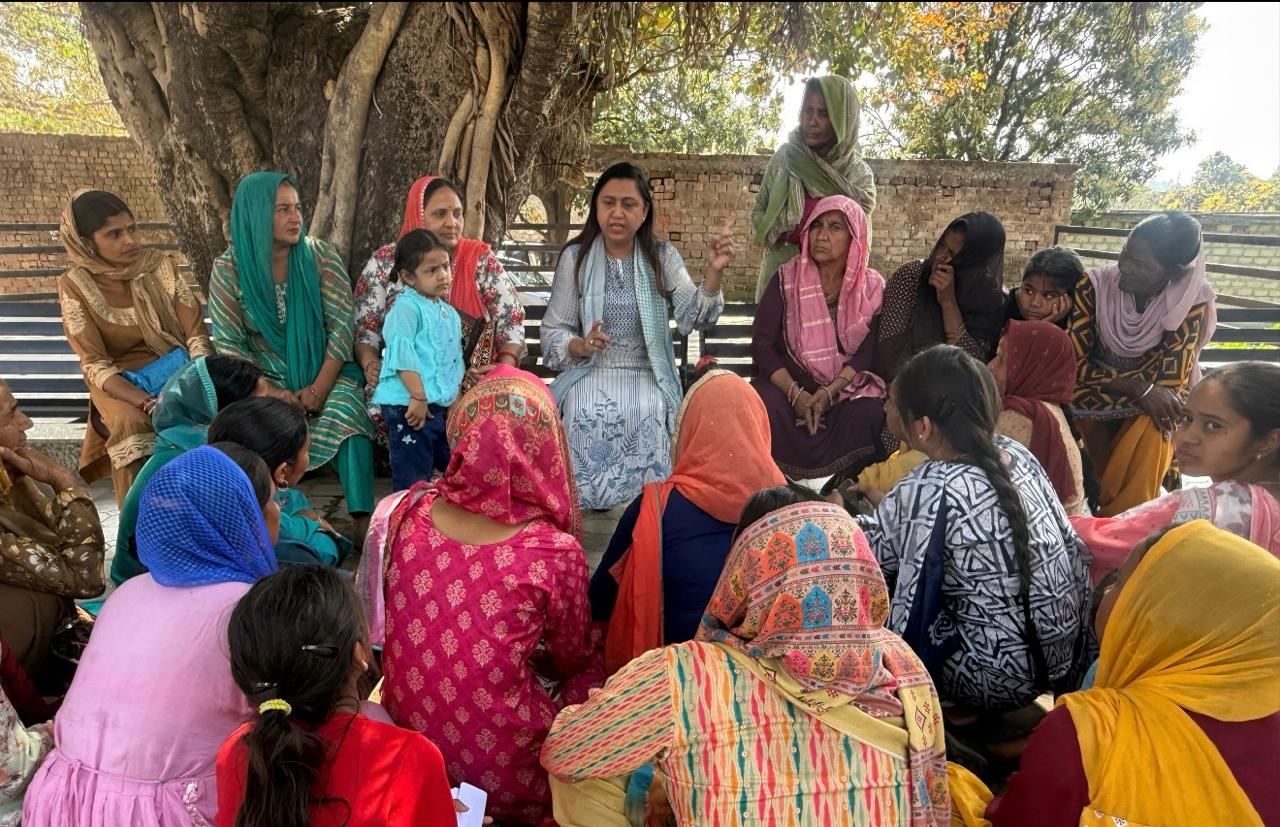
Real awareness is when we go to that basti and sit with 10 women on the floor, just like them, and tell them with love in our eyes —
“You have a right. I will go with you to the police station. I will stand outside while you speak. You will not be alone. Never again.”
We need to give them awareness that women cells are specially made to address their issues.
All they need is somebody to support them, somebody to hold their hand and say, I trust you, so that the voice can be heard.
Real awareness is when we go to a Government Girls School in Bishnah and teach a 13-year-old girl the difference between a good touch and a bad touch in Dogri, in Kashmiri, in Gojri — in the language her mother uses.
And tell her, “If something feels wrong, it IS wrong. And you are never to be blamed.”
Real awareness is when we gather 20 men or more — auto drivers, shopkeepers, contractors — and tell them with empathy, not anger —
“Your masculinity is not in danger when a woman is safe. Your masculinity is PROVEN when a woman is safe because of you.”
In my years in the field, I have learned one truth:
You cannot give a woman safety by putting a lock on her. You give her safety by cleaning the street she walks on fearlessly.
We need women’s voices
We need WOMEN VOICE, but we need it to echo from the loudspeakers of our villages, from the nukkads of our slums, from the drawing rooms of our big houses.
We need a Women’s Suraksha Committee in every panchayat — not on paper, but with 5 real women whose phone numbers are written on the panchayat wall, in bold letters, so that no girl has to search for help.
We need Aanganwadi didis and ASHA workers to be trained not just in health, but as first responders for abuse because a woman will tell an ASHA didi before she will ever tell a police officer because she trusts her didi’s heart more than a uniform.
We need to educate the society through different forums and mediums to create awareness on a larger scale day after day.
We as women have to make sure these young women who come for our domestic help are given safe and secured environment.
So that we as women can give them confidence and assurance that, “In my house, you are safe. If anyone makes you uncomfortable, even if it is my own family, you tell me. Your job will not go. His entry will.”
That one sentence can change her life.
That one sentence can return her dignity.
My sisters of J&K, my daughters from the slums, my girls from the hills
If you are reading this and you have kept quiet for years, I want to tell you — I believe you.
Even if no one else did.
I believe you.
Your pain is real. Your fear is real, you are not alone.
Please don’t bury your pain so deep that you forget your own worth.
You matter.
Your dream matters.
To our sons, brothers and fathers of Jammu and Kashmir
We have survived militancy, we have survived floods, we have survived winters that freeze blood.
We are brave people.
Let’s show that bravery now.
Bravery is not fighting an outsider. Real bravery is fighting the wrong inside our own home, our own mohalla and our society.
Hold the hand of one Gauri.
Stand with one little girl from Doda.
And you will have done more punya than all the temple prayers.
Let us make J&K that state where a girl from a slum can travel at 9 pm for her work and her mother does not get a panic attack.
Where a domestic help can work with dignity, with her head held high.
Where a rural girl can dream of being a doctor, not just of reaching home safely, because if our women are not free, we can never be free.
We don’t need to protect women because they are weak.
We need to protect these women because our society has been weak in giving them the rights.
Come, let us be the voice which she never had.
1 COMMENT
F8BET thương hiệu nổi bật 2026 . Nạp đầu nhận ngay 68k.


F8BET thương hiệu nổi bật 2026 . Nạp đầu nhận ngay 68k.