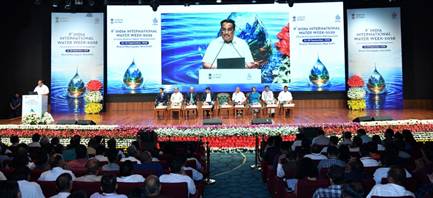
NEW DELHI, SEPTEMBER 25: The 9th India International Water Week (IIWW) 2026 concluded here on Friday with a focus on climate-resilient water management, sustainable drinking water services, digital innovation and stronger community participation.
Held from September 22 to 25 at Bharat Mandapam under the theme “Climate Resilient Water Management”, the event brought together 7,224 delegates, 227 exhibitors and participants from two Partner Countries and 14 Partner States and Union Territories, including a delegation from Jammu & Kashmir. A total of 119 papers were presented during the Water Week.
Union Minister for Jal Shakti C. R. Patil, who chaired the valedictory ceremony, said the deliberations highlighted three key priorities — people’s participation in water conservation, taking science and technology to the ground, and strengthening international and institutional cooperation.
Referring to the Jal Jeevan Mission (JJM), Patil said the expansion of household tap-water access since the Mission’s launch in 2019 had contributed to improved health, dignity and quality of life in rural communities while reducing the time and effort spent by women in fetching water.
He said the next phase of the Mission would need to focus on ensuring adequate, regular, safe and sustainable drinking water services, with community participation, source sustainability and appropriate technology playing a central role.
Minister of State for Jal Shakti V. Somanna said water security involved safe and reliable drinking water, sanitation, clean surroundings and effective wastewater management.
He stressed the need for an integrated approach covering drinking water, sanitation, greywater, wastewater and solid waste management, and highlighted the progress under Swachh Bharat Mission-Grameen, including ODF Plus and solid and liquid waste management.
Minister of State Raj Bhushan Choudhary highlighted measures for climate-resilient water resources management, including irrigation development, command-area modernisation, dam rehabilitation, groundwater management and recharge, river rejuvenation, flood management, hydrological forecasting, reservoir management and improved water information systems.
He stressed timely completion and effective utilisation of water-resource projects, saying investments should translate into measurable outcomes for people, agriculture, the economy and ecosystems.
Secretary, Department of Drinking Water and Sanitation (DDWS), Ashok K. K. Meena said climate resilience begins with water resilience and described the hydrological cycle as a global common good.
He called for conserving, reusing and replenishing water and said the long-term success of water programmes would depend on translating the knowledge and solutions discussed at IIWW into implementation and measurable outcomes on the ground.
Seven thematic areas
The recommendations presented at the valedictory session called for stronger and more participatory water governance, safe reuse of treated wastewater, deeper international cooperation, data-driven governance, community-led groundwater recharge, wider use of digital and emerging technologies, stronger multi-hazard early warning systems and river-basin approaches for climate adaptation.
The recommendations also called for innovative financing and enabling frameworks for public-private partnerships, improved water-use efficiency, sustainable sediment management, preservation of reservoir storage, scientific aquifer mapping, environmental flows and community-led ecosystem-based water management.
The brief report and recommendations were presented by Rajeev Kumar Mital, Director General, National Mission for Clean Ganga.
WASH conference focuses on sustainable services
The 2nd India International WASH Conference 2026 was organised by DDWS in collaboration with the Dr Syama Prasad Mookerjee National Institute of Water and Sanitation (SPM-NIWAS), Kolkata.
Additional Secretary and Mission Director, National Jal Jeevan Mission, Kamal Kishore Soan said 57 research papers were presented during the four-day conference, with additional papers presented at SPM-NIWAS.
The discussions focused on source sustainability, operation and maintenance, water quality, climate resilience, digital technologies, sustainable sanitation and zero-waste management.
Soan said sustainable WASH outcomes required active community participation alongside technical and institutional interventions.
The India-Africa Roundtable on WASH brought together ambassadors, high commissioners and senior diplomatic representatives from 22 African countries, along with development partners and WASH-sector stakeholders.
The roundtable discussed cooperation in capacity building, water-quality surveillance, digital platforms, community-led approaches, climate-resilient infrastructure and exchange of implementation experiences.
More than 50 engineering students participated in the WASH Conference in partnership with the All-India Council for Technical Education (AICTE).
Eight JJM capacity-building modules released
A key feature of the valedictory ceremony was the release of eight capacity-building modules developed under the Jal Jeevan Mission for Gram Panchayat representatives, Village Water and Sanitation Committee members and Sujalam Shakti Group members.
The modules cover institutional roles and responsibilities, source sustainability, water quality, operation and maintenance, technology, community participation and climate resilience, using village-level situations to explain rural drinking water service delivery.
The modules are intended to strengthen local institutions and community stakeholders in managing water services and sustaining infrastructure.
Several publications, reports and protocols were also released during the ceremony, including two books by NERIWALM on sustainable and efficient irrigation, the Protocol for Riverine Macroplastics Monitoring by the National Mission for Clean Ganga, and reports on the 1st Census of Major and Medium Irrigation Projects, 7th Minor Irrigation Census, 2nd Census of Water Bodies and 1st Census of Springs.
The Irrigation Atlas developed by the Central Water Commission was also e-launched, while awards under various categories of the IIWW 2026 exhibition were presented.
Digital infrastructure discussed for rural water services
Earlier in the day, sessions focused on digital transformation, innovation and stronger water governance.
A session on “Digital Public Infrastructure in the Water Sector” examined the use of interoperable data, artificial intelligence, geospatial technologies and citizen-centric platforms in water governance and service delivery.
The discussions highlighted the “Water as One Data” approach, with Sujalam Bharat positioned as the digital public infrastructure for rural drinking water.
Participants discussed trusted and authenticated datasets, geospatial asset mapping, citizen feedback, Jal Seva Analytics, the Rural Data Stack and applications such as leakage detection, predictive maintenance and asset management.
The session also included a demonstration of Google’s Global Flood Hub on AI-enabled riverine and urban flash-flood forecasting.
Water-quality technologies and groundwater assessment
A separate session on “Water Quality and Cost-Effective Technology” examined innovations in water quality, ecological restoration, climate adaptation, groundwater assessment and water-sector instrumentation.
Presentations covered microalgae-based phytoremediation, extensive green roofs for rainfall retention, microplastics monitoring and borehole geophysical electrical logging for groundwater-quality assessment.
The discussions also highlighted the role of scientific instrumentation and monitoring systems in improving the reliability of water-resource management.
Focus shifts from infrastructure to service delivery
The session on “Rural Water Supply Governance and Implementation Framework” examined the transition under the Jal Jeevan Mission from rapid infrastructure creation to reliable, sustainable and accountable water services.
Ashok K. K. Meena said the substantial expansion of rural drinking water infrastructure meant that the focus was now shifting towards assured, reliable and sustainable service delivery.
He highlighted the need to strengthen Gram Panchayats as local water-service institutions, supported by appropriate service providers and robust operation and maintenance arrangements.
He also highlighted Jal Seva Ankalan, through which Gram Panchayats can assess service levels, identify gaps and prepare improvement plans through participatory processes.
Discussions at the session highlighted groundwater sustainability, source protection, climate-resilient planning, seasonal demand and locally appropriate supply models.
Examples from Madhya Pradesh, Gujarat and Bihar highlighted institutional responsibilities, financing mechanisms, community ownership, transparent tariff systems, professionalised services and digital tools for sustaining rural water schemes.
The discussions also highlighted eGram Seva, Avani and digital dashboards for improving transaction visibility and decision-making, alongside continuous and locally contextualised capacity building.
The conference concluded with an emphasis on evidence-based planning, technological innovation, institutional strengthening, climate-resilient infrastructure and community participation as key elements of India’s water-security efforts.
I’ve kept the report substantially shorter than the original PIB release while retaining the major figures, policy shifts, conference outcomes and the most newsworthy session findings.