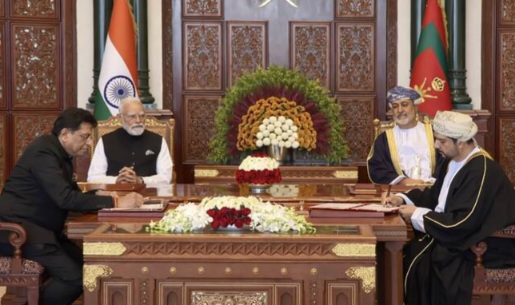
New Delhi, Dec 18: India and Oman on Wednesday signed a far-reaching Comprehensive Economic Partnership Agreement (CEPA), marking a major milestone in New Delhi’s economic engagement with the Gulf region and opening a new phase of bilateral trade, investment and services cooperation.
The agreement was signed in the presence of Prime Minister Narendra Modi and Oman’s ruler Sultan Haitham bin Tarik by Union Commerce and Industry Minister Piyush Goyal and Oman’s Minister of Commerce, Industry and Investment Promotion, Qais bin Mohammed Al Yousef.
Officials described the CEPA as one of India’s most ambitious trade agreements in the region. Oman has offered zero-duty access on 98.08 per cent of its tariff lines, covering 99.38 per cent of India’s exports by value. All major labour-intensive sectors—including textiles, leather, footwear, gems and jewellery, engineering goods, plastics, furniture, agricultural products, pharmaceuticals, medical devices and automobiles—will benefit from full tariff elimination, with immediate concessions on nearly 98 per cent of tariff lines.
India, in turn, will liberalise tariffs on 77.79 per cent of its tariff lines, covering 94.81 per cent of imports from Oman by value, while safeguarding sensitive sectors such as dairy, tea, coffee, rubber, tobacco, bullion, jewellery and select labour-intensive products through exclusions or tariff-rate quotas.
The agreement also delivers unprecedented outcomes in services. For the first time, Oman has made wide-ranging commitments across 127 services sub-sectors, including computer-related services, business and professional services, audio-visual services, research and development, education and health. A key highlight is enhanced mobility for Indian professionals, with expanded quotas and longer stays for intra-corporate transferees, contractual service suppliers, independent professionals and business visitors.
CEPA further allows 100 per cent foreign direct investment by Indian companies in major services sectors in Oman and includes a provision for future negotiations on social security coordination. In a first-of-its-kind move, Oman has also extended comprehensive commitments on traditional medicine across all modes of supply, opening significant opportunities for India’s AYUSH and wellness sectors.
Addressing non-tariff barriers, the agreement provides for fast-tracking marketing authorisations for pharmaceuticals approved by leading global regulators, acceptance of good manufacturing practice inspection documents, mutual recognition of halal certification, acceptance of India’s organic certification, and enhanced cooperation on standards and conformity assessment.
Bilateral trade between India and Oman currently exceeds USD 10 billion, supported by a strong Indian diaspora of nearly 700,000 people and over 6,000 Indian enterprises operating in Oman. The government said the CEPA—India’s second free trade agreement in the last six months after the United Kingdom—was expected to boost exports, generate employment, strengthen supply chains and deepen long-term economic engagement between the two countries.