

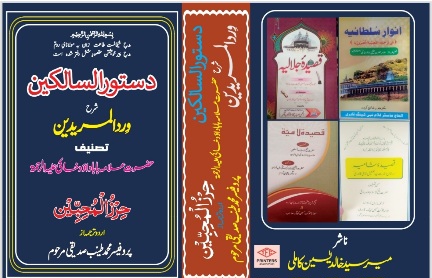
Srinagar: In a momentous tribute to Kashmir’s spiritual and literary legacy, two seminal Persian works—Wird-ul-Murideen and Dastur-us-Salikeen—authored by renowned 16th-century saint and scholar Allama Sheikh Baba Dawood Khaki (RA), were officially republished and released at the revered Dargah-i-Sultania (RA).
The launch ceremony was held on Tuesday during the auspicious Urs of Allama Khaki (RA), drawing religious scholars, community leaders, and devotees from across the Valley to the spiritual grounds of Koh-e-Maran, Srinagar.
The republished volume—an aesthetically presented single edition—was formally unveiled by distinguished scholars including Maulana Shaukat Hussain Keng Qadiri, Al-Haj Peerzada Shabir Ahmad Makhdoomi, and Peerzada Mohammad Altaf Masoodi.
The event saw participation from prominent personalities such as Syed Shakeel Ahmad Qalandar, Mir Syed Abid Yaseen Kamili, Peerzada Asadullah Makhdoomi, Peerzada Abdul Majeed Makhdoomi, and many others. It was organized under the patronage of Ashiq Ahmad, Administrator of the local J&K Muslim Waqf Board unit.
Speaking on the occasion, Alhaj Shabir Ahmad Makhdoomi reflected on Allama Khaki’s (RA) profound spiritual legacy and his close discipleship under Hazrat Sultan-ul-Arifeen Sheikh Hamzah Makhdoom (RA). He described the republished works as timeless spiritual resources that continue to enlighten seekers today.
Maulana Shaukat Hussain Keng Qadiri called Allama Khaki (RA) a beacon of Sufism in 16th-century Kashmir—praised for his theological depth, poetry, and insightful commentaries.
He elaborated that Wird-ul-Murideen is a poetic guide for spiritual aspirants rich in mystical symbolism, while Dastur-us-Salikeen serves as a profound manual on Sufi practice and metaphysics.
“These are not just literary compositions—they are spiritual roadmaps,” he remarked.
Comments are closed.