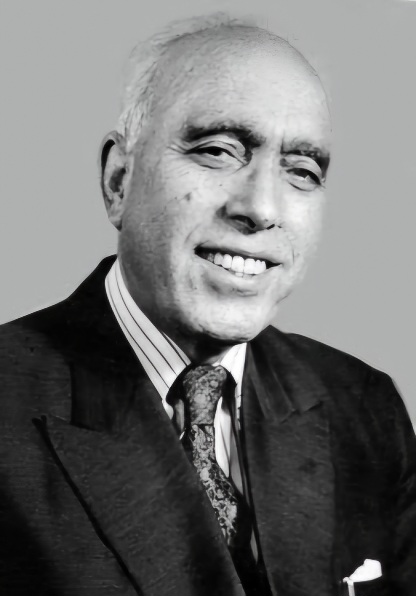
Why J&K needs a Sheikh Mohammad Abdullah Centre for Economic Policy Research

By: Sabreen Malik and Inayat Khan

Srinagar: As Jammu & Kashmir prepares for its 2025-26 Budget, voices from academia, business, and civil society are advocating for the establishment of the Centre for Social and Economic Research to promote evidence-based public policy making in contrast to the present practice of contemplative policy making.

The proponents of this idea suggest that the proposed centre must ideally be named after J&K’s former Prime Minister and Chief Minister, Sheikh Mohammad Abdullah, and focus on addressing the existing gaps in economic policymaking, including public finance analysis and regional development through evidence-based research.

The proposal, which has garnered widespread support, envisions the Centre as a hub for informed decision-making, sustainable development and governance innovation. Key stakeholders are concerned about the absence of a well informed institutional mechanism in public policy formulation in the present Omar Abdullah-led government and argue that such an institution is essential to make the best use of the state’s  available but limited resources.

Dr. Javaid Iqbal Khan, a professor in the Department of Economics at Kashmir University, while highlighting the Centre’s potential to address systemic policy making issues, told Ziraat Times, “The Centre should focus on critical areas like livelihoods, poverty, and inequality, which are often overlooked in traditional budget planning. By analyzing public finances and fiscal policies, it can help improve transparency and efficiency in governance,” he explained, advocating such a Centre to come up at the Kashmir University for its requisite human and physical resources.

Arjimand Hussain, founder of Ziraat Times, supported this idea, suggesting such a centre would be a befitting tribute to late Sheikh Mohammad Abdullah for his pioneering initiatives for inclusive social and economic development in J&K.

“J&K has long felt the need for a knowledge hub, translating applied academic research into actionable policy frameworks for policymakers and government institutions. In the past eminent thought leaders like Abdul Rahim Rather sahab, Dr Haseeb Drabu sahab, Tariq Karra sahab, Prof Nisar Ali sahab, Mohammad Shafi Pandit sahab, Khurshid Ganai sahab and others have so ably steered and guided J&K’s public economic policy. It is the right time to take that extra step and create this institution”.

“The current practice of stakeholder consultation is good but it is not enough in framing policies which require data-driven evidence”,  said Mr Arjimand, who has worked on public policy making issues in over a dozen countries across the world, adding, “this is a world of resource optimisation, expenditure efficiency and results-based development paradigm, as opposed to the traditional output-based development paradigm.”

“J&K faces several challenges, from high unemployment to rural-urban disparities. A dedicated research centre like this would provide the evidence base needed to design targeted interventions and ensure that public funds are utilized effectively,” Makhan Chaudhary, a former civil servant told Ziraat Times.

Ratan Lal, a Jammu-based businessman, echoed these sentiments, stressing the importance of regional economic development. “Jammu and Kashmir needs a long-term vision for industrial growth, tourism, and rural development. This Centre can provide the insights needed to attract investments and create jobs,” he said.

Sanjay Kaul, a retired economist, while emphasizing the transformative potential of a public policy research centre in J&K, opines, “Business-focused engagements  often focus on immediate market trends and regulatory ease, potentially leading to policies that undermine long-term economic stability and sustainability. Without data and research, policies risk being based on perceptions, assumptions, or lobbying efforts, rather than real economic indicators.”

Dr. Manjit Singh, a businessman and healthcare advocate, highlighted the dual benefits of such an initistive. “A Centre for Economic and Social Public Policy Research in J&K would tremendously help any J&K government in gaining objective insights on economic and social issues, ensuring policies are practical and effective. Importantly, it would help any government here to evaluate the short- and long-term effects of existing and proposed policies, helping our governments anticipate economic, social  consequences of such policy practices”, he noted.

Selective discussions alone do not help in addressing systemic economic challenges like inequality, inflation, or unemployment, which require holistic, research-backed solutions, said Naheed Khan, an investment banker based in the Gulf. She also argued that without comparative studies, J&K government could risk missing out on innovative or globally successful economic models.

Sheikh Mohammad Abdullah, the former Prime Minister and Chief Minister of Jammu & Kashmir, is known for his pivotal role in the social and economic empowerment of J&K. His leadership is widely recognised to have laid the foundation for several transformative initiatives, including the pioneering agrarian reforms & land redistribution. His “Land to the Tiller” Policy of the 1950s is widely recognised as one of the most revolutionary land reforms in India, abolishing landlordism, redistributing land to peasants and upliftment of the rural economy. His initiatives also heralded the end of the feudal Jagirdari and Zamindari systems, ensuring equitable land ownership among farmers.

Sheikh Mohammad Abdullah’s educational reforms also expanded free education at all levels, particularly for rural and underprivileged sections of society through the establishment of schools and colleges, laying the groundwork for literacy growth in Kashmir. Crucially, he is credited to have championed equal rights for all communities of J&K at a time of fissiparous narratives, ensuring representation of marginalized groups in the governance of an inclusive, democratic and secular J&K.

 As the budget process unfolds, all eyes will be on whether the government heeds these calls and invests in a more inclusive and sustainable future for this soon-to-be-a-state again.


Comments are closed.