

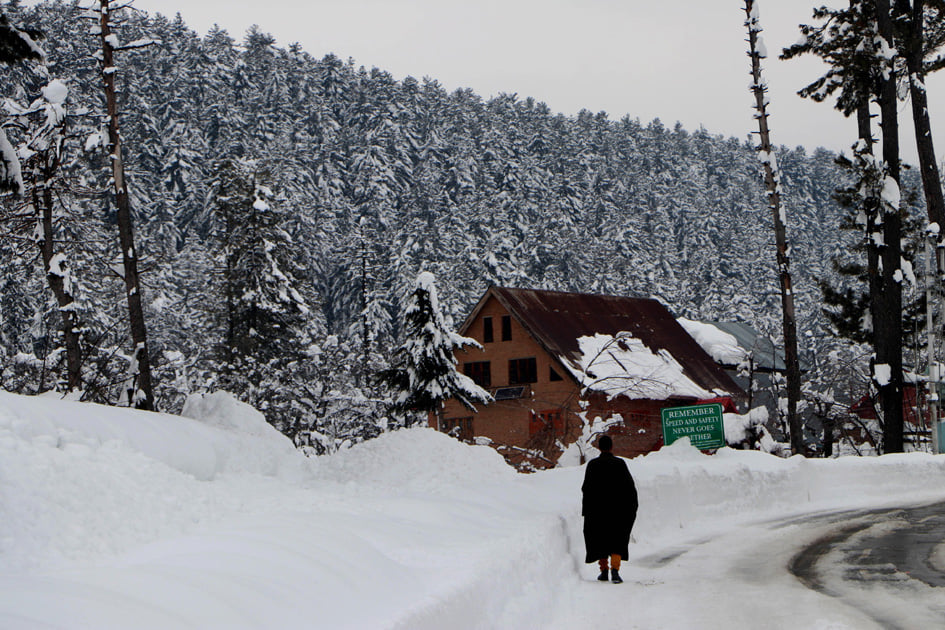
 Srinagar, Jan 21: A Western Disturbance cloud system is likely to result in snowfall in most parts of Kashmir valley region, Chenab valley, Pirpanjal region areas, Kargil-Zanaskar and parts of Ladakh between Saturday to Monday afternoon.
According to Ziraat Times Weather Outlook for this period, a big weather system spanning from Afghanistan to J&K is likely to result in mild to medium snowfall in most of the areas falling in Kashmir valley region, Chenab valley, Pirpanjal region areas, Kargil-Zanaskar and parts of Ladakh, while intermittent, and occasionally heavy, rainfall in likely in Jammu plains.
Snowfall is likely to begin early Saturday from north Kashmir areas, which is likely to spread to central and South Kashmir areas.
The total snowfall during these three days is likely to range between 2 feet in the mountains, 6-12 inches in the Karewas and 4-8 inches in the plains.
Due to a temperature differential in the lower atmosphere, the eastern parts of Kashmir valley like Tral, Pampore, Awantipora and parts of lower Pulwama and Anantnag are likely to receive low snowfall.
The precipitation spell is likely to end on Monday afternoon, according to the ZT outlook.
Night time temperatures in most of Kashmir valley’s plain areas are also likely to remain in positive during these days. After Monday night time temperatures are likely to slide back to below zero.
Note: Ziraat Times issues weather forecasts/outlooks in the interest of farmers and the general public to address the need for specific and detailed geographical forecasts. ZT forecasts are based on the analysis of multiple weather data – including cloud movement models associated with the westerly jet and localized cloud formation, temperature and wind speed differential models within J&K and surrounding regions, past weather patterns and traditional knowledge. It may be noted that we do not rely on online weather portals for their predictions and, therefore, we avoid issuing long and medium term forecasts, which are mostly unreliable.
While maximum care is taken in generating this information, and most times our forecasts are accurate; at times, the forecast might not go as anticipated. We advise discretion in using this information.
Comments are closed.